At the heart of the Seiko 5 Sports Automatic beats the Calibre 4R36, a self-winding movement with manual winding capability, 24 jewels, and a power reserve of approximately 41 hours. That combination places a genuinely mechanical experience on the wrist at a price point where quartz usually dominates, a rarity that explains why the line has held its ground for decades.
The origin of this formula traces back to 1963, when Seiko introduced the first 5 Sports model built around five promises: a day-date display, water resistance, a recessed crown at four o'clock, a durable case, and an automatic movement. The current generation keeps that architecture intact while refining the finishing, movement, and case dimensions. The design language of the Seiko brand remains unmistakable across every reference in the family.
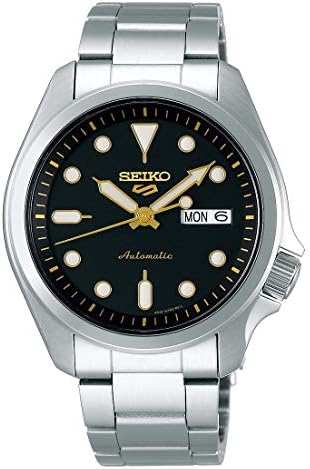
Where the modern line departs from its ancestors is in range. Buyers can now choose between skin divers with rotating bezels, field-style models on nylon straps, and dual-time travellers carrying a 24-hour hand. The breadth matters because the line functions less as a single watch and more as a modular platform. A quick scan of the Seiko 5 Sports collection reveals how far that platform stretches, from compact 38mm cases to 42.5mm options with GMT functionality.
Movement Architecture: What the 4R36 Actually Delivers
Seiko builds the 4R36 in-house, and its specification sheet reads like a list of practical compromises. The movement hacks, meaning the seconds hand stops when the crown is pulled out, which allows precise time setting. It also hand-winds, so a watch that has sat unworn for a few days can be brought back to life without shaking it. Neither feature was guaranteed on entry-level automatics even a decade ago.
The oscillator runs at 21,600 vibrations per hour, or six beats per second, which produces a smoother sweep than the 3 Hz movements found in some competitors. Accuracy is quoted by Seiko in a conventional range rather than a chronometer standard, a positioning choice consistent with the line's focus on reliability rather than laboratory precision. With 24 jewels and a 41-hour reserve, the movement covers the gap from Friday evening to Monday morning without losing time.
Case, Crystal, and the Everyday Survival Question
Most references in the range carry a 10 bar water resistance rating, equivalent to 100 metres. That covers swimming, showering, and accidental submersion, but Seiko stops short of recommending saturation diving; the rotating bezel, where present, is a dive-style aesthetic feature rather than a certified tool for professional use. Magnetic resistance is rated at 4,800 A/m, enough to shrug off the fields generated by laptops and phone speakers.
Hardlex crystal protects the dial across most of the line. It is not sapphire, and it will pick up micro-scratches over years of wear, but it resists impact cracking better than sapphire in many real-world knocks, which suits the target wearer. Case weights sit around 161 to 170 grams for bracelet models, giving the watch a reassuring presence without tipping into discomfort during extended wear.
Dial Legibility and LumiBrite Performance
The hands and hour markers are coated with LumiBrite, Seiko's proprietary luminous compound. Its distinguishing trait is speed: it charges quickly under brief light exposure and glows brightly for the first hours of darkness, then fades gradually. For anyone who wakes during the night or finishes a shift after sunset, the dial stays readable when it matters most.
Day-date windows sit at the three o'clock position on most non-GMT variants, with both English and an alternate language available on the day disc. This is a small detail with a long heritage, tracing back to the original 1963 concept where the day-date was one of the founding five attributes. The current implementation keeps the text clean and unobtrusive rather than letting it dominate the dial layout.
Three Buying Paths Within the Line
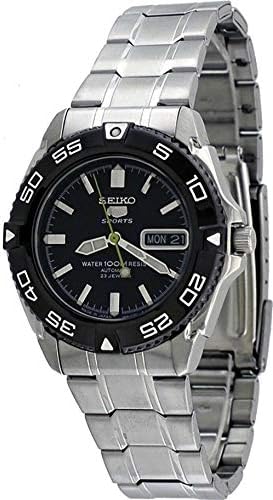
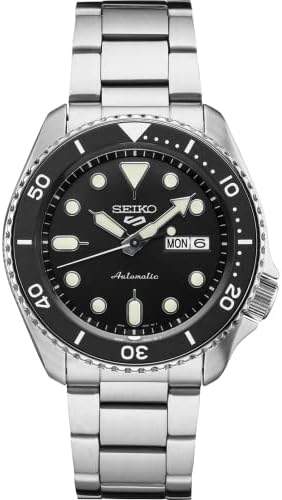
The family splits into three practical directions, and each suits a different type of wearer. A dive-style reference such as the SEIKO 5 Sports Automatic Watch for Men carries the core formula: day-date calendar, LumiBrite hands and markers, unidirectional rotating bezel, and 100 metres of water resistance, all driven by the 4R36 movement. It is the most direct expression of what the line has always done.
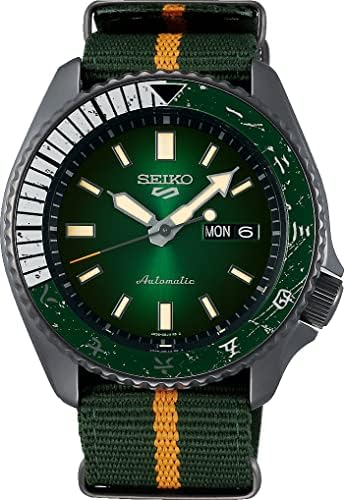
For those who prefer a lighter, field-inspired setup, a Japan-made reference like the SEIKO 5 SPORTS Automatic made in Japan keeps the same automatic foundation and strips it of metal weight. The textile strap keeps the watch stable during movement and reduces the overall mass on the wrist, an advantage for hikers and runners who notice bracelet heft over long distances.
A third path addresses travellers. A dual-time reference like the Seiko 5 Sports Automatic GMT SSK003K1 adds a 24-hour hand and a two-tone bezel, turning the platform into a dual-time instrument. That configuration shares the family's automatic winding, manual winding, and hacking functions while adding a complication usually reserved for watches costing considerably more.
Strap Options and Everyday Versatility
Stainless steel bracelets dominate the catalogue, typically finished with a mix of brushed and polished surfaces. The case lugs measure 22mm on the SRPD series, a width that supports an extensive aftermarket ecosystem of leather, rubber, and NATO straps. Swapping straps changes the character of the watch entirely, from office-appropriate formality to weekend informality, without touching the movement inside.
Nylon-strap references arrive pre-configured for casual wear. Owners often note that the fabric softens over the first weeks of use, conforming to the wrist in a way that rigid bracelets do not. Seiko has leaned into this by offering field-style variants whose proportions suit smaller wrists while retaining the 41-hour reserve and hacking seconds.
The Value Case and What Buyers Should Expect
The comparison point for most shoppers sits between this line and entry Swiss automatics. The Seiko answers with a longer power reserve than many rivals, an in-house movement, and a service network that spans continents. Seiko positions the 5 Sports line around reliability and accessible mechanics rather than luxury finishing, and the specification sheet supports that claim with concrete numbers.
Buyers should expect Hardlex instead of sapphire, a press-fit rather than screwed case back on most models, and bezel action that works smoothly but does not pretend to be a professional dive instrument. Within those boundaries, the watch delivers what it promises: a mechanical movement that requires no battery, a day-date display that stays legible, and a case that survives typical urban and light outdoor use.
Why the Line Endures
Few mechanical watch families have maintained continuity for six decades without abandoning their founding principles. The Seiko 5 Sports Automatic achieves this by treating each reference as a variation on a proven theme rather than a reinvention. The movement stays serviceable, the case stays wearable, and the dial stays readable, whether the model is a rotating-bezel diver, a nylon-strapped field watch, or a GMT-equipped travel companion.
For someone stepping into mechanical watch ownership for the first time, the formula offers a low-risk entry with genuine substance inside the case. For experienced collectors, the breadth of references provides enough variety to keep the line interesting across years of ownership. Either way, the appeal rests on the same foundation that carried the original 1963 model: dependable automatic engineering wrapped in a design meant to be worn, not stored.
 Just Pick Your Favorite Stylish Watch online





















Item Reviews