The Amazfit Active Max and the Garmin Forerunner 165 approach the mid-range running watch category from two distinct directions. One leans on display size and battery endurance; the other leans on training science and recovery feedback. This guide sets out the specifications that matter most for a purchase decision, so it is worth bookmarking and sharing with anyone weighing the two.
| Buying Decision Factor |
Amazfit Active Max |
Garmin Forerunner 165 |
| Price Positioning |
Budget-friendly - more hardware per dollar |
Premium for the segment - you pay for the training ecosystem |
| Battery Life (Typical Use) |
Up to 25 days - charge roughly once a month |
Up to 11 days smartwatch mode - weekly charging |
| GPS Accuracy and Positioning |
Built-in GPS, solid for road and open-sky runs |
Multi-band GNSS heritage - tighter pace and distance consistency under tree cover |
| Display and Case Size |
1.5-inch AMOLED, 48mm case - larger data fields, suits broader wrists |
AMOLED color touchscreen, 43mm case - lighter, flatter on the wrist |
| Training Metrics and Recovery |
Heart rate, sleep, basic load - reports what happened |
Training effect and recovery insights - tells you how hard the next session should be |
| Navigation and Offline Maps |
Offline maps supported - route tiles stored on the watch |
Route guidance without downloadable topographic layers |
| Sport Modes |
170+ modes - trail, gym, racket sports and more |
Running-focused profiles |
| Health Sensors |
Heart rate and sleep tracking |
Heart rate, sleep, SpO2 |
| Storage and Connectivity |
4GB, iOS and Android pairing |
4GB, iOS and Android pairing |
| Water Resistance |
Water-resistant, swim tracking |
5 ATM, swim tracking |
| App Ecosystem and Coaching |
Zepp app - clean daily summaries, lighter coaching layer |
Garmin Connect - deep training logs, structured plans, race predictions |
| Best Suited For |
Everyday tracking with long battery life |
Structured run training |
The table exposes the core tension between the two: the Active Max trades a smaller brand ecosystem for a larger screen, more storage allocation for offline navigation, and a dramatically longer charge interval, while the Forerunner 165 concentrates its value in coaching-oriented metrics that many runners rely on to pace a training block.
Display, Dimensions, and Everyday Wearability
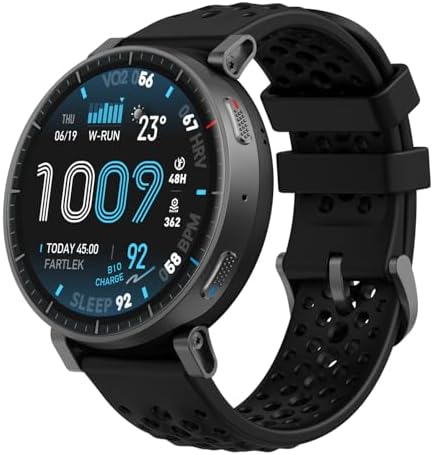
The first thing anyone notices is the screen. The Active Max uses a 1.5-inch AMOLED panel inside a 48mm case, which puts it in the large-watch territory that suits broader wrists and makes glanceable data easy to read mid-stride. The Forerunner 165 pairs its color AMOLED display with a 43mm case, a footprint that sits flatter against the wrist and slips under a shirt cuff with less resistance.
That size difference has practical consequences beyond aesthetics. A 48mm case carries more surface area for on-screen data fields, map tiles, and widget stacks, but it also adds rotational mass that some wearers notice during longer runs. A 43mm case distributes weight differently and tends to feel less present when the arm is bent at the elbow. Neither is objectively better; the deciding factor is wrist circumference and how much visual information is needed at a glance.
Battery Strategy: Marathon Endurance vs Weekly Charges
Battery capacity is where the two diverge most sharply. The Amazfit Active Max Smart Watch 1.5" 48mm GPS is rated for up to 25 days of typical use, a figure that reshapes the charging habit entirely: instead of a weekly dock ritual, the charge cycle stretches out far enough that the watch can accompany a multi-day hiking trip without a power bank.
The Garmin Forerunner 165 Running Colorful AMOLED Black is still generous by smartwatch standards but meaningfully shorter. The tradeoff is deliberate rather than a shortcoming: brighter, more frequent screen wake behavior, continuous training metric sampling, and GNSS tracking sessions consume power faster, and Garmin has historically prioritized consistent sensor fidelity over raw charge intervals.
Navigation: Offline Maps Against Route Clarity
Storage allocation shapes navigation capability here. With 4GB on board, the Active Max can hold offline map data and route tiles locally, which means a wrong turn on an unfamiliar trail can be corrected without reaching for a phone. A 170-plus sport mode library also covers everything from trail running to racket sports, so the wrist serves as a general activity hub rather than a single-purpose run computer.
The Forerunner 165 keeps the navigation experience focused: pace, distance, heart rate zones, and route guidance presented cleanly, but without downloadable topographic layers. For runners who circle a known loop or follow a familiar path, that absence rarely registers. For anyone mixing trail days and city runs in the same week, the difference becomes more apparent.
Training Metrics and Recovery Feedback
Training science is the Forerunner line's center of gravity. The 165 delivers training effect scores and recovery guidance that help answer a deceptively difficult question: how hard should the next session be? Those two data points, combined with heart rate zone breakdowns, allow a runner to build a coherent weekly structure without hiring a coach.
The Active Max covers the essentials, including continuous heart rate and sleep quality tracking, but leans its analytics toward general wellness rather than performance periodization. It reports what happened; the Garmin reports what happened and what it suggests should come next. That distinction explains the two audiences these watches attract.
Sharing the Road: Common Ground Between Both Watches
It is easy to frame the comparison as opposition, but the overlap is substantial. Both pair with iOS and Android phones, both carry 4GB of storage, both include built-in GPS, both support swim tracking, and both rely on heart rate and sleep sensors as their primary health inputs. Where the pair really splits is in how much guidance is delivered back to the wearer. A runner chasing a personal best will notice the training-effect feedback the moment weekly mileage climbs. Someone using the watch as a daily tracker, a step counter, and a sleep log will notice the charger far more than any metric. That mental test, run through a normal training week, usually settles the decision faster than any specification sheet.
The Garmin Forerunner 165 belongs to a lineage that has spent years refining run-focused coaching tools, and buyers stepping into that ecosystem inherit its recovery philosophy immediately. Models within the Forerunner 165 lineup tend to attract users who want structured guidance rather than passive metrics. The Amazfit approach travels a different road, using generous battery endurance and larger displays to serve people who wear one device from morning alarm to evening sleep report without thinking about charging.
Enthusiast forums and video comparisons tend to land on the same split: runners chasing structured training gravitate toward the Garmin, while those prioritizing display size and charge interval drift toward the Amazfit. The contrast sharpens further when the Amazfit brand's wider catalog is set beside the Garmin brand's broader lineup, since each reflects a different set of priorities.
Making the Final Choice
The Active Max rewards users who live away from wall outlets: frequent travelers, hikers, and anyone who finds weekly charging an annoyance. Its 1.5-inch 48mm AMOLED panel suits large data layouts and detailed maps, and the broad sport mode library keeps a single watch useful across wildly different activities.
The Forerunner 165 rewards users who measure progress in split times and recovery windows. Its training effect data and recovery insights are designed to inform the next session, which matters enormously to anyone preparing for a race or building toward a personal best.
Both watches share a foundation of GPS, AMOLED visuals, health monitoring, and cross-platform pairing, which means the correct answer depends on what the wearer wants the watch to say after the run ends: a wider view of daily activity and a longer battery curve, or a sharper set of instructions for what comes next.
 Just Pick Your Favorite Stylish Watch online












Item Reviews