The Garmin Epix 2 and the Fenix 7 share the same 47mm case platform, the same five-button control layout, and the same multisport firmware, yet they diverge on one component that reshapes ownership: the display. Understanding that fork is the difference between a watch that disappears into a three-week expedition and one that keeps full-color topographic maps readable under a jacket sleeve. This guide is built to be kept, not skimmed.
| Feature and Selling Point |
Garmin Epix 2 |
Garmin Fenix 7 |
| Display Technology |
1.3-inch AMOLED, 416 x 416 pixels |
1.3-inch transflective MIP, 260 x 260 pixels |
| Smartwatch Battery Life |
Up to 16 days (gesture mode), 6 days always-on |
Up to 18 days (28 days Solar) |
| GPS Battery Life |
Up to 42 hours |
Up to 57 hours (73 hours Solar) |
| Solar Charging |
Not available |
Available on Solar and Sapphire Solar editions |
| Map Rendering Density |
416 x 416 pixels for sharper trail detail |
260 x 260 pixels, lower fine-detail density |
| Always-On Readability |
Dimmed AMOLED, needs wrist raise for full brightness |
Continuous MIP visibility without backlight |
| Case Size Options |
42mm, 47mm, 51mm |
42mm (7S), 47mm (7), 51mm (7X) |
| Glass Options |
Corning Gorilla Glass DX, Sapphire |
Power Glass, Sapphire, Corning Gorilla Glass DX |
| Weight (47mm Titanium) |
Approximately 70g |
Approximately 73g titanium, 79g steel |
| Built-in Flashlight |
Available on 47mm and 51mm models |
Available on 7X and Pro models |
| Multi-Band GNSS |
Available on Sapphire editions |
Available on Sapphire Solar editions |
| Water Rating |
10 ATM |
10 ATM |
| Mapping and Navigation |
Full-color TopoActive maps on AMOLED |
TopoActive maps on MIP with Sketchy routing |
| Best Use Case |
Daily wear with vivid smartwatch display |
Multi-day treks and solar reliance |
The first row frames the whole dilemma: the Epix 2 wins on pixel density and color reproduction, while the Fenix 7 wins on raw endurance and solar independence. Everything below is the reasoning behind those two numbers.
What Separates These Two Platforms in Practice
Both watches grew from the same engineering program, which is why the shared DNA runs deep. They carry the same sports profiles, the same training metrics, the same recovery and Body Battery tooling, and the same 10 ATM water rating. The split is deliberate: one reference for brilliant smartwatch visibility and one reference for battery-dependent backcountry autonomy.
That means buyers are not choosing between a good watch and a lesser watch. They are choosing the operating assumption that shapes every future trip. Epix 2 buyers assume they will recharge frequently and want full-color mapping every time they look down. Fenix 7 buyers assume they might not see a charger for weeks and want the screen readable from any wrist angle.
The AMOLED Advantage
The Garmin epix Gen 2 Active Touchscreen Slate pairs a 1.3-inch AMOLED panel rated at 416 x 416 pixels with the same multisport firmware as the Garmin fēnix 7 Pro Sapphire Solar Black GPS. That density makes topographic lines, waypoint labels, and street names render with an intensity closer to a phone screen than a traditional sports watch. During navigation, the difference is immediate: dense trail networks on the Epix 2 resolve into distinct paths, while the same map on the Fenix 7 loses fine detail at a lower 260 x 260 pixel resolution.
The catch is battery behavior. Always-on AMOLED drains far faster than a transflective layer, which is why the Epix 2 lasts around 16 days in standard smartwatch mode and roughly 6 days with always-on enabled. The Fenix 7 reaches up to 18 days, and Fenix 7 Solar editions extend that window with solar charging and Power Glass.
The MIP Endurance Argument
Transflective MIP displays never brighten more than the ambient light demands, so the Fenix 7 stays legible in direct sun without a backlight and keeps its pixels visible through a jacket cuff. That design choice produces significantly longer GPS runs, roughly 57 hours against the Epix 2's 42 hours, and the Sapphire Solar configuration pushes that further when conditions allow.
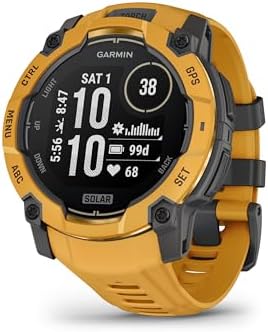
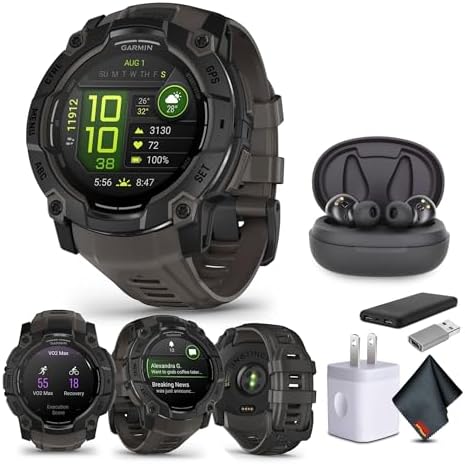
For anyone who prioritizes that endurance in the 47mm platform, the Garmin fēnix 7 Pro Sapphire Solar Black GPS combines the solar layer, sapphire crystal, and a built-in flashlight within the same recovery and training ecosystem. The trade-off is visual: MIP lags on color saturation, and the lower resolution map rendering is noticeable when trail intersections tighten.
Case Sizes, Materials, and How the Watch Feels Daily
The chassis itself is nearly identical, which is why every internal dilemma is really a display debate. Both families break into 42mm, 47mm, and 51mm sizes. The Fenix 7 labels them 7S, 7, and 7X; the Epix 2 markets them by millimeter alone. The Epix 2 is slightly lighter, with Sapphire variants sitting around 70 grams, while the Fenix 7 stays around 73 grams in titanium or 79 in steel.
- Both: 10 ATM water rating for swimming and shallow diving
- Both: Multi-band GNSS on Sapphire and Sapphire Solar tiers
- Both: TopoActive maps, built-in flashlight on larger versions
- Epix 2 only: Always-on AMOLED smartwatch mode
- Fenix 7 only: Solar charging with Power Glass crystal
On the wrist, the Epix 2 feels more like a modern connected watch: gestures are smoother, notifications pop with color, and the always-on dimming is subtle enough for meetings. The Fenix 7 feels more like a specialized tool, built to survive whatever the user throws at it, from multi-day rock routes to winter climbs. Buyers weighing the full extended family can review the Fenix 7 lineup to see how solar builds and case sizes shift the equation, while the Garmin brand's broader adventure range places both platforms alongside its other multisport references.
Who Should Buy Each Watch
The decision rests on a few clean questions. For any buyer who uses the watch as a primary smartwatch and wants the screen to compete with a phone, the Epix 2 is the stronger choice. Its AMOLED panel delivers saturated color, higher resolution, and vastly better map clarity, which matters enormously on frequent navigational use.
For buyers who use the watch as a tool on long expeditions and want independence from charging in the backcountry, the Fenix 7 is the stronger choice. Solar charging, the transflective screen's unlit readability, and better GPS battery endurance all compound into real-world advantage over several consecutive days outdoors.
| Buyer Profile |
Best Choice |
Why |
| City runners who use maps daily |
Epix 2 |
Highest map resolution and best color rendering |
| Multi-day thru-hikers without power |
Fenix 7 Solar |
Solar charging extends GPS runs toward multi-week autonomy |
| Mixed office and gym users |
Epix 2 |
Best always-on look under indoor lighting |
The critical trade-offs settle into a simple rule. Choosing the Epix 2 means accepting more frequent charging in exchange for the most vivid navigation display in this line. Choosing the Fenix 7 means accepting a functional-but-restrained panel in exchange for extended autonomy and solar resilience in the field.
The verdict is not about superiority. It is about scenario fit, and buyers who understand their own use proportion can decide with confidence rather than relying on marketing copy. That clarity is the real value of comparing these two platforms side by side.
 Just Pick Your Favorite Stylish Watch online














Item Reviews