The Amazfit Active Max and the Garmin Forerunner 55 both sit in the affordable end of the sports watch market, yet they approach the category from opposite directions. One leans on a large AMOLED display, offline maps, and a long feature list; the other leans on running-focused coaching, a lightweight case, and a proven training ecosystem. Deciding between them comes down to what a buyer actually does with a watch on the wrist. This guide is built to be kept: it sets out the specifications, the trade-offs, and the buying criteria that separate these two models, so the right choice becomes obvious rather than emotional.
| Feature and Selling Point |
Amazfit Active Max |
Garmin Forerunner 55 |
| Display type and size |
1.5-inch AMOLED |
1.04-inch MIP, always-on transflective |
| Case size and profile |
48mm, larger presence on the wrist |
Lightweight compact case built for running |
| Weight class |
Heavier due to size and battery |
Noticeably lighter for fast sessions |
| Stated battery life |
Up to 25 days typical use |
Up to 2 weeks smartwatch mode |
| GPS navigation style |
Offline maps with on-watch routing |
Breadcrumb track and back-to-start |
| Training guidance |
170+ sport modes, broad activity coverage |
Daily Suggested Workouts and race predictions |
| Coaching ecosystem |
Zepp app with general wellness focus |
Garmin Connect with deep running metrics |
| Onboard storage |
4GB for maps and media |
Minimal, activity data only |
| Health sensors |
Heart rate, sleep tracking, wellness suite |
Heart rate, sleep, stress and Body Battery |
| Water resistance |
Swim-ready, pool and open-water capable |
5 ATM, pool swimming supported |
| Smartphone platforms |
iOS and Android, wider compatibility |
iOS and Android |
| Best suited to |
Everyday wear, travel, mixed-sport users |
Runners chasing pace and structured plans |
| Display in direct sun |
Bright AMOLED, punchy colours |
Always-visible transflective panel |
| Charging rhythm |
Less frequent charging for casual users |
Weekly top-ups with regular GPS use |
| Value proposition |
Maximum screen and features per dollar |
Maximum training credibility per dollar |
| Upgrade path |
Stays within the Amazfit ecosystem |
Clear step up to Forerunner 165 and 570 |
The single most important line in that table is the training-guidance row. The Amazfit Active Max wins on display size, storage, and headline battery figures, while the Forerunner 55 counters with a lighter build and a coaching layer that the Garmin brand's collection has refined across multiple generations of running watches. Neither column is objectively better; they simply answer different questions. The sections below unpack those differences so a buyer can match the watch to the training plan rather than to a specification sheet.
Who Each Watch Is Actually Built For
The Amazfit Active Max is positioned for people who want one device to cover everything: commutes, gym sessions, weekend hikes, sleep tracking, and the occasional run. Its 48mm case, 1.5-inch AMOLED panel, 4GB of storage, and offline maps make it a generalist tool. Buyers who travel or train in unfamiliar areas gain real utility from on-watch maps, and the long battery rating means charging becomes a background task rather than a weekly ritual. In practical terms, the Amazfit Active Max Smart Watch 1.5" 48mm GPS is a lifestyle-first wearable that happens to track sport well.
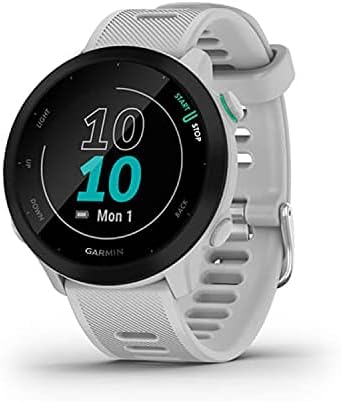
The Forerunner 55 answers a narrower question: how does a runner improve? Garmin's running line has always prioritized pace accuracy, structured workouts, and post-run analysis over screen technology. The watch is deliberately small and light because arm swing matters over long distances, and its memory-in-pixel display stays readable in bright sun without draining the battery. Daily Suggested Workouts adapt to recent training, race prediction estimates finish times, and recovery advice is delivered in plain language. For anyone following a plan, the Garmin Forerunner 55 GPS Running Watch Black is less a gadget and more like a coach on the wrist.
Display, Size, and Daily Wearability
Screen technology is the most visible difference between the two. AMOLED delivers deep blacks, high contrast, and vivid colour, which makes watch faces, maps, and notifications look sharp. The trade-off is power consumption, which Amazfit offsets with a large battery and a large case. A 48mm watch suits broader wrists and reads clearly at a glance, but it can catch on sleeves and feels substantial during fast arm movement. Buyers who wear a watch to sleep should also consider whether the size interferes with comfort.
Garmin's transflective display works on the opposite principle. It reflects ambient light instead of emitting it, so readability improves as the sun gets brighter, and the backlight is only needed after dark. The panel is smaller and less colourful, and animations are simpler, but the screen is never off. That design choice keeps the case slim and the weight low, which matters during intervals, tempo runs, and long sessions where every gram is noticed. Neither approach is inherently superior; one favours visual impact, the other favours endurance and unobtrusiveness.
Battery Claims and What They Mean in Practice
Battery figures are the most quoted and least understood specification in this category. A 25-day rating typically assumes typical smartwatch use: notifications, heart-rate monitoring, sleep tracking, and limited GPS activity. Once GPS is engaged for long sessions, the figure drops sharply because satellite positioning is the single biggest power draw on any sports watch. Buyers who run several times a week should plan around GPS hours, not standby days.
Garmin states that the Forerunner 55 offers up to two weeks of battery life in smartwatch mode, with GPS sessions reducing that window according to duration and satellite settings. The practical difference between the two watches is therefore smaller than the headline numbers suggest for runners, but larger for casual users. Someone who mostly walks, tracks sleep, and checks notifications will charge the Amazfit far less often. Someone running five times a week will find both watches asking for a cable at a similar rhythm. The right question is not which battery is bigger, but how often the watch will actually use GPS.
GPS, Mapping, and Route Confidence
Offline maps are the Amazfit Active Max's strongest functional advantage. Storing map data on the watch means a route can be followed without a phone, which is genuinely useful when running or hiking somewhere unfamiliar. On-watch navigation reduces the need to stop and check a handset, and it keeps the experience self-contained. The cost is complexity: map screens demand more interaction and drain power faster than a simple distance readout.
The Forerunner 55 takes a simpler approach. It records a GPS track, shows pace and distance in real time, and can guide a runner back to the starting point along the path already travelled. There is no map to scroll or pan, which keeps battery use predictable and the interface uncluttered mid-run. For runners on known routes, this is sufficient. For travellers and hikers, the Amazfit's mapping is a genuine advantage. Matching the navigation style to how the watch will actually be used is one of the most reliable ways to avoid buyer's regret.
Training Features and Coaching Depth
Amazfit covers more than 170 sport modes, which speaks to breadth: cycling, swimming, strength training, yoga, rowing, skiing, and dozens of variations. For multi-sport athletes or anyone who wants one watch for every activity, that coverage is convenient and reduces the sense of compromise. Health tracking extends to heart rate, sleep stages, and general wellness metrics, presented through the Zepp app in a friendly, consumer-oriented way. The emphasis is on awareness rather than structured performance improvement.
Garmin's strength lies in depth rather than breadth. The Forerunner 55 line was developed around distance running, and the feature set reflects that. Daily Suggested Workouts propose sessions based on recent load, race prediction translates training into a realistic finish time, and recovery guidance discourages overtraining. Cadence, pace zones, and interval structures are handled natively. The Garmin Connect platform then stores years of history, making long-term progress visible rather than anecdotal. Runners who follow plans will find this ecosystem considerably more useful than a long list of sport modes they rarely open.
Health Tracking and Everyday Smart Features
Both watches monitor heart rate around the clock and estimate sleep quality overnight, and both can display phone notifications and control music playback. The differences are in accent rather than presence. Amazfit leans toward wellness reporting, with summaries that are easy to read and quick to act on. Garmin leans toward physiological load, combining stress, sleep, and activity into a single readiness-style indicator that informs the next training decision.
For buyers whose priority is general health awareness, either watch will satisfy. For buyers who want health data to influence training, Garmin's interpretation layer is more actionable. It is worth noting that wrist-based heart rate remains less accurate than a chest strap during high-intensity intervals on both devices, so serious interval training benefits from an external sensor regardless of which watch is chosen. This is a category-wide limitation rather than a flaw unique to either model.
Design Language, Materials, and Durability
The Amazfit Active Max reads as a modern smartwatch, with a large, glass-covered face and a smooth bezel that gives it a premium look at a budget price. That large surface area naturally attracts fingerprints and, over time, micro-scratches, so screen protection is a sensible accessory. Water resistance covers swimming in pools and open water, which widens its appeal to swimmers and triathletes. The overall impression is of a consumer electronics product designed to look good in everyday settings.
The Forerunner 55 adopts a tool-watch aesthetic: a compact resin case, a raised bezel for protection during trail runs, and a simple five-button layout that works with sweaty fingers or in rain. It is designed to survive being knocked against doorframes, dropped on pavements, and worn through winter training. Neither watch targets luxury materials such as titanium or sapphire, and neither claims to. Within the price bracket, both are appropriately durable; the Garmin simply sacrifices visual drama in exchange for resilience.
Software Ecosystem and Long-Term Use
Garmin Connect is one of the deeper fitness platforms available, with web access, export options, and years of historical data storage. Watches in the Garmin ecosystem can also step up the range later; Garmin's own product comparison material positions the Forerunner 570 with an aluminum bezel, built-in speaker and microphone, and up to 11 days of battery life, and the Forerunner 165 series adds a touchscreen, showing how the line evolves while retaining the same software logic. A buyer entering at the Forerunner 55 level therefore inherits a familiar interface if they upgrade in a few years.
Amazfit's Zepp platform is more self-contained. It covers activity history, sleep trends, and watch configuration competently, and syncing is straightforward on iOS and Android. Buyers focused on a single device and a simple app experience will find little to complain about. Those considering the Amazfit brand's wider lineup should note that ecosystem switching later can mean exporting or abandoning history depending on the platform involved. Choosing an ecosystem, rather than a single watch, is arguably the more consequential long-term decision.
Buying Criteria: Matching the Watch to the Runner
The decision framework here is unusually clear. A buyer should first define the primary use case. If the watch will predominantly support structured running with pace targets, intervals, and a training plan, the Forerunner 55 is the more capable tool: it is lighter, its coaching is more instructive, and its platform is built for progression. If the watch will be worn daily across mixed activities, with travel, hiking, and casual exercise in the mix, the Amazfit Active Max offers more screen, more storage, and more on-watch utility for the money.
Wrist size deserves honest consideration. A 48mm case is a substantial object on a smaller wrist, and discomfort usually leads to a watch being left in a drawer. Conversely, runners who want a bright, responsive screen for glancing at notifications will find the compact Garmin display less engaging away from training. Buyers should also weigh battery behaviour against their GPS habits, and decide whether offline maps solve a real problem or merely sound appealing.
None of these trade-offs makes one watch better than the other in absolute terms. What they do is make the choice predictable: training-first buyers will be happier with the Garmin, lifestyle-first buyers with the Amazfit. Replacing a watch that was chosen for the wrong reason usually costs more than spending a little longer on the criteria beforehand.
Sports watches in this bracket have improved to the point where both devices handle the fundamentals reliably. The remaining gap is intent, not capability. A watch that matches the way its owner actually moves, trains, and travels will be worn for years, and that longevity is the truest measure of value in a crowded market where specifications alone rarely tell the whole story.
 Just Pick Your Favorite Stylish Watch online













Item Reviews