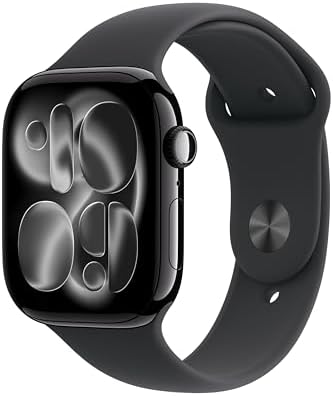
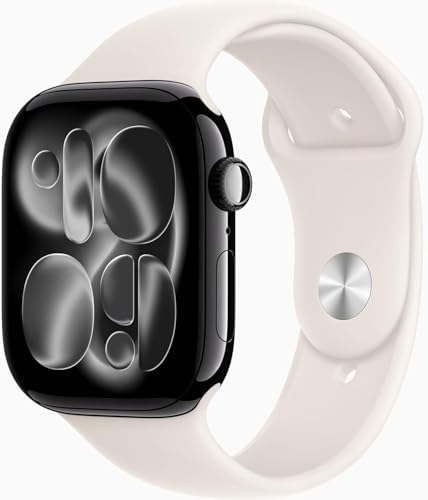
At 50mm across, the Amazfit Bip Max Smart Watch 2.07" 50mm GPS is among the largest mainstream smartwatches available, while the Apple Watch Series 11 [GPS 46mm] Jet Black Aluminum Black 46mm M/L GPS keeps to a slimmer 46mm case in Jet Black aluminum. That size gap frames the entire comparison, because it shapes who each watch is built for: the Bip Max chases battery life and screen real estate for outdoor and hybrid training, and the Series 11 chases health tracking depth and app integration for iPhone owners. This guide is written as a buying reference worth keeping permanently, not a feature dump.
| Decision Factor |
Amazfit Bip Max |
Apple Watch Series 11 |
| Case size |
50mm |
46mm |
| Display type |
2.07" AMOLED |
Always-On Retina LTPO |
| Case material |
Polymer alloy |
Jet Black aluminum |
| Battery life |
Up to 20 days |
24 hours, 38 hours low power |
| GPS |
Built-in multi-band |
GPS and GLONASS |
| Onboard storage |
4GB offline maps |
32GB apps and music |
| Water resistance |
Water-resistant |
50m / WR50 |
| Sleep tracking |
Zepp sleep stages |
Sleep Score and apnea alerts |
| ECG and heart alerts |
Heart rate only |
ECG and high/low HR notifications |
| Sport modes |
150+ including HYROX Mode |
Standard Apple workout library |
| Hybrid training metrics |
Yes, dedicated mode |
Third-party apps only |
| Phone compatibility |
iOS and Android |
iPhone only |
| Safety features |
Basic notifications |
Fall and crash detection |
| Charging cadence |
Roughly twice a month |
Daily or every other day |
| Best suited to |
Multi-day training, offline maps, Android or iPhone |
iPhone health tracking and daily apps |
| Key selling point |
20-day battery in a 50mm AMOLED body |
Tightest health and safety ecosystem |
The table makes the split obvious: the Bip Max wins on endurance, screen size, and training breadth, while the Series 11 wins on health monitoring depth, safety features, and iPhone integration. Everything below explains the trade-offs behind those rows so the right purchase becomes clear rather than assumed.
How Battery Life Rewrites Daily Habits
Battery life is not a spec sheet footnote; it changes how a watch is worn. Zepp positions the Bip Max around a 20-day usage window, which means charging becomes a monthly errand rather than a nightly ritual. That matters for people who travel, camp, or simply dislike managing cables before bed. Continuous sleep tracking also becomes more reliable, because the watch stays on the wrist through the night without a top-up session.
Apple states that the Series 11 delivers around 24 hours of typical use, extending toward 38 hours in Low Power Mode. The trade-off is intentional: the LTPO display, continuous background health sampling, and app ecosystem all draw power in exchange for richer, real-time data. Anyone stepping from a 20-day device to a one-day device should plan for a charging routine, and anyone stepping the other way should expect to give up some always-on responsiveness.
Display, Case, and Wearing Experience
A 50mm case is a commitment. On smaller wrists the Bip Max reads as oversized, sitting tall and covering more forearm than a traditional watch, but the reward is a 2.07-inch AMOLED panel that makes maps, stats, and notifications easy to read mid-stride. Runners who glance at pace data without breaking stride tend to prefer that larger canvas. The 46mm Series 11 sits closer to a conventional large-watch footprint, and the aluminum case keeps it light enough for round-the-clock wear, including sleep.
Material expectations differ too. Apple builds the Series 11 around recycled aluminum in finishes like Jet Black, with a fit-and-finish that reads as jewelry-adjacent. The Bip Max prioritizes rugged utility over luxury surfaces. Neither choice is wrong; they simply serve different buyers, one who wants a sports instrument and one who wants a watch that works with office attire.
Training Features: HYROX Mode vs the Apple Workout Stack
Amazfit has leaned into hybrid training, and the Bip Max ships with more than 150 sport profiles plus a dedicated HYROX Mode for the race format that mixes running with functional stations. For athletes training specifically for that event, having a watch that understands the structure of the race removes a layer of manual lap counting.
Apple takes a different route, relying on a curated workout library and a deep third-party app ecosystem rather than a sprawling native mode count. Everything from interval timers to gym logging exists, but it usually arrives through third-party software rather than out of the box.
- Choose Bip Max if: the training plan includes offline mapping, hybrid races, or long GPS sessions far from a charger.
- Choose Series 11 if: the routine revolves around iPhone apps, guided workouts, and tight sync with health records.
- Storage note: the Bip Max carries 4GB for offline maps, while the Series 11 uses its larger storage pool for music and apps.
Health Monitoring and Safety Depth
Apple has positioned the Series 11 as a health companion first, with features such as Sleep Score, overnight wrist-temperature style insights, and abnormal heart rhythm notifications feeding into the iPhone Health app. Fall detection and crash detection add a layer of reassurance that is difficult to replicate outside the Apple ecosystem, especially for older relatives or solo commuters.
The Bip Max covers the essentials: continuous heart rate, sleep staging, blood oxygen style metrics, and stress tracking through the Zepp app, which has been noted as a capable alternative to established fitness platforms. For general wellness awareness, that is enough. For clinical curiosity or doctor-shared reporting, the Apple path is deeper.
Offline Maps, Storage, and Practical Navigation
Offline maps are a quietly decisive feature. Trail runners and cyclists who leave signal range generally want turn-by-turn guidance without pulling out a phone, and the Bip Max's downloadable map storage supports exactly that scenario. It is the kind of function that rarely appears in marketing headlines but shapes real buying decisions.
The Series 11 leans on connected navigation instead, with richer turn-by-turn feedback when paired to an iPhone, plus the ability to install mapping and workout apps. The difference is philosophical: local storage versus cloud-tethered convenience.
Ecosystem, Compatibility, and Long-Term Ownership
The Bip Max works with both Android and iPhone through the Zepp app, which makes it a flexible pick for households that mix phone platforms. The Series 11 requires an iPhone, and that constraint is also its strength: notifications, messages, health records, and Apple Pay style conveniences integrate without friction.
Ownership costs follow the same pattern. The Bip Max appeals to buyers who want a capable watch without a subscription mindset or daily charging, while the Series 11 appeals to buyers already invested in Apple's services. For those exploring alternatives, Amazfit's endurance-focused lineup covers a range of models, while the Apple brand's wider catalog spans everything from watch straps to health subscriptions.
Who Should Buy Which Watch
The Bip Max is the better answer for someone whose week includes long outdoor sessions, hybrid training blocks, or travel where a charger is not guaranteed. Its 50mm frame and multi-day battery are features, not compromises, for that buyer. The Series 11 is the better answer for an iPhone owner who values health data, safety alerts, and daily app integration more than charging intervals.
For readers comparing broader lineups, the Series 11 lineup sits alongside other Apple models, and each occupies a distinct spot in this same buying conversation, so the deciding factors above still apply.
When the decision finally comes down to a single criterion, the simplest test is this: choose the Bip Max if you want to forget the charger, and choose the Series 11 if you want your wrist to remember everything about your health. Both watches deliver on their promise; they simply promise different things, and matching that promise to your routine is the smartest purchase decision of all.
 Just Pick Your Favorite Stylish Watch online




















Item Reviews