The Garmin Instinct 3 series arrives with a clear split in its lineup: a 45 mm AMOLED version, a 45 mm Solar version, a 50 mm Solar version, and a Tactical Edition, while the Instinct 2 that preceded it built its reputation on a monochrome memory-in-pixel display and class-leading battery endurance. For anyone deciding between the two generations, the choice is less about raw novelty and more about which trade-offs matter on a wrist that sees trail dust, salt water, and sub-zero mornings.
This guide is built as a decision tool rather than a feature recap. It weighs the dimensions that actually change how the watch feels and performs day to day, from display technology and solar behavior to case sizing and flashlight utility. Both generations remain in circulation, so the comparison below reflects what a buyer will genuinely live with over months, not what looks best on a spec sheet.
| Feature & Selling Point |
Garmin Instinct 3 |
Garmin Instinct 2 |
| Display Technology |
AMOLED (45 mm option) or monochrome MIP on Solar versions |
Monochrome MIP, always-on transflective |
| Battery (Smartwatch Mode) |
Up to 28 days; 70 days with solar |
Up to 28 days; effectively unlimited with solar |
| Battery (GPS Mode) |
Up to 25 hours; 31 hours with solar |
Up to 30 hours on the larger case variants |
| Battery Saver Mode |
Up to 65 days; 71 days with solar |
Extended storage watch mode beyond GPS variants |
| Case Size Options |
45 mm and 50 mm tiers |
40 mm, 45 mm, and 50 mm X variants |
| Bezel Construction |
Metal reinforced bezel |
Reinforced polymer bezel |
| Integrated Flashlight |
Built-in LED flashlight on all variants |
Not available, except the Tactical Edition |
| Solar Charging |
Solar lens on Solar-specific models |
Solar lens on Solar models |
| Smart Notifications |
Yes, with readable AMOLED text on AMOLED tiers |
Yes, condensed on monochrome display |
| Health and Wellness Suite |
Expanded sensor package and updated firmware |
Full Health Monitoring suite at launch |
| Water Resistance Rating |
10 ATM / 100 meters |
10 ATM / 100 meters |
| Best Suited Scenario |
Buyers wanting modern display and flashlight |
Buyers prioritizing endurance and lighter price |
| Primary Trade-Off |
AMOLED versions cost battery runtime |
No flashlight outside Tactical Edition |
| Unique Selling Point |
First Instinct line with an AMOLED option and universal flashlight |
Mature ecosystem with the widest case-size spread |
The table makes one point clear before the analysis begins: the Instinct 3 does not simply replace the Instinct 2 on every axis. The newer generation wins on display legibility, bezel reinforcement, and the universal flashlight, while the Instinct 2 still holds its own on battery endurance in Solar form and the 40 mm option that smaller wrists appreciate.
The Display Question: AMOLED Versus MIP
Garmin markets the Instinct 3 as a rugged GPS smartwatch built around an AMOLED display, smart notifications, health and wellness features, and an integrated flashlight. That positioning is a departure from the Instinct 2, whose identity rested on a monochrome memory-in-pixel panel designed to sip power rather than glow.
The practical difference is not cosmetic. An AMOLED screen on the Instinct 3 renders messages, map tiles, and training overlays with far greater clarity, and colors are vivid in a way the Instinct 2 cannot approach. The trade-off is familiar to anyone who has owned an AMOLED smartwatch: the panel consumes more battery per hour of screen-on time, which is why the Instinct 3 lineup splits between the brighter AMOLED 45 mm and the MIP-based Solar versions.
Buyers used to the visibility of MIP displays should note that they also remain readable without backlighting, whereas the AMOLED version needs a bright pixel refresh to stay sharp outdoors. Neither solution is objectively superior; they solve different problems.
Battery Endurance Across Both Generations
Garmin's official product comparison data places the Instinct 3 at up to 28 days in smartwatch mode, 65 days in battery saver watch mode, and 40 hours in GPS-only mode, with solar assistance extending these figures to 70 days and effectively unlimited battery saver use. An early hands-on forum test of the Instinct 3 Solar 45 mm, run in smartwatch mode with heart rate, Bluetooth, notifications, and sleep detection active and no solar top-up, confirmed the sort of real-world endurance that the spec sheet only hints at.
The Instinct 2's reputation was built on a similar promise. Its Solar variants pushed the watch toward near-perpetual operation in watch mode, and its raw GPS runtime comfortably exceeded the Instinct 3's published 25 to 31 hours on the 45 mm Solar tier. For users on multi-day treks where every charging stop is a logistical problem, that GPS endurance advantage is not trivial.
- Instinct 3: 28 days smartwatch, 40 hours GPS, up to 70 days with solar
- Instinct 2 (Solar, 45 mm): 28 days smartwatch, extended GPS runtime
- Key distinction: AMOLED variants of the Instinct 3 shorten maximum runtime, Solar variants preserve it
Choosing between the two often comes down to whether a week of tracking between charges is enough. The Instinct 2 series favors consistency over brilliance, accepting a muted screen in exchange for predictable endurance that rarely demands attention.
Design, Materials, and Durability
One of the more tangible updates in the newer line is the metal reinforced bezel, documented in Garmin's official description of the Instinct 3 Solar 45 mm. That reinforcement adds a layer of confidence on rock scrambles and clumsy descents, and visually differentiates it from the more uniform polymer build of the Instinct 2.
Both generations share the same core durability core: 10 ATM water resistance, a fiber-reinforced polymer case, and a chemically strengthened glass cover. The Instinct family has never been a dress watch family, and neither generation makes apologies for its utilitarian silhouette. The Instinct 2's 40 mm, 45 mm, and 50 mm spread offers more granular fit choices than the Instinct 3's 45 mm and 50 mm tiers, which matters for slimmer wrists that found the mid-size gen-two comfortable.
Flashlight Utility in the Field
The built-in LED flashlight became a headline feature of the Instinct 3, and Garmin has equipped it across the lineup rather than reserving it for a limited edition. In practice this is one of the few features that changes behavior outdoors: reaching for a wrist rather than a pocket light becomes second nature during pre-dawn campsite packing or a late trailhead return.
For campers who want that same capability with a different balance of features, the Garmin Instinct 2 Camo-Edition Graphite offers a distinct aesthetic within the older generation's ecosystem, pairing the same multi-GNSS support and TracBack routing with a camouflage finish that suits field use.
Solar Efficiency and Real-World Charging
Solar capture on both generations depends on lens area and ambient conditions, and Garmin states that the "unlimited with solar" figure applies specifically to watch-saver mode under sustained bright light rather than heavy GPS use. The Instinct 2 set expectations for what solar could contribute, and the Instinct 3 largely inherits rather than reinvents that approach on its Solar variants.
Health Tracking, Sensors, and Software
Both watches sit at the top of Garmin's outdoor segment for physiological monitoring. Heart rate, pulse ox, sleep scoring, stress tracking, and body battery readings are present across the two generations, with the Instinct 3 benefiting from newer firmware baselines and updated sensor handling. Multi-GNSS support, TracBack routing, and turn-by-turn navigation carry over, and the newer generation inherits the same expanded outdoor toolkit rather than trimming it.
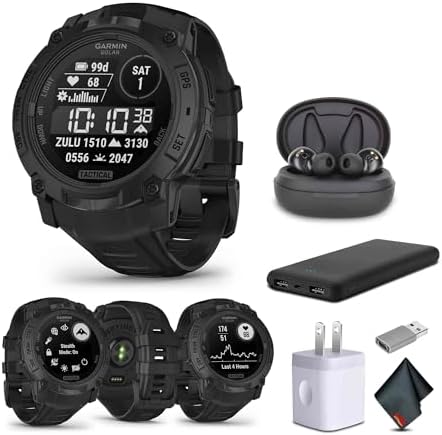
For comparison shoppers, the Garmin Instinct 3 Tactical Edition AMOLED 50mm GPS shows where the line has moved: the largest display option plus tactical-oriented firmware options make it the most feature-dense way to experience the current generation, but it also represents the most battery-hungry configuration.
Which Instinct Belongs on Your Wrist
Buyers who want a watch that stays readable in every lighting condition, appreciate a built-in flashlight, and value a reinforced bezel should lean toward the Instinct 3 in its Solar configuration, which preserves the endurance identity while adding the modern conveniences. Those who need every available GPS hour between charges, prefer a 40 mm case, or are shopping on a tighter budget will find the Instinct 2 still does the job without functional compromise during normal use.
The Garmin brand's ecosystem continues to mature around both models, with Garmin Connect serving as the hub for activity review, navigation planning, and firmware updates regardless of which generation sits on your wrist. Neither watch is old, and neither is oversold; the right choice depends entirely on whether improved visibility and the flashlight feature are worth the trade in maximum GPS runtime, or whether the older generation's endurance and size options remain the deciding criteria.
 Just Pick Your Favorite Stylish Watch online





















Item Reviews