The Apple Watch Series 11 and the Apple Watch Ultra 3 share the same S-series silicon generation, the same watchOS foundation, and the same iPhone pairing requirement, yet they answer two very different questions. One is a slim, low-profile all-rounder built to vanish under a shirt cuff. The other is a 49mm titanium instrument engineered for open water, altitude, and days away from a charger. This comparison maps every decision-relevant difference between them so the right wrist gets the right watch.
| Decision Factor |
Apple Watch Series 11 |
Apple Watch Ultra 3 |
| Case Sizes |
42mm and 46mm |
49mm only |
| Case Materials |
Aluminum and titanium options |
Rugged titanium |
| Display Brightness |
Up to 2,000 nits |
Up to 3,000 nits |
| Battery Life (Normal Use) |
Up to 24 hours |
Up to 42 hours |
| Low Power Mode |
Up to 38 hours |
Up to 72 hours |
| Water Resistance |
50m, snorkeling to 6m |
100m, recreational scuba to 40m |
| Navigation |
GPS, compass |
Precision dual-frequency GPS, compass, waypoints |
| Satellite Communications |
Not available |
Satellite messaging and emergency SOS |
| Depth and Water Sensors |
Water temperature sensor |
Depth gauge, water temperature sensor |
| Action Control |
Touch, digital crown, side button |
Adds configurable Action Button |
| Connectivity Cost |
GPS or GPS + Cellular in select sizes |
GPS + Cellular standard |
| Wrist Fit and Bulk |
Slim profile, sleeps easily |
Larger, heavier, glove-friendly |
| Band Compatibility |
42mm and 46mm band ecosystem |
49mm band ecosystem |
| Best For |
Daily wear, sleep tracking, general fitness |
Multisport, diving, remote trails |
| Key Selling Point |
Thin, light, all-day versatility |
Rugged endurance and off-grid capability |
Three rows decide most purchases: battery life, water resistance, and satellite reach. The Series 11 clears a single demanding day and stretches into a second with Low Power Mode, while the Ultra 3 roughly doubles normal-use endurance and reaches 72 hours in its reduced-power state. Both track water temperature, but only the Ultra 3 adds a depth gauge certified for recreational scuba to 40 meters and satellite messaging when cellular and Wi-Fi are absent. Those two capabilities form the real dividing line between a fitness companion and an off-grid instrument.
Who Should Buy the Apple Watch Series 11
The Series 11 is the correct choice for anyone whose training stays within reach of a charger and a cell tower. Runners logging road miles, swimmers doing pool laps, gym-goers tracking strength work, and desk workers who want notifications, sleep scores, and heart-rate trends on the wrist will find the sensor suite complete. The 42mm option suits smaller wrists, and the 46mm version keeps a generous screen without the bulk of a 49mm case.
Sleep tracking is where the slimmer profile earns its keep. A lighter case is easier to forget overnight, and the nightly charge ritual becomes second nature. Buyers who remove the watch before bed lose much of the health-monitoring value, so comfort at night is not a minor detail. It is a functional requirement, and the aluminum build keeps the entry cost lower than any titanium alternative.
Who Should Buy the Apple Watch Ultra 3
The Ultra 3 is built for the buyer who leaves the paved world behind. Divers who want a depth gauge on the wrist, hikers crossing ridgelines beyond cell coverage, climbers and backcountry skiers who value satellite SOS, and multisport athletes juggling swim, bike, and run in a single session all fall inside its design brief. The configurable Action Button is a physical control that works with gloves and in motion, which matters when attention is split between the activity and the interface.
Endurance is the other argument. Forty-two hours of normal use and 72 hours in Low Power Mode mean a weekend trip no longer requires a charging cable. For travelers and expedition-style users, that alone can justify the upgrade. The 49mm titanium case and 100-meter water rating round out a package that is heavier on the wrist but considerably more capable off the grid.
Design Philosophy: Concealment Versus Capability
Apple treats these two watches as answers to different questions. The Series 11 prioritizes concealment and comfort, with a curved case that tucks under a shirt cuff and a weight that stays unobtrusive through a night of sleep tracking. Available in lightweight aluminum or titanium across two sizes, it reads as technology first and accessory second.
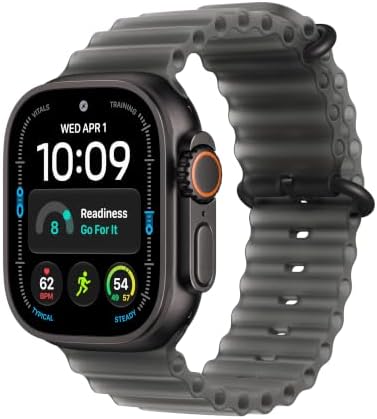
The Ultra 3 answers a different brief. Its raised bezel, rugged titanium case, and Black Ocean Band signal durability before the screen even lights up. Rather than appeal to everyone, the titanium build is engineered to survive impacts, saltwater, and cold, whether the day involves open-water laps, a ridgeline traverse, or an early trailhead start. Both sit inside the Apple brand's wearable line, which has kept the same band attachment system across generations.
Battery Endurance and What It Changes
Battery capacity is not an abstract spec; it dictates how the watch is used. The Series 11, with up to 24 hours of normal use and roughly 38 hours in Low Power Mode, assumes a nightly charging ritual. That suits anyone who sleeps with the watch for recovery tracking, because the top-up happens without thought. Screen brightness peaks around 2,000 nits, which stays legible in daylight without pushing the power budget.
Across a full week of mixed use, the Ultra 3 behaves like a different category of device. It carries up to 42 hours in normal use and up to 72 hours in Low Power Mode, letting travelers leave the charger behind for a weekend. To reach those figures, Apple fits a larger battery and a display capable of 3,000 nits, the brightest ever on an Apple Watch. According to Apple, the Ultra line is designed for multi-day adventures, and the endurance difference of roughly a full extra day per charge is the single strongest reason to move up. If battery is the deciding factor, the Series 11 remains the lighter daily driver for anyone near a charger each night.
Water Resistance, Diving, and Satellite Reach
Both watches handle swimming, but their ceilings differ. The Series 11 is rated to 50 meters and, per Apple, supports snorkeling down to 6 meters, a sensible limit for pool laps and shallow reef swims. The Ultra 3 keeps a 100-meter rating and, crucially, adds a depth gauge that Apple certifies for recreational scuba diving to 40 meters. That is not a marketing distinction; it is the line between a watch you can wear in the water and one you can plan a dive around.
Satellite connectivity sharpens the same divide. The Ultra 3 can send messages and emergency SOS over satellite when cellular and Wi-Fi are absent, a feature that changes the safety calculus on remote trails. For hikers, climbers, and backcountry skiers, that capability is not a niche extra. It is the reason the Ultra exists.
Navigation, Sensors, and Training Depth
This is the clearest functional fork between the two. The Series 11 provides GPS, an on-watch compass, and water-temperature sensing, everything required for road running, pool swims, and gym sessions. The Ultra 3 layers precision dual-frequency GPS, a build that reduces position errors in dense cities and deep canyons, plus waypoints, a depth gauge, and an Action Button configurable for sudden tasks like starting an interval or dropping a waypoint without looking at the screen.
The Action Button matters more than its spec sheet suggests. Mid-interval, mid-descent, or mid-ride, physical control beats touch, because most navigation failures occur when attention is split between the activity and the interface. The Ultra assumes that reality; the Series 11 assumes a calmer, closer-to-home routine.
Case Size, Weight, and Daily Reality
Wrist size is the quietest and most personal factor in the entire decision. The Series 11 arrives in 42mm and 46mm, so those with smaller wrists, or anyone who wants sleep-tracking comfort, can pick a compact case. That comfort matters over years of wear, since a heavy watch is harder to forget about.
The larger, heavier 49mm Ultra 3 sits closer to a field watch, noticeable during the day and occasionally cumbersome at night. Glove-friendly and impact-resistant, it is a deliberate trade: size and weight for durability and screen area. Anyone coming from a smaller aluminum model should try an Ultra on the wrist before buying.
The Criteria That Decide the Purchase
Strip away the spec sheets and the decision reduces to four questions. Does the routine involve diving, sustained off-grid travel, or multi-day expeditions? Would the extra size ever become a reason to leave the watch in a drawer? Is satellite SOS a genuine safety requirement or a reassuring extra? Is the nightly charging habit already established, or would a longer battery window meaningfully change the week?
Positive answers to the first and third questions favor the Ultra 3 and its titanium case. Negative answers favor the Series 11, which covers sleep tracking, training, notifications, and daily wear at a lower price and in a lighter package. Both run the latest watchOS on iPhone 11 or later with iOS 26, so neither is a longevity compromise.
The real decision is between capability and comfort, between a watch built for extremes you may never face and one engineered to disappear into an everyday routine. Apple hardware on the wrist tends to age gracefully, gaining value as health tracking matures. Whichever path looks right, the choice is secure.
 Just Pick Your Favorite Stylish Watch online












Item Reviews