The Garmin Instinct 3 and the Forerunner 965 share an AMOLED display generation and a multisport GPS core, yet they are engineered for opposite ends of the outdoor spectrum: one is built to survive weather, impacts, and multi-day trips, the other to quantify interval splits, recovery, and race readiness. Deciding between them comes down to which compromises fit a specific training or travel profile, not to which watch is objectively superior. The comparison below is structured as a permanent reference for that decision, covering the criteria that genuinely change a purchase.
| Feature and Selling Point |
Garmin Instinct 3 (45mm AMOLED) |
Garmin Forerunner 965 |
| Primary Design Intent |
Rugged outdoor, tactical and field use |
Road and trail endurance training |
| Case and Bezel Construction |
Metal-reinforced bezel, fiber-reinforced polymer body |
Titanium bezel, fiber-reinforced polymer case |
| Display Type and Size |
1.2-inch AMOLED, raised protective rim |
1.4-inch AMOLED, full-color mapping |
| Smartwatch Battery Life |
Up to 18 days on the 45mm AMOLED model |
Up to 23 days in smartwatch mode |
| GNSS Battery Life |
Multi-band GNSS tuned for long expeditions |
Up to 31 hours GPS-only, 22 hours SatIQ |
| Navigation and Mapping |
Breadcrumb navigation, point-to-point routing |
Full-color TopoActive maps, multi-band GNSS |
| Training Analytics Depth |
Core metrics, HRV status, VO2 max, recovery time |
Training Readiness, Training Status, race predictor |
| Built-in Flashlight |
Yes, integrated LED flashlight |
Not included |
| Water Rating |
10 ATM (100 meters) |
5 ATM (50 meters) |
| Case Dimensions |
45mm across, chunky profile |
46.1mm across, thinner profile |
| Weight |
Substantial on wrist, armored feel |
Approximately 53 grams with strap |
| Music and Contactless Payment |
Garmin Pay and music storage on select variants |
Garmin Pay and on-device music on all variants |
| Ideal User Profile |
Hikers, backpackers, tactical and field users |
Marathoners, triathletes, competitive runners |
| Decision-Defining Trade-Off |
Durability and runtime sacrifice on-screen maps |
Mapping and analytics sacrifice some armor |
The most decisive row is navigation. The Forerunner 965 carries full-color TopoActive maps that turn the wrist into a self-contained route-finding instrument, while the Instinct 3 relies on breadcrumb tracks and point-to-point routing. The second pivot is armor: a 10 ATM rating and an integrated flashlight on the Instinct 3 are practical advantages in darkness and weather, points the Forerunner trades away for a larger, thinner, brighter training canvas.
Two Different Interpretations of the Modern AMOLED Watch
Garmin's catalog has historically been fragmentary, with dozens of overlapping references. The Instinct 3 and the Forerunner 965 are, however, clean statements of intent. One inherits a design language that started with Garmin's tactical and outdoor references, then adds the brightness and polish of an AMOLED panel. The other descends from a long lineage of running computers that gained color screens only recently, and it carries every training algorithm Garmin has developed for endurance athletes.
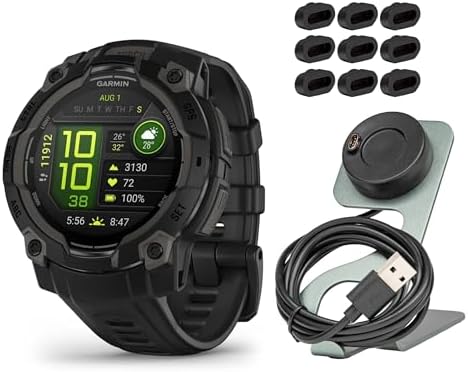
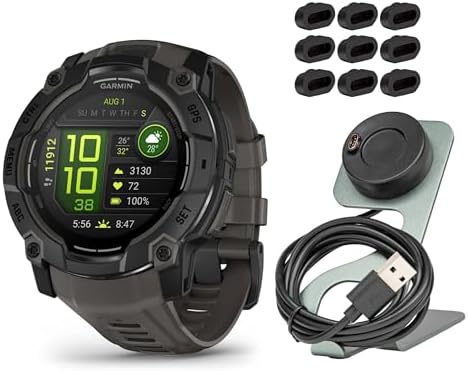
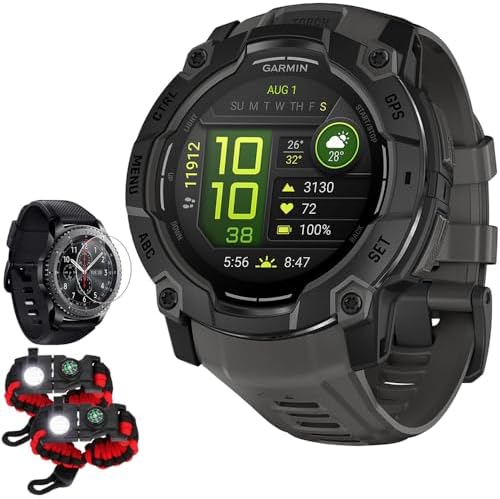
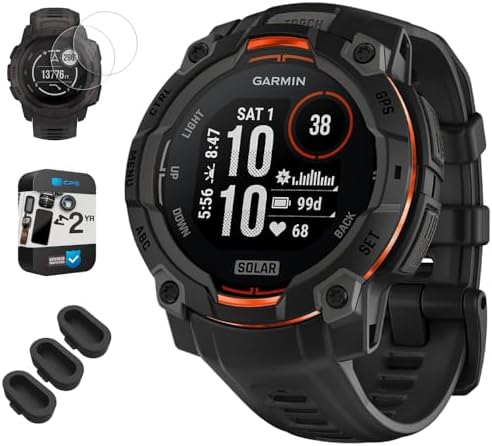
The Instinct 3's case is a layered construction: a fiber-reinforced polymer body with a metal-reinforced bezel and a raised rim that shields the display from knocks. The design language is deliberately monolithic, the kind of silhouette that reads as waterproof and drop-resistant before any specification is checked. The 45mm AMOLED variant reviewed here is available as the Garmin Instinct 3 45mm AMOLED, a reference that condenses the essential character of the line: color screen, armored body, extended runtime.
The Forerunner 965, by contrast, has been carved down for speed. Its titanium bezel reduces mass without giving away rigidity, and its polymer case is thinner than the Instinct's. The watch sits closer to the wrist, which matters in the last kilometers of a marathon when every gram is a tax. This silhouette is represented by a reference that has become a benchmark for long-course triathletes, the Garmin Forerunner 965, whose specification set emphasizes training software over field survival.
Battery Architecture: Endurance in Days Versus Endurance in Hours
The two watches measure stamina on different clocks. The Instinct 3 45mm AMOLED is rated by Garmin for up to 18 days in smartwatch mode, a number that reflects its identity as a device that might be worn for a full backcountry week without a charger in the pack. The Forerunner 965 is rated for up to 23 days in smartwatch mode, and Garmin lists up to 31 hours in GPS-only mode, up to 22 hours in SatIQ (AutoSelect) GNSS mode, and roughly 26 hours in GPS-only GNSS terms on comparable Forerunner references.
The distinction matters more in the field than on paper. A hiker who predominantly uses breadcrumb navigation and a barometric altimeter leans on the Instinct's larger daily battery and route-based approach. A runner whose watch is charged every night alongside a phone is not really buying battery; they are buying the quality of the data recorded inside those GPS hours. That means the Forerunner 965's GNSS runtime is not a liability, it is simply calibrated to a different use case: five-hour marathon efforts, cyclic bike segments, and brick sessions that never exceed half a day of continuous satellite lock.
Charging Habits as a Buying Signal
Any buyer can predict their own behavior. A watch charged every night belongs with the Forerunner. A watch charged when it is convenient, possibly in a tent, belongs with the Instinct. This single question eliminates half of the confusion in comparing the two references.
What the AMOLED Screen Costs in Runtime
Both watches use AMOLED panels, which are bright, saturated, and far more power-hungry than the memory-in-pixel displays that defined earlier generations of both lines. Garmin mitigates this with gesture-activated raise-to-wake behavior and always-on display settings. The Instinct 3 AMOLED is the most screen-radical departure in the Instinct family, and its 18-day rating reflects the compromises involved in that upgrade.
Training Analytics: Where the Forerunner Separates
Garmin has long segmented its software portfolio by line. The Forerunner devices carry the deepest training layer: Training Readiness scores derived from sleep, HRV, recent training load, and stress; Training Status classification; race predictor tables; and structured workout guidance that includes daily suggested workouts calibrated to recovery. Whether this software is meaningful is subjective, but according to Garmin's own specification sheets, these metrics are included on the Forerunner 965 and folded into a broader training ecosystem.
The Instinct 3 includes a substantial subset of these analytics, since the line has moved upmarket in recent generations. HRV status, VO2 max, recovery time, and daily suggested workouts are present across a broad swath of the outdoor lines, but the full multi-factor readiness modeling that competitive runners expect from the Garmin brand's running-specific references remains most complete on the Forerunner side of the catalog, where the Garmin Forerunner 965 sits at the top of the endurance range.
- Training Readiness: exclusive to the higher training tier in Garmin's hierarchy.
- Race Predictor: useful for marathon and triathlon planning.
- Daily Suggested Workouts: present across both, tuned to each watch's sensors.
- Multi-Band GNSS: available on both, but layered over different navigation engines.
The Field and the Track: Two Different Users
There is a temptation to state that the Instinct 3 suits hikers and the Forerunner 965 suits runners. That framing is accurate but incomplete, since many athletes rotate between trail and road. A runner preparing for a multi-day mountain race may benefit from the Instinct's 10 ATM water resistance, its integrated flashlight, and its shock-absorbing bezel over the Forerunner's lighter, more screen-centric build. Conversely, the Forerunner's thinner case and larger topo map surface can be used for urban route-finding, hill repeats, and urban exploration, not just racing.
Three purchase paths deserve specific attention. First, the backpacker whose trips are family vacations with day hikes: the Instinct 3 AMOLED delivers more durability for less training software, and the flashlight is a genuine utility, not a gimmick. Second, the age-group triathlete who prioritizes performance analytics: the Forerunner 965 provides deeper readiness modeling and its larger display makes the next interval easier to read. Third, the runner who mixes both: the Forerunner offers more versatility in daily life, while the Instinct feels at home outside the city.
Maps, Compass, and the Real Cost of a Breadcrumb
For many buyers, this row is the single thing to test before opening a wallet. The Forerunner 965 includes full-color TopoActive maps with turnaround alerts, points of interest, and on-screen route drawing. A trail runner can plot a loop on the watch itself and navigate it without a phone. The Instinct 3 uses breadcrumb navigation and point-to-point routing through the companion app; it tells you where you are relative to a track, but it does not paint a landscape.
In a forest at dusk the maps are worth their power drain. In a canyon or a corridor of rock, a breadcrumb and a compass heading suffice. The question is not technological superiority, but the style of movement across terrain: moving through unknown spaces versus covering a known path. The Instinct is designed for the former, the Forerunner for the latter at maximum efficiency.
Wrist Presence, Water Resistance, and Daily Life
The Instinct 3 AMOLED measures 45mm across and is designed to feel like a tool strapped to the wrist. That presence is welcome in a glove box, on a rock face, or while splitting wood. It is less welcome under a tailored shirt cuff or on a pillow. The 10 ATM rating, which corresponds to 100 meters of water resistance, exceeds the Forerunner 965's 5 ATM (50 meters). For swimmers this rarely changes the decision, since both handles pool lengths, but for divers, surfers, and kayakers the higher rating is objective protection.
The Forerunner is tuned for daily wear. It is large, at about 46mm, but it is proportioned for long sessions and sleep tracking. Its titanium bezel and lighter profile allow one to wear it to bed and not notice it, which matters if the user relies on sleep scores and morning readiness to guide training. Garmin lists its weight at roughly 53 grams with strap, a figure that includes a flexible polymer build rather than the Instinct's armored approach.
Which Watch to Buy: Matching Product to Person
Buyers who prioritize multi-day hiking, outdoor work, field travel, or survival-grade durability should choose the Instinct 3 AMOLED and accept the compromise on full-color mapping. Buyers who prioritize running analytics, triathlon training load, and on-wrist cartography should choose the Forerunner 965 and accept the thinner case and the 5 ATM rating. Those who train competitively but travel frequently will want the Forerunner unless their travel involves wilderness, in which case the Instinct is the safer companion.
A second-tier set of tie-breakers may clarify the final decision. The flashlight is a genuine differentiator for campers, van lifers, and emergency responders. The titanium bezel of the Forerunner 965 adds a distinctly modern aesthetic to a running tool. Battery days favor the Instinct for people who forget chargers; GPS hours favor the Forerunner for people who never need more than a day of satellite lock. Both watches support Garmin Pay and music storage, and both use the same companion app and the same AMOLED color language.
What remains outside the specification sheet is identity. A watch is chosen partly for the habits it reinforces. The Instinct is an invitation to move through wild places and treat the device as equipment. The Forerunner is an invitation to measure, refine, and repeat. Neither invitation is wrong; they simply appeal to different athletes at different points in their trajectory. Recognizing that is the final, and most durable, buying criterion available.
 Just Pick Your Favorite Stylish Watch online
















Item Reviews