The Garmin Forerunner 165 enters the mid-range running watch segment with a 1.2-inch AMOLED display, a claimed smartwatch battery life of up to 11 days, and GPS-only tracking rated at up to 19 hours, while the Coros Pace 4 arrives as a lighter, budget-focused alternative built around the same core promise: reliable pace and distance data without a flagship price. Both models target runners who want structured training tools rather than a full smartwatch ecosystem, yet they approach that goal through different hardware priorities, different companion apps, and different assumptions about how much a runner is willing to spend. This guide is built to be kept as a reference, because the decision between these two watches comes down to a handful of concrete trade-offs that are easier to weigh once they are laid out side by side.
| Feature and Selling Point |
Garmin Forerunner 165 |
Coros Pace 4 |
| Display Type |
AMOLED, full color |
Memory-in-pixel, always-on focus |
| Smartwatch Battery Life |
Up to 11 days |
Positioned for extended multi-day use |
| Battery Saver Mode |
Up to 20 days |
Low-power profiles available |
| GPS-Only GNSS Battery |
Up to 19 hours |
Tuned for long single-session efforts |
| All-Systems GNSS Mode |
Supported |
Supported |
| Weight Class |
Around 39 g category |
Lighter racing orientation |
| Training Load and Recovery Insight |
Built-in metrics and recovery guidance |
Training load and fatigue modeling |
| Running Dynamics Support |
Requires compatible sensor |
Requires compatible sensor |
| Mapping or Breadcrumb Navigation |
Basic course and route support |
Breadcrumb navigation focus |
| Music Storage |
Music-capable variant available |
Not a core design priority |
| Smart Notifications |
Phone alerts and app ecosystem |
Basic notification support |
| Companion App Depth |
Garmin Connect training ecosystem |
Coros app with coaching tools |
| Water Resistance Standard |
5 ATM-class swim-safe rating |
Swim-safe rating for pool sessions |
| Price Positioning |
Mid-range, feature-dense |
Entry-tier value focus |
| Best Suited Use Case |
Daily training plus all-day smartwatch duty |
Racing and run-first minimalism |
The table points to the single most consequential split between these two watches: the Forerunner 165 is designed to be worn as a daily smartwatch as much as a running tool, which is why its AMOLED panel and music-capable variant matter, whereas the Pace 4 channels its engineering budget into lightness and battery endurance for runners who treat a watch as race equipment rather than a wrist companion. The display decision cascades into battery behavior, and the battery decision cascades into how each watch fits into a training week.
Where the Garmin Forerunner 165 Makes Its Case
Garmin has positioned the Forerunner 165 as the entry point into its modern AMOLED running family, and the specification sheet backs that positioning with concrete numbers rather than marketing language. The smartwatch mode rating of up to 11 days and the battery saver figure of up to 20 days are both published by Garmin, and the GPS-only figure of up to 19 hours is enough for the overwhelming majority of marathon and ultra training sessions without a mid-run charge. Garmin's own product comparison pages list these figures directly, which makes them straightforward to evaluate against a training calendar.
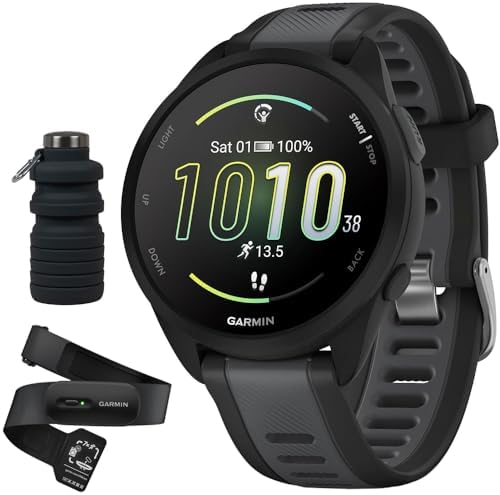
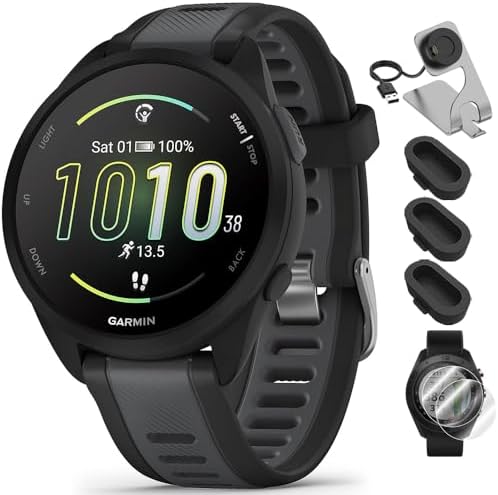
The display is the feature most runners notice first. An AMOLED panel produces saturated color and high contrast, which improves glanceability for pace, heart rate, and interval timers in bright outdoor light and makes the watch feel like a current-generation device on the wrist. That choice has a cost in power draw, and the published battery figures reflect a design that trades some endurance for screen quality. For a runner who checks notifications, reads workout summaries, and wants a watch that looks appropriate in a meeting, that trade is usually the right one, and the Garmin Forerunner 165 Running Colorful AMOLED Black combines that display with the training toolkit in a single wrist-ready device.
Training intelligence is the second pillar. Garmin states that the Forerunner 165 includes training metrics and recovery insights, and the Garmin Connect platform turns those raw measurements into a daily picture of readiness. Recovery time recommendations, training status labels, and workload comparisons are not novelties for a data-driven runner; they change what session gets run on a given morning. The same app ecosystem supports structured workouts and course downloads, so the watch becomes a node in a broader planning system rather than a standalone stopwatch.
Where the Coros Pace 4 Answers Back
Coros has built its reputation on a straightforward proposition: give runners the metrics that matter, strip the rest, and keep the watch light enough to forget about during hard efforts. The Coros Pace 4 follows that lineage and competes most directly on weight and value rather than on screen technology. A lighter case reduces wrist fatigue over long distances and changes how the watch behaves when arms swing at race pace, a detail that matters more to competitive runners than to recreational joggers.
Battery endurance is the second front. Where the Forerunner 165 publishes a smartwatch figure of up to 11 days and a GPS-only figure of up to 19 hours, the Pace 4 is engineered around extended multi-day use and long single-session efforts, with low-power profiles that let a runner stretch a charge across a training block. For athletes logging back-to-back long runs or spending weekends on trails without a charger, that endurance profile is a genuine scheduling advantage rather than a spec-sheet footnote.
The Coros companion app has also matured into a credible coaching environment, with training load and fatigue modeling that mirrors what Garmin Connect offers. The difference is presentation philosophy: Coros tends to surface fewer metrics with more emphasis on interpretation, while Garmin provides a wider dashboard that rewards users willing to dig through layers. Neither approach is objectively superior, and the right choice depends on whether a runner wants a coach-like summary or a full data console.
Display, Weight, and the Daily Wear Trade-Off
The AMOLED decision is not cosmetic. A brighter, higher-contrast panel is easier to read at a glance mid-interval, and it makes the watch a more pleasant object to interact with during the other twenty-three hours of the day. The trade is power consumption and, in some cases, a slightly larger physical footprint. Runners who prioritize legibility and device feel will gravitate toward the Garmin approach, and the Forerunner 165 series offers several finish options for buyers who want the same internals in a different look.
Weight cuts the other way. The Pace 4's lighter build is a deliberate racing decision, and it is most valuable to runners covering half marathons and above who notice every gram late in a race. That advantage is real but narrow: for a 5K or 10K runner, or for someone who mainly trains on a treadmill, the difference is unlikely to be perceptible. Weighing the two priorities honestly is the first step in deciding between these watches, and it usually resolves the question faster than any spec comparison.
Battery Behavior Across a Training Week
A practical way to evaluate the battery figures is to map them onto an actual schedule. A runner training five days a week with one long run of two to three hours will rarely push a 19-hour GPS rating to its limit, which means the Forerunner 165's constraint is really the smartwatch mode figure of up to 11 days, and battery saver extends that to up to 20 days when needed. Garmin's published numbers make this easy to plan around, and daily charging habits are rarely required.
The Pace 4's endurance story is aimed at the runner who deliberately minimizes charging interruptions, such as someone stacking long trail days or traveling without reliable power. The practical difference shows up in how often the watch leaves the wrist, and that is a lifestyle question as much as an engineering one. Runners who dislike routine charging will find the Coros approach more forgiving, while runners who already charge a phone every night will not notice the difference.
Ecosystem, Data, and Long-Term Satisfaction
Both watches record GPS tracks with typical accuracy that manufacturers describe as being within a few meters under normal conditions, and both support multi-constellation satellite modes for improved positioning in challenging environments. The meaningful difference lies downstream of the raw track: what the platform does with it. Garmin Connect aggregates training history across years, integrates with a wide range of third-party services, and supports structured workout delivery, which is why long-term Garmin users tend to stay within the ecosystem once their history accumulates.
The Coros app is more focused and increasingly capable, with coaching tools that appeal to runners who want guidance rather than raw spreadsheets. Athletes who follow a coach or a structured plan often find the Coros presentation easier to act on, while self-coached runners who like to build their own analysis tend to prefer Garmin's depth. The right question is not which app has more features but which one a runner will actually open after a hard session, because a platform that goes unused delivers no value regardless of its capability.
Music support is a smaller but decisive factor for some buyers. The Forerunner 165 offers a music-capable variant, which allows phone-free runs with Bluetooth headphones, while the Pace 4 does not treat music storage as a core design priority. For runners who train without a phone and rely on audio, that single feature can settle the decision, and the Garmin brand's lineup spans a wide enough range of configurations that the right balance of screen, storage, and battery is usually available within the same family.
Who Should Buy Which Watch
The Forerunner 165 is the better fit for runners who want one device to cover training, recovery guidance, notifications, and everyday wear, and who value a vivid AMOLED display enough to accept a smartwatch battery rating in the region of 11 days. It also suits buyers who want music on the wrist and who expect to stay within the Garmin Connect ecosystem for years, since training history becomes more useful the longer it accumulates. Recreational runners training for a first half marathon, and commuters who want a running watch that looks at home at a desk, fall squarely into this group.
The Coros Pace 4 is the better fit for competitive runners who prioritize low weight, extended battery endurance, and a lean coaching interface, and who are comfortable treating the watch as race equipment rather than a lifestyle device. Trail runners stacking long days, and athletes who already follow a structured plan through the Coros app, will extract more value from it. Buyers on a tighter budget who want the essentials done well will also find the value proposition more compelling than a feature-dense alternative.
Neither watch is a compromise for the runner it was designed for. The Forerunner 165 is the more complete everyday device, and the Pace 4 is the more disciplined training instrument, and the purchase decision comes down to which of those two descriptions matches how the watch will actually be used.
 Just Pick Your Favorite Stylish Watch online























Item Reviews