The Garmin Forerunner 165 series and the Coros Pace 3 collection both target runners who want accurate GPS tracking, structured workouts, and week-long battery life without paying flagship prices. One leans on a bright AMOLED panel and a deep training ecosystem, while the other pursues low weight and long GPS endurance. This guide sets the two head to head on the specifications that actually change a buying decision, so the trade-offs are clear before any money is spent.
| Feature & Selling Point |
Garmin Forerunner 165 |
Coros Pace 3 |
| Display |
1.2-inch AMOLED, full color |
1.2-inch memory-in-pixel, always-on |
| Weight |
39 g |
About 30 g |
| Smartwatch Battery |
Up to 11 days |
Up to 15 days |
| All-Systems GPS Battery |
Up to 17 hours |
Up to 15 hours |
| Satellite Systems |
GPS, GLONASS, Galileo |
GPS, GLONASS, Galileo, BeiDou, QZSS |
| Route Navigation |
Breadcrumb course following |
Turn-by-turn with offline maps |
| Training Load Analysis |
Built-in, no subscription |
EvoLab, no subscription |
| Running Dynamics |
On-watch basics, sensor for full set |
Full set from wrist sensor |
| Music Storage |
Yes, offline playlists |
MP3 playback, limited storage |
| Contactless Payments |
Garmin Pay supported |
Not available |
| Water Rating |
5 ATM |
5 ATM |
| Case Size |
43 mm |
41.9 mm |
| Third-Party App Ecosystem |
Connect IQ store |
Minimal, first-party focused |
| Best Suited To |
All-round training plus daily smart features |
Pure running focus and race-day weight |
The single most consequential split in that table sits in the first row: a bright AMOLED screen against an always-on memory-in-pixel panel. Everything downstream, from battery figures to daily usability, flows from that display choice, and it is the fastest way to know which side of this comparison fits a given runner.
Display Philosophy and Daily Readability
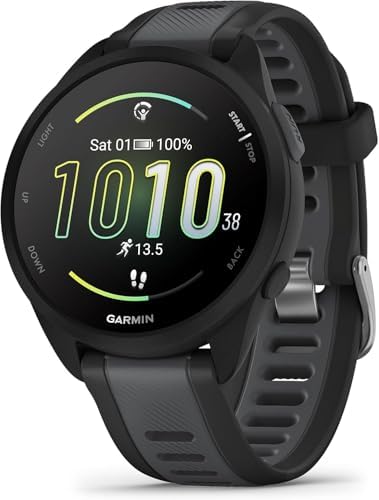
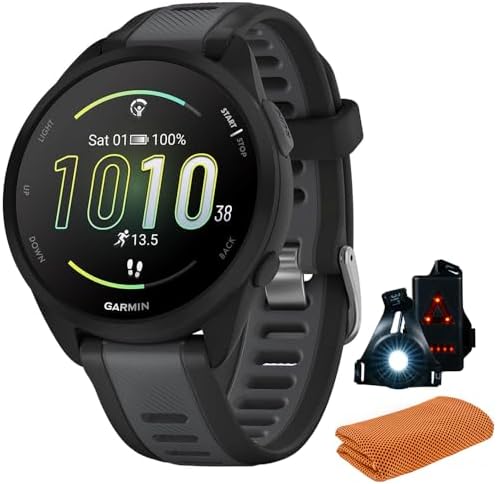
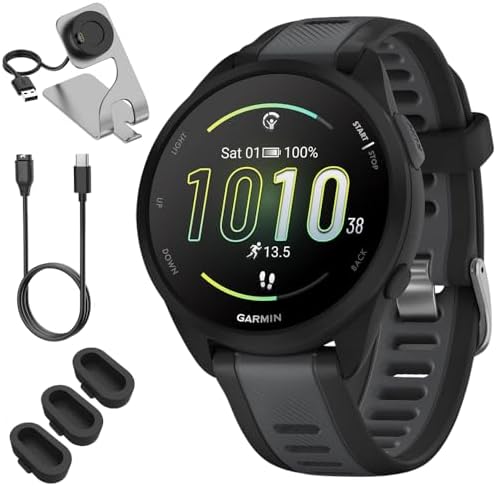
Running watches live or die by how quickly a glance delivers pace, heart rate, and elapsed time. The Garmin Forerunner 165 Running Colorful AMOLED Black delivers that with a 1.2-inch AMOLED panel that produces saturated colors, deep blacks, and high brightness for outdoor visibility. Race pace, heart-rate zones, and training status render with the clarity of a modern smartphone screen, which matters during interval sessions when a glance has to deliver information instantly.
The Coros Pace 3 takes a different route with a memory-in-pixel display that stays permanently visible without waking the screen. That approach favors runners who dislike wrist gestures mid-stride and who value battery economy above color fidelity. Neither approach is inherently superior; the choice depends on whether a runner prioritizes vivid data presentation or an always-readable, low-power panel.
Battery Endurance Across Training Modes
In everyday smartwatch use, Garmin lists the Forerunner 165 at up to 11 days, extending to 20 days in Battery Saver mode. In all-systems GNSS mode, the watch is rated for up to 17 hours of continuous tracking, with a longer GPS-only figure. Those numbers comfortably cover marathon training weeks and most ultra distances at moderate intensity.
The Coros Pace 3 counters with roughly 15 days in smartwatch mode and about 15 hours with full multi-constellation GPS active. On paper the smartwatch gap favors Coros while the all-systems GPS gap tilts toward Garmin, which is why battery claims should always be compared mode by mode rather than as a single headline number.
Navigation and Satellite Support
Satellite coverage differs meaningfully. The Forerunner 165 locks onto GPS, GLONASS, and Galileo, which is sufficient for road running and open trail routes in most regions. Course following is breadcrumb-based, guiding a runner along a preloaded line without a full street map beneath it.
The Pace 3 adds BeiDou and QZSS to the constellation list and supports turn-by-turn navigation with offline maps loaded to the watch. For runners who explore unfamiliar trail networks or race on unmarked courses, on-watch mapping reduces the need to check a phone. The Forerunner 165 handles the same scenarios but asks the runner to trust the line rather than read the terrain.
Training Metrics and the Ecosystem Behind Them
Garmin's training framework on the Forerunner 165 includes training status, training load, recovery time, VO2 max, and race predictions, all computed on the watch and inside the Garmin Connect app. The Garmin brand's platform also extends to Connect IQ, where third-party watch faces, data fields, and small apps can be installed. For runners who enjoy customizing screens and pulling data into a wider health picture, that platform depth is a genuine differentiator.
Coros answers with EvoLab, a training analysis engine that tracks fatigue, load impact, and race predictor values without a subscription. Both brands include their analysis tools at no recurring cost, which separates them from platforms that gate deeper metrics behind monthly fees. The practical difference is ecosystem breadth versus a tightly focused running dashboard.
Running Dynamics and Form Analysis
On-watch running dynamics are a Coros strength. The Pace 3 derives cadence, stride length, ground contact time, and vertical oscillation from its wrist sensors alone, giving form-conscious runners feedback without extra hardware. The Forerunner 165 covers core metrics such as cadence and pace but reserves the full dynamics set for paired sensors like a chest strap or running pod.
For runners working on efficiency, that distinction can decide the purchase. A runner who wants form data out of the box will find the Pace 3 more self-contained, while a runner already invested in Garmin sensors will lose nothing on the Forerunner 165.
Smart Features, Weight, and Everyday Wear
Away from the track, the two watches diverge further. The Forerunner 165 supports music storage with offline playlists, Garmin Pay contactless payments, and smartphone notifications, making it a credible daily wearer that happens to be a running tool. At 43 mm and 39 g, it sits comfortably on most wrists without bulk.
The Pace 3 weighs roughly 30 g and measures 41.9 mm across, making it one of the lightest GPS watches in its class. That low mass disappears on the wrist during long efforts, and the smaller case suits narrower wrists. The trade-off is a leaner smart feature set: music playback is limited to local MP3 files, and there is no contactless payment system. A runner who wants a watch that doubles as a wallet and music player will lean Garmin; a runner chasing grams will lean Coros.
Who Should Buy Which Watch
The decision comes down to training style and daily habits rather than raw specifications. Runners who want a vivid AMOLED display, on-watch music, contactless payments, third-party app support, and a training platform that connects to a broad health ecosystem will find the Forerunner 165 lineup a natural fit. It is the better pick for anyone who treats a running watch as an everyday smartwatch that also tracks serious sessions.
The Coros Pace 3 fits runners who prioritize race-day lightness, always-on display readability, built-in mapping with turn-by-turn guidance, and wrist-based running dynamics. It rewards athletes who want the lightest possible tool on their arm and are content to leave payments and app stores behind. Both watches cover 5 ATM water resistance, so pool sessions and rainy long runs are handled equally.
Training volume, navigation needs, and daily smart features are the three criteria that settle this comparison. A runner who checks all three against personal habits will land on the right watch without second-guessing the spec sheet.
 Just Pick Your Favorite Stylish Watch online















Item Reviews