The Bulova Lunar Pilot descends from a privately owned chronograph worn during the Apollo 15 mission, and that origin story separates it from nearly every affordable chronograph on the market. The production series translates that flight-worn prototype into a wearable reference without pretending to be a replica. The Bulova brand's archive positions the line as a bridge between mid-century space instrumentation and modern quartz craftsmanship, a connection that remains tangible on the wrist rather than confined to a press release.
The 262 kHz Movement Behind the Lunar Pilot
At the core of most Lunar Pilot references sits the NP20 movement, a high-precision quartz caliber Bulova describes as running at a frequency of 262 kHz. That figure matters because standard quartz crystals typically oscillate at 32,768 Hz, so the Lunar Pilot's resonator vibrates roughly eight times faster. The practical result is a sweeping seconds hand that glides rather than ticks, and a rate of timekeeping that Bulova markets with a stated accuracy of just a few seconds per month.
This movement technology is not a marketing flourish layered onto a retro design; it is the defining character of the line. The chronograph hand sweeps smoothly enough to read fractional seconds during timing exercises, and the pushers engage with a crispness that reflects the caliber's three-pronged crystal construction. For buyers who appreciate mechanical watches but prefer the low-maintenance reliability of quartz, the Lunar Pilot offers a rare middle ground.
Case Dimensions and Wearing Experience
Case sizing varies across the Lunar Pilot family, and this matters considerably for fit. Bulova's official specifications list the Black Hole edition at 41.2mm across with a 20mm lug width, while the silver-tone 98K112 reference measures 43.5mm with the same 20mm lug spacing. The range gives buyers a genuine choice between a more restrained presence and a broader, more vintage-proportioned silhouette. In both cases, the lug width keeps strap and bracelet options plentiful.
On the wrist, the Lunar Pilot reads as a tool watch first and a dress piece second. The case carries the angular lines and stepped bezel geometry associated with 1960s chronograph design, and the sapphire crystal with anti-reflective coating keeps the dial legible under harsh light. Water resistance is rated at WR100/10Bar/333ft on the Black Hole reference, which Bulova specifies as suitable for swimming, showering and snorkeling, while the 98K112 reference carries a WR50/5Bar/166ft rating intended for still-water swimming. Buyers should check the specific reference rather than assume a single rating applies across the line.
- Black Hole 98A335: 41.2mm case, black stainless steel, WR100 rating
- 98K112: 43.5mm case, silver-tone stainless steel, WR50 rating
- Shared: 20mm lug width, anti-reflective sapphire crystal
Dial Design and the Black Hole Effect
Dial aesthetics divide the Lunar Pilot references into distinct personalities. The Black Hole edition employs a special dial material Bulova describes as having 99.4\% light-absorbing capability, producing a near-total blackness that swallows reflections and pushes the white indices and hands forward. It is an unusual technical choice for a sub-thousand-dollar chronograph, and it gives that reference a visual identity separate from the rest of the range.
The silver-tone dial alternative takes the opposite route, leaning into legibility and classical contrast. Both approaches preserve the essential Lunar Pilot layout: a bi-compax arrangement with running seconds and a 30-minute chronograph totalizer, a tachymeter scale for speed calculations, and a date window positioned for everyday usefulness. The design language stays consistent with the historic antecedent while allowing collectors to choose between stealth and tradition.
Heritage Context and Market Positioning
Bulova's archive series frames the Lunar Pilot within its broader catalog of historically rooted references, and that framing is accurate rather than convenient. The original chronograph worn on the lunar surface was a prototype never intended for commercial release, which makes the production Lunar Pilot a faithful reinterpretation rather than a replica. That distinction matters to collectors who value authenticity claims and prefer documented provenance over loose marketing language.
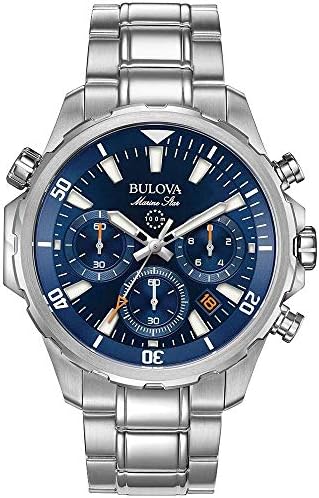
Within Bulova's lineup, the Lunar Pilot sits above entry-level quartz chronographs and below the brand's more ornate dress pieces. Its closest internal relatives occupy different territory entirely. The Bulova Men's Marine Star Series B Blue offers a sportier six-hand layout and a blue dial, while the Bulova Men's Snorkel - America's 250th White Blue Red 41mm Edition features a hybrid-ceramic case and rubber strap. Neither shares the Lunar Pilot's movement or its spaceflight narrative.
Competing Alternatives and Buying Criteria
Prospective buyers weighing the Lunar Pilot against other chronographs must confront a specific question: how much does movement character matter relative to case finishing and brand prestige? A conventional Swiss quartz chronograph at a similar price will typically offer a standard 32 kHz movement, a generic case, and limited historical grounding. Mechanical chronographs in the same bracket usually sacrifice accuracy and add servicing costs. The Lunar Pilot's 262 kHz caliber occupies a distinct position between these poles.
The practical trade-offs are worth stating plainly. The higher-frequency movement consumes battery faster than a standard quartz caliber, so owners should expect more frequent cell replacement. The case dimensions on the larger references suit wrists of roughly 7 inches and above, while the 41.2mm Black Hole version accommodates smaller wrists more gracefully. Chronograph pushers on quartz movements can feel less tactile than their mechanical counterparts, though the Lunar Pilot's engagement is precise enough for regular timing use.
A buyer deciding between references should rank priorities in this order: case size first, dial treatment second, water resistance third, and bracelet or strap configuration last. The Lunar Pilot Chronograph 96B258 is the classic configuration for those who want the historical aesthetic without the extreme dial treatment of the Black Hole edition.
Who Should Consider the Lunar Pilot
The Lunar Pilot rewards a specific kind of owner: someone who values technical curiosity over brand hierarchy, appreciates a documented historical connection, and wants chronograph functionality without the upkeep of a mechanical movement. It suits aviation enthusiasts, engineering-minded collectors, and anyone drawn to the story of a privately owned watch that accompanied a lunar mission.
It is less suited to buyers seeking slim dress proportions, automatic winding, or a bracelet-first luxury feel. Those priorities point toward different segments of the market entirely. The Lunar Pilot is a purposeful instrument with a narrative attached, and it performs best when judged on those terms rather than against categories it never intended to compete in.
The series endures because it makes an unusual argument credible: that high-frequency quartz, honest dimensions, and genuine provenance can carry a watch further than ornamentation. Each reference in the lineup extends that argument with its own variation on case size and dial finish, letting the collection serve both first-time buyers and long-term collectors without diluting what makes the line distinctive.
 Just Pick Your Favorite Stylish Watch online























Item Reviews