The Citizen Eco-Drive Blue Angels family draws its identity from a simple engineering premise: a watch should never need a battery change. Citizen's Eco-Drive system converts both natural and artificial light into energy, storing it in a rechargeable cell that powers the movement. In the Blue Angels line, that technology meets a design language inspired by the United States Navy flight demonstration squadron, whose blue and yellow livery appears throughout the collection.
The lineup spans several silhouettes, and the differences between them matter more than the shared badge. Case sizes move from roughly 43 mm on the World Chronograph A-T to 45 mm on the Promaster Skyhawk A-T, with the broader collection covering everything from compact three-hand models to oversized pilot chronographs. Ownership decisions therefore start with wrist presence and strap preference, not with the logo on the dial.
How Eco-Drive Changes the Ownership Experience
Eco-Drive is best understood as a light-harvesting quartz system rather than a conventional battery watch. A solar cell beneath the dial captures ambient light, a rechargeable cell stores the energy, and the movement draws from that reserve. Citizen states that the system is designed to convert both natural and artificial light into usable power, which means desk lighting and shop windows contribute as readily as direct sun.
The practical result is a watch that stays ready without a servicing ritual around battery swaps. For anyone who has opened a drawer to find a dead quartz watch, the appeal is obvious. The trade-off is that light exposure sustains the system; a watch stored in a dark box for extended periods should be brought into daylight periodically to keep the cell conditioned.
Atomic Timekeeping and Radio Control
The World Chronograph A-T reference AT8020-03L demonstrates how far the line pushes utility. According to Citizen, the movement synchronizes atomic time across 26 world cities with radio-controlled accuracy in 5 zones. It adds a 1/20-second chronograph measuring up to 60 minutes, a perpetual calendar, 12/24-hour format switching, and a power reserve indicator.
This is the specification set that separates the Blue Angels line from decorative aviation watches. Radio control removes the need to reset the time after travel or daylight-saving changes, while the perpetual calendar eliminates the recurring date correction that monthly calendars demand. The chronograph counter resolves small intervals well below one second, which suits timing leg intervals rather than merely adding visual complexity to the dial.
Case, Crystal, and Build Across the Range
Citizen's official Blue Angels listings describe water resistance of 200 metres, 20 bar, or 660 feet across the range, together with anti-reflective sapphire crystal on the specified references. Case sizes are catalogued from approximately 37 mm to 42.5 mm in the large bracket, with extra-large models exceeding 43 mm.
Those numbers matter in daily wear. A sapphire crystal with an anti-reflective coating keeps the dial legible in bright cockpit or coastal light, and 200-metre water resistance allows swimming and water sports without a second thought. The size spread is equally consequential: a 45 mm pilot case reads very differently on a six-inch wrist than a 38 mm three-hand model, so trying on before buying remains the single most useful physical check.
Aviation Design Language and Its Origins
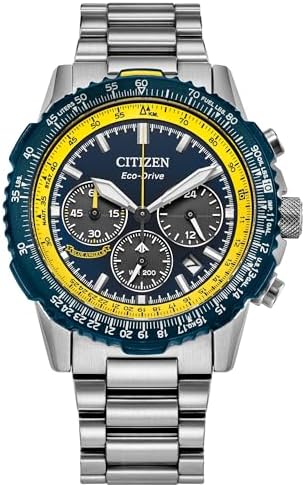
The Blue Angels association is visible in materials as much as in color. The Skyhawk A-T reference JY8078-52L pairs a 45 mm stainless steel case with a blue ion-plated bezel, a pilot's rotating slide rule bezel, a screw-down Promaster crown, and the official Blue Angels insignia on the caseback. Function drives form here: slide rule bezels descend directly from flight-computer navigation, where calculations of fuel burn, ground speed, and time aloft were performed before digital avionics existed.
Dial design follows pilot convention. High-contrast hands, large numerals, and luminous markers support reading at a glance in poor light. The yellow accents echo the squadron's livery without overwhelming legibility, and the blue dial of the AT8020-03L extends that palette into a two-tone case and polyurethane-coated leather strap arrangement. The result is a blend of showcase and tool watch rather than a dress piece with aviation graphics.
Placement within the Citizen catalog helps clarify intent. The Citizen brand has long built its identity around light-powered movement, and the Blue Angels references sit at the crossroads of that technology and the Promaster professional series. Buyers who want the aviation aesthetic in a simpler package can look at models such as the Citizen Men's Eco-Drive Sport Casual Brycen, which keeps the chronograph format without the slide rule bezel. Those who prefer a cleaner steel bracelet option may find the Citizen Men's Eco-Drive Stainless Steel Watch to office wear. The aviation-focused choice in this grouping, though, is the Citizen Men's Eco-Drive Blue Angels Promaster, whose 12/24-hour display and 60-minute chronograph are configured for the cockpit and for everyday timekeeping alike.
Who Should Consider the Blue Angels Line
Three buyer profiles fit this collection. The first is the pilot or aviation professional who wants radio-controlled accuracy, a slide rule bezel, and redundant timekeeping formats in one wearable. The second is the frequent traveler who values perpetual calendar and atomic sync as genuine conveniences rather than gimmicks. The third is the design-conscious collector drawn to instrument-style dials and blue-and-yellow accents that hold visual interest without flamboyance.
Those who rarely expose a watch to light, or who prefer automatic movements for their mechanical purity, should look elsewhere. Eco-Drive is engineered around light availability, and a mechanical calibre offers a different relationship to ownership entirely. Setting realistic expectations about how a watch will be worn and stored matters more than the label on the dial.
Key Selling Points at a Glance
- Energy source: Light, both natural and artificial, stored in a rechargeable cell
- Accuracy: Radio-controlled timekeeping in 5 zones, atomic sync across 26 world cities on designated references
- Chronograph: 1/20-second precision measuring up to 60 minutes on the World Chronograph A-T
- Water resistance: 200 metres across officially listed Blue Angels references
- Crystal: Anti-reflective sapphire on catalogued models
- Case sizes: Approximately 37 mm to over 43 mm depending on reference
- Design cues: Slide rule bezel, Promaster crown, blue ion-plated bezel, squadron insignia on the caseback
Practical Ownership Notes
Long-term ownership of an Eco-Drive watch depends on sensible light habits rather than service intervals. Wearers who take the watch outdoors regularly, even briefly, keep the cell topped up. The power reserve indicator on the AT8020-03L is a useful diagnostic: it shows whether the system is holding charge before performance degrades. Strap choice also shapes the experience, since polyurethane-coated leather suits humid environments poorly compared with steel bracelets or resin straps.
Radio-controlled synchronization can be affected by location. Reception is strongest in open areas away from dense structures and electronic interference, so users in enclosed urban environments may rely more heavily on manual setting. This is a limitation of radio timekeeping generally, not a defect specific to the Blue Angels line, and it does not affect the movement's core timekeeping stability.
The Blue Angels collection represents a specific philosophy: instruments should be self-sufficient. A watch that draws its energy from the room it sits in, corrects itself against atomic signals, and carries the design vocabulary of naval aviation speaks to a public that values capability over decoration. For the right wearer, that combination is compelling for years rather than seasons.
 Just Pick Your Favorite Stylish Watch online












Item Reviews