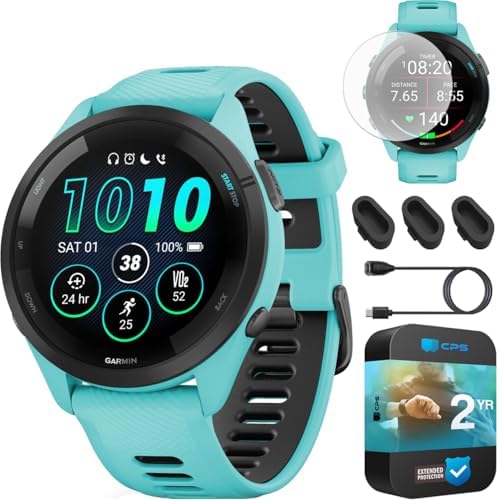
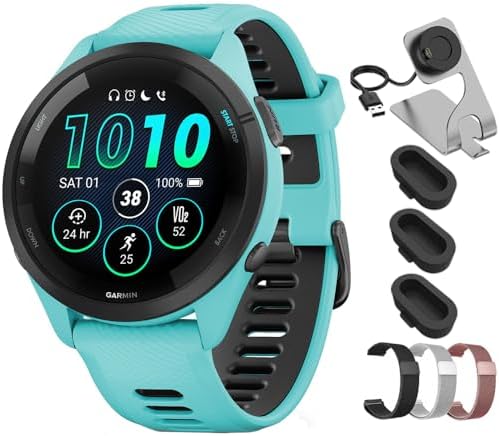
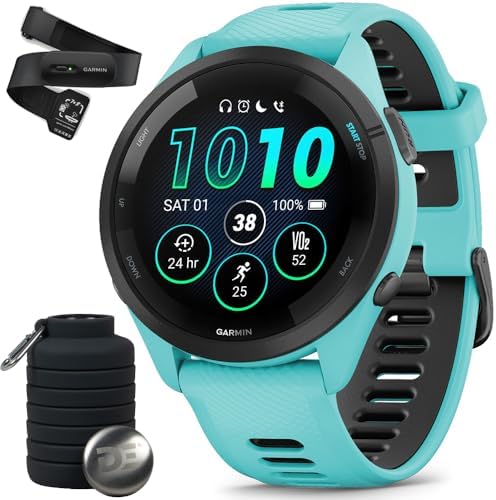
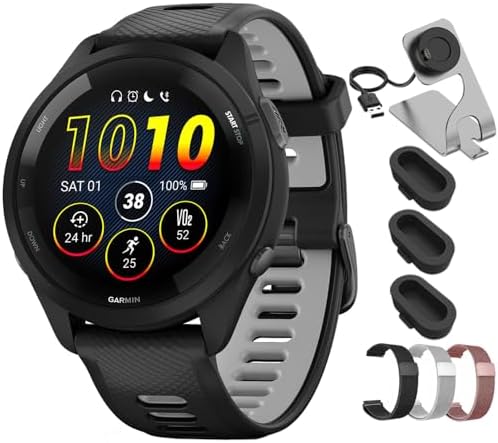
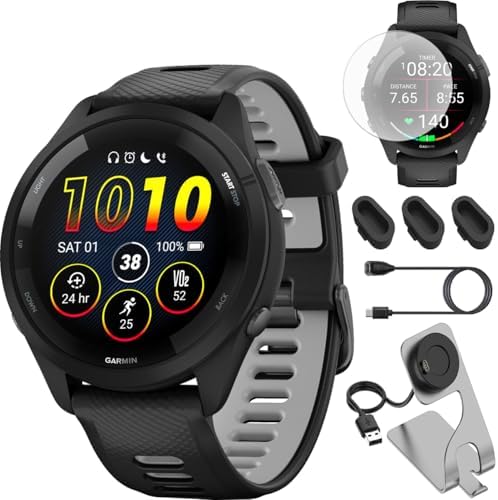
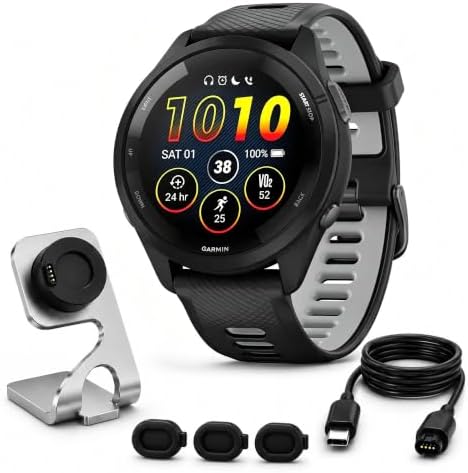
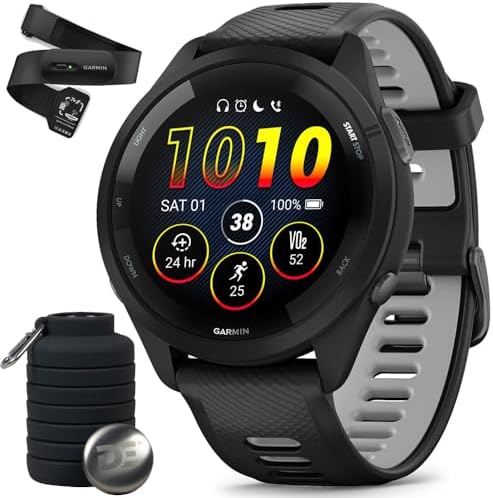
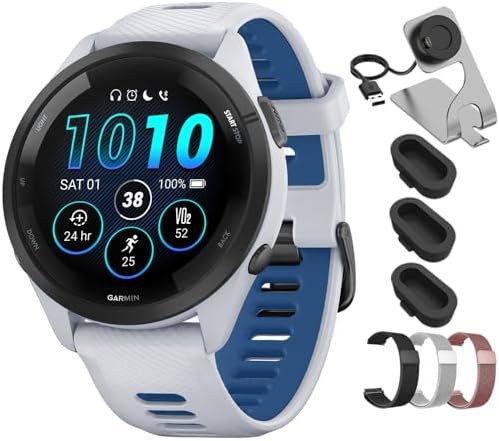
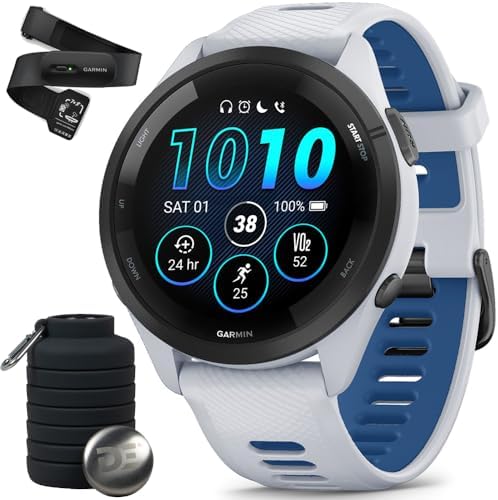
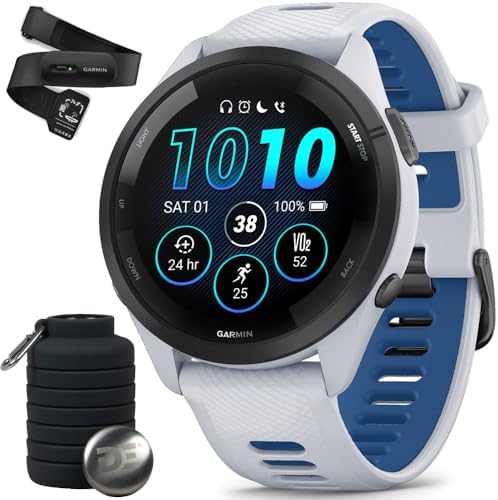
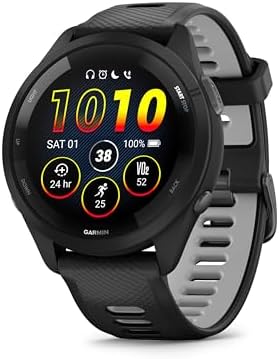
The Garmin Forerunner 265 and the Forerunner 165 both bring vibrant AMOLED displays and comprehensive training feedback to the wrist, yet they occupy distinct tiers of capability and price. The decision between them hinges on how deeply a runner wants to analyze their performance. The Forerunner 265 delivers multi-band GNSS positioning, a Training Readiness score, and roughly double the battery life of the Forerunner 165, while the Forerunner 165 retains the core essentials at a more accessible price point. This guide breaks down exactly where the two diverge, so the choice becomes a matter of matching features to actual training habits rather than speculation.
| Purchase-Decision Factor | Garmin Forerunner 265 | Garmin Forerunner 165 |
|---|---|---|
| Price Positioning | Mid-tier premium (roughly $150–$200 more) | Entry-tier AMOLED value |
| GPS Accuracy Technology | Multi-band GNSS (dual-frequency lock) | All-systems GNSS (single-band) |
| Longest GPS Runtime | Up to 26 hours | Up to 19 hours |
| Smartwatch Runtime | Up to 14 days (5 days always-on) | Up to 11 days |
| Recovery Guidance | Training Readiness + HRV Status | Training Status only |
| Running Dynamics | Built-in (no pod required) | Via accessory only (extra cost) |
| Elevation Accuracy | Barometric altimeter | GPS-derived elevation only |
| Phone-Free Music | Up to 500 songs | None |
| Display Size | 1.3-inch (46mm) / 1.1-inch (265S) | 1.2-inch AMOLED |
| Weight on Wrist | 47 g (46mm) / 39 g (265S) | 39 g |
| Water Resistance | 5 ATM | 5 ATM |
| Best Training Scenario | Racing, ultra/trail, structured plans | Daily 5K–10K road running |
| Value Verdict | Worth it if you use the data | Best price-to-essentials ratio |
The table highlights the most significant gaps: the Forerunner 265’s multi-band GNSS accuracy, greater battery endurance, and Training Readiness score serve runners tracking performance meticulously, while the Forerunner 165 strips those features down to a lighter price and a simpler daily-training package. The most consequential difference for many runners is the Forerunner 265’s 26 hours of GPS battery life versus 19 hours on the Forerunner 165, followed by multi-band positioning that holds a signal in dense urban spaces and tree cover. The Forerunner 165 counters with a lower weight and straightforward simplicity that suits runners who never need the extra metrics.
Why AMOLED Displays Change the Daily Experience
Both watches share Garmin’s shift toward AMOLED panels, a change that alters how runners interact with their data on every run. The Forerunner 265 fits the larger screen (1.3 inches on the 46mm variant), while the Forerunner 165 uses a 1.2-inch AMOLED panel. For bright daylight runs, the AMOLED output remains visible even when sunlight is direct, and the raised color contrast makes pace, heart rate, and maps immediately legible at a glance rather than requiring a squint mid-stride.
Battery cost is the trade-off. Always-on display mode reduces battery longevity, which is why Garmin lists both watches with an always-on qualification in the smartwatch mode figure. The Forerunner 265’s 14-day battery in smartwatch mode, or five days with the always-on display enabled, provides a cushion most runners can work with. The Garmin Forerunner 165 Running Colorful AMOLED Black is more than adequate for weekly charging routines but less generous during travel or extended training blocks.
Training Metrics and the Readiness Score
Garmin differentiates the two watches most sharply in analytical depth. The Forerunner 265 carries Training Readiness, a morning score that weighs sleep quality, recovery time, HRV status, and recent training load into a single number, telling you whether to push or back off. It gives the watch a coach-like quality that many runners find invaluable before hard sessions. The Forerunner 265 lineup also includes Training Status, which interprets fitness trends over weeks, plus HRV Status, which reads overnight heart-rate variability to flag stress or recovery lags.
The Forerunner 165 includes Training Status and most core running metrics but omits Training Readiness and HRV Status. Training effect, training load, and VO2 max estimates remain available on both watches. The distinction is that the 265 offers guidance while the 165 offers data. Neither approach is wrong. Runners who interpret their own data and prefer to make training decisions manually find the Forerunner 165 perfectly serviceable. Runners who want a daily readiness signal and structured recovery feedback gravitate toward the 265.
GPS and Satellite Accuracy in Real Conditions
The Forerunner 265’s most significant technical advantage is its multi-band GNSS receiver, which references more radio frequency bands simultaneously to reduce positioning errors. The practical effect appears during city runs between tall buildings, trail runs under heavy tree canopy, and any route where satellite signals are occluded. Multi-band tracking stays locked more consistently, producing smoother GPS traces and more accurate pace and distance figures on upload.
The Forerunner 165 uses all-systems GNSS, which references multiple satellite constellations (GPS, GLONASS, Galileo) but not multi-band frequencies. Its accuracy is solid in open terrain, which covers the vast majority of road running. Trail runners and urban runners in dense environments may notice trace irregularity on the Forerunner 165, whereas the Garmin Forerunner 265 Running Colorful AMOLED Black maintains a cleaner lock. The barometric altimeter, which the 265 includes but the 165 does not, further improves elevation gain accuracy on hills and undulating routes.
- Multi-band advantage: Reduced signal drift in cities and forests
- Barometric altimeter: Precise elevation tracking on hilly routes
- All-systems GNSS on 165: Accurate for flat road running and open courses
Training Features and Daily Use
Runners considering the Forerunner 165 lineup get structured workouts, daily suggested workouts, and pace and heart-rate based targets. The watch supports Garmin Coach adaptive training plans and race predictions, and it handles interval training and lap functions without complaint. The Forerunner 265 adds more complete training suggestions and integrates metrics more coherently, particularly once Training Readiness begins feeding into the daily recommended workout.
Built-in running dynamics distinguish the 265. Ground contact time, vertical oscillation, and stride length are calculated from wrist-based sensors without an accessory. The Forerunner 165 only produces those metrics when paired with a Garmin Running Dynamics Pod or compatible HRM-Pro chest strap, an extra purchase that partially narrows the price gap. On-desk features also matter for daily use: the Forerunner 265 stores up to 500 songs and pairs with Bluetooth headphones for phone-free runs, while the Forerunner 165 carries no music storage.
Choosing on Price versus Capability
Garmin positions the two watches at clear price tiers, with the Forerunner 165 occupying the entry point of the AMOLED running line and the 265 above it. Weighing the decision beyond price means asking which capabilities will actually be used. A casual runner tracking 5K and 10K routes will not use multi-band GPS mode most weeks, and may not interpret HRV or Training Readiness at all. Paying for the 265 for those runners amounts to storing capacity that stays dormant. For runners logging more than 50 kilometers weekly, racing, or following structured plans that adjust based on recovery, the additional data layer earns its price through concrete training insight rather than novelty.
Battery Life During Training Blocks and Travel
The Forerunner 265’s 26-hour GPS runtime in standard GNSS mode extends significantly farther than the Forerunner 165’s 19 hours, which is meaningful for ultramarathon training, long trail outings, or any scenario where recharging before the next long run is not guaranteed. Smartwatch battery life reflects the 265’s larger buffer at 14 days against the 165’s 11. During a heavy training block with daily GPS sessions, the difference compresses but remains real. Users who want to travel for a long weekend and leave the charger at home still benefit from the 265’s reserve. Both watches rely on a proprietary charging cable, and both charge quickly from empty to full within roughly two hours.
Who Each Watch Is Built For
Beginner and recreational runners who prioritize a clear, bright display, reliable distance tracking, and basic training feedback should find the Garmin Forerunner 165 delivers everything a first serious running watch needs without adding complexity. Its 39-gram weight keeps it discreet on the wrist.
For those stepping into the Garmin brand’s more analytical performance family, the Forerunner 265 justifies its price for multi-band GPS accuracy, Training Readiness, HRV Status, weighted altitude readings through a barometric altimeter, built-in running dynamics, and the music storage needed during phone-free runs. Runners training for specific goals, racing regularly, or managing recovery deliberately will extract genuine value from those tools. The choice is ultimately between immediate capability and long-term training insight, and the best fit is simply the watch that matches the way the runner actually trains.