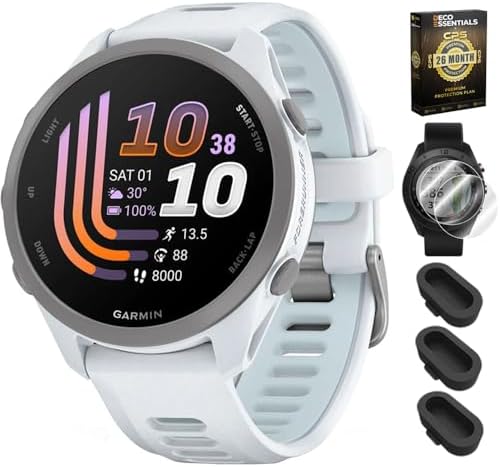
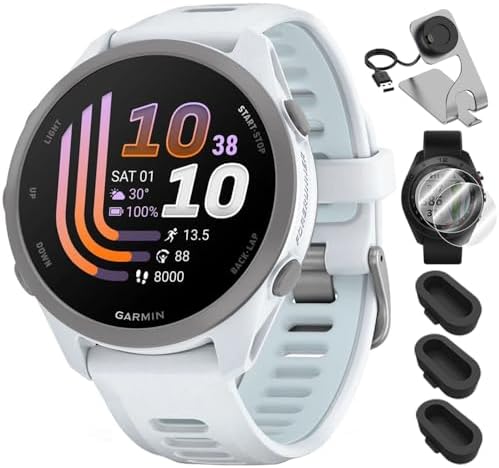
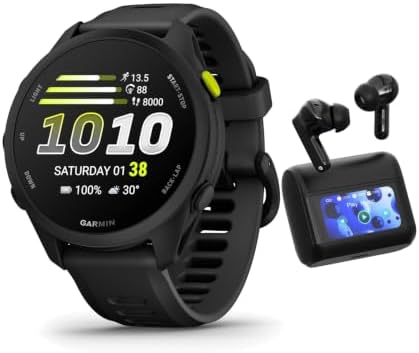
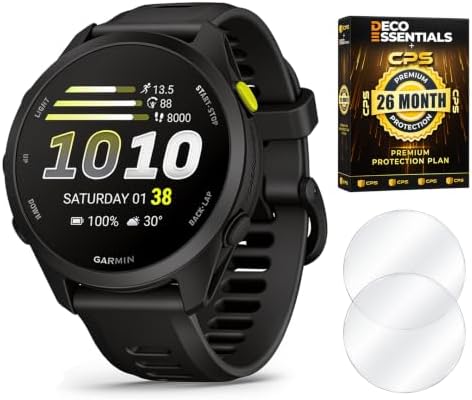
The Garmin Forerunner 265 and the Forerunner 165 both bring vivid AMOLED displays and a training-first philosophy to the wrist, yet they diverge sharply on satellite accuracy, onboard music, and price positioning. This comparison serves as a practical buying reference for runners weighing a mid-tier workhorse against an entry-level specialist, so keep it bookmarked before committing to either model.
| Feature & Selling Point | Forerunner 265 | Forerunner 165 |
|---|---|---|
| Display | AMOLED, 1.3 in | AMOLED, 1.2 in |
| Smartwatch Battery | Up to 13 days | Up to 11 days |
| GPS-Only Battery | Up to 20 hours | Up to 19 hours |
| All-Systems GNSS | Up to 14 hours | Up to 17 hours |
| Training Readiness | Yes | Yes |
| Multi-Band GPS | Yes | No |
| Built-in Music | Yes (Music edition) | No |
| Touchscreen | Yes | Yes |
| Daily Suggested Workouts | Yes | Yes |
| Running Dynamics | Yes (built-in) | Yes (built-in) |
| Water Rating | 5 ATM | 5 ATM |
| Weight | 47 g | 39 g |
| Case Size | 46 mm | 43 mm |
| Best Suited For | Music, dual-band accuracy | All-day wear, value seekers |
| Positioning | Mid-level running watch | Entry-level running watch |
| Key Selling Point | Multi-band GPS + Music | Lightweight, lower price |
The table makes the core trade-off visible: the Forerunner 265 awards multi-band GPS and offline music, while the 165 counters with a lighter 39-gram body and a friendlier price. Battery figures published by Garmin show the 265 lasting up to 13 days in smartwatch mode compared to 11 days on the 165, though both settle into similar GPS-only endurance near 19 to 20 hours.
Garmin’s Positioning of Two AMOLED Runners
Garmin’s own running watch comparison page classifies the Forerunner 165 series as an entry-level running GPS smartwatch and the Forerunner 265 series as a mid-level running GPS smartwatch. That single sentence defines the entire comparison: both inherited the AMOLED screen technology and the training metrics ecosystem, but they sit at different rungs of the same ladder.
The design language shared across the Garmin brand’s running portfolio stays consistent, with polymer cases, silicone straps, and five-button controls supported by a touchscreen layer. What separates these two models is not appearance but what sits beneath the glass, where the 265 carries sensor hardware and storage that the 165 omits.
Display and Wearability: Size Against Lightness
The 1.3-inch AMOLED panel on the 265 spreads data fields comfortably, a benefit for runners watching pace, heart rate, and distance simultaneously. The 1.2-inch display on the 165 renders the same layout at a slightly denser packing, and in practice most runners adapt to either within a session or two.
Weight proves more decisive. At roughly 39 grams, the 165 sits closer to Garmin’s own event-focused track watches, while the 47-gram 265 carries the presence of a full training daily driver. Sleepers who wear a watch overnight often notice the handful of extra grams, and the 165’s 43 mm case suits narrower wrists more naturally than the 46 mm shell of the 265.
Both devices share a 5 ATM water rating, covering rain, sweat, and pool laps, so swimmers lose nothing by choosing the lighter option. For those who want the AMOLED experience without the larger footprint, the Forerunner 165 directly addresses that preference.
Training Metrics: The Shared Core
Here the two watches converge more than the spec sheet implies. Both track training readiness, which synthesizes sleep, recovery time, HRV status, and acute load into a single daily score. Both generate daily suggested workouts that adjust to the runner’s current condition, and both record running dynamics such as cadence, ground contact time, and vertical oscillation without an external pod.
- Training readiness: available on both models
- Daily suggested workouts: available on both models
- Built-in running dynamics: available on both models
- Recovery insights: available on both models
- Training status: available on both models
A common misconception, discussed at length in public forums, holds that the entry-level 165 lacks training readiness, when in fact it inherits the metric from the more expensive model. The practical inequality instead emerges in navigation, mapping depth, and race prediction tools that scale with the price bracket.
The GPS Question: Single-Band vs Multi-Band
Multi-band GNSS reception stands out as the most consequential hardware gap. The 265 locks onto multiple satellite frequency bands simultaneously, an architecture designed to reduce positional error in dense urban corridors, steep canyons, and tree-covered trails where signal reflections commonly distort single-band tracks.
The 165 relies on standard all-systems satellite reception, which performs admirably in open terrain but can produce track wobble around tall buildings. Curiously, Garmin lists up to 17 hours in all-systems mode for the 165 against roughly 14 hours for the 265, because the extra satellite bands and larger display of the 265 demand more power. Neither figure should trouble marathoners, yet ultrarunners will appreciate the longer single-band runtime of the smaller watch when accuracy demands are modest.
Music, Storage, and Everyday Convenience
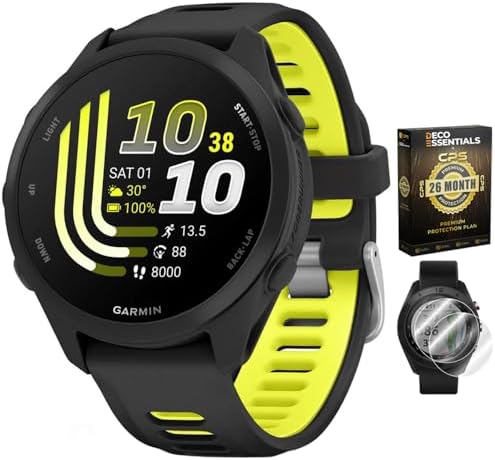
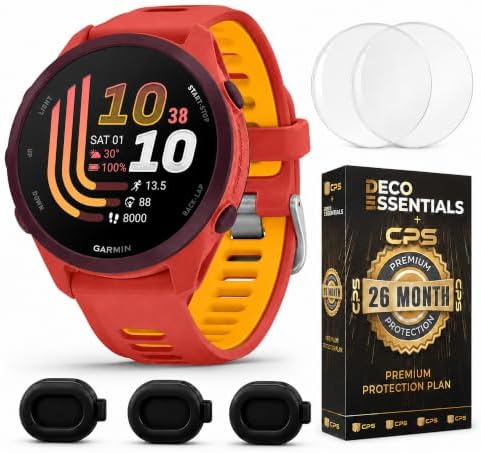
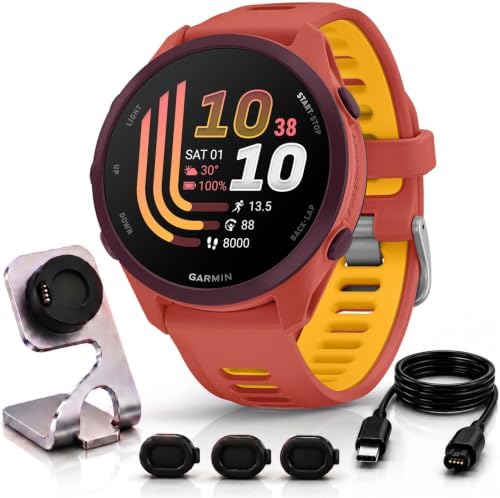
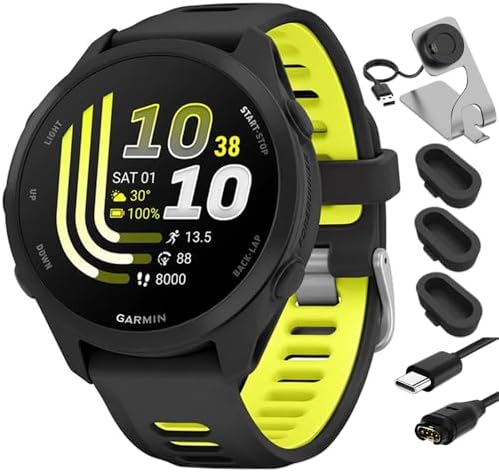
The 265 Music edition stores playlists and podcasts directly on the watch, pairing with Bluetooth headphones for phone-free runs. That combination, plus contactless payments and the richer smartwatch features, positions the Garmin Forerunner 265 Running Colorful AMOLED Black as a replacement for the phone on short sessions. The 165 omits onboard music entirely, requiring a carried phone for audio.
Smartwatch battery life mirrors this split. Garmin’s product comparison lists up to 20 days in battery saver mode for the 165, echoing the 265’s saver profile, but daily-use endurance favors the larger model at up to 13 days against 11. Runners who charge weekly rather than daily will find both acceptable; those who travel frequently may lean toward the 265’s longer intervals.
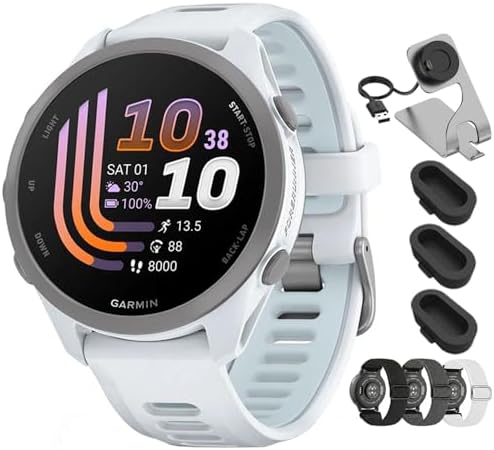
For athletes who simply want a dependable AMOLED runner at the lowest sensible cost, the Garmin Forerunner 165 Running Colorful AMOLED Black remains the rational entry point without surrendering the core training platform.
Who Should Choose Which
The 265 answers to runners who train in cities, race on varied terrain, and want music without a phone. Multi-band GPS, onboard storage, and the larger display justify the premium for that audience. The 165 answers to runners prioritizing comfort and budget, particularly those with smaller wrists or a preference for featherweight wear during speed sessions.
Neither is a lesser running instrument. Garmin built the 165 to carry the same training intelligence as its mid-tier sibling, stripping only the hardware extras. That engineering decision makes the entry model unusually capable for its class, and it explains why the comparison keeps surfacing in running communities.
Long-Term Value and Ecosystem Fit
Both watches sync with Garmin Connect, where training history, courses, and health metrics accumulate over years. Software updates have historically extended feature sets across the Forerunner line, so the value of either purchase grows with the platform rather than peaking at unboxing.
Choosing between the Garmin Forerunner 265 and the Forerunner 165 ultimately comes down to two variables: how much satellite accuracy and music independence matter, and how much wrist weight the runner tolerates. Answer those honestly, and the right AMOLED runner identifies itself.