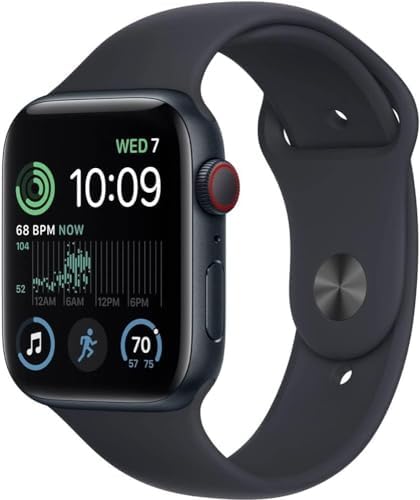
The Apple Watch SE 3 introduces an always-on Retina display, a feature absent from the Apple Watch SE 2nd Gen, alongside a new S10 chip and faster charging. Both models share the same 40mm and 44mm aluminum case sizing, 50-metre water resistance, and 18-hour all-day battery ratings, making the display, processor, and charging speed the primary decision points for buyers. This guide is built as a practical reference for that decision, and it is worth bookmarking for anyone weighing the two generations side by side.
| Feature & Selling Point | Apple Watch SE 2nd Gen | Apple Watch SE 3 |
|---|---|---|
| Display | Retina LTPO OLED, no always-on mode | Always-on Retina LTPO OLED |
| Processor | S8 SiP with 64-bit dual-core | S10 SiP |
| Case Sizes | 40mm and 44mm aluminum | 40mm and 44mm aluminum |
| Battery Life | Up to 18 hours, 32 hours Low Power Mode | Up to 18 hours, 32 hours Low Power Mode |
| Charging | Standard magnetic charging | Fast-charge capable |
| Glass Durability | Standard Ion-X glass | Ion-X glass 4x more crack resistant |
| Water Resistance | 50 metres | 50 metres |
| Health Sensors | Heart rate, sleep tracking, crash detection | Heart rate, sleep tracking, sleep apnea alerts |
| Connectivity | GPS, GPS + Cellular options | GPS, GPS + Cellular options |
| Software Support | watchOS 11 | watchOS 26 |
| Safety Features | Crash Detection, Fall Detection | Crash Detection, Fall Detection, Emergency SOS |
| Best Suited For | Budget-conscious first-time buyers | Buyers wanting the latest SE generation |
| Release Year | 2022 | 2025 |
| Case Materials | Aluminum | Aluminum |
| Always-On Display | No | Yes |
| Key Upgrade | Established entry-level platform | Always-on display and S10 chip |
The most consequential differences centre on the always-on display, the S10 processor, fast charging, and the 4x crack-resistant Ion-X glass. Buyers weighing the Apple Watch SE 2nd Gen (GPS, 40mm) against the newer generation should also note that both share identical 18-hour battery ratings, 50-metre water resistance, and the same 40mm/44mm case sizing.
What the SE 3 Changes Beneath the Surface
Apple’s decision to carry the S10 chip into the SE line represents a shift in how the company positions its entry-level wearable. The SE 2nd Gen, launched in 2022, ran on the S8 system-in-package, a chip that also powered the Series 8. By equipping the Apple Watch SE 3 [GPS 40mm] Midnight Aluminum with the S10, Apple has narrowed the performance gap between its budget offering and the flagship Series 11, which shares the same silicon.
The practical effect is faster on-device processing for Siri requests, smoother animations, and quicker app launches. More significantly, the S10 handles the always-on display at a 1Hz refresh rate in dimmed mode without measurable impact on battery life. The SE 2nd Gen had no always-on option at all, a functional distinction that matters most for users who glance at their wrist during meetings, workouts, or driving.
Processor and Efficiency Gains
The S10 in the SE 3 includes a 4-core Neural Engine, which accelerates machine learning tasks such as sleep apnea detection and the double-tap gesture. Apple’s official specification page for the SE 3 lists the same 18-hour all-day battery rating as the SE 2nd Gen, but fast-charge capability allows the SE 3 to reach 80 percent in approximately 45 minutes, roughly twice the charging speed of the SE 2nd Gen. This reduces downtime for users who charge overnight or during a morning routine.
Durability and Glass Improvements
Apple states that the Ion-X glass on the SE 3 is 4x more crack resistant than the SE 2nd Gen’s front crystal. For anyone who has dropped a watch face-first onto pavement, this is a tangible improvement. The aluminum case remains unchanged, retaining the same 50-metre water resistance and IP6X dust resistance found across the SE family.
Health and Safety Features Compared
Both generations inherit the SE line’s core health suite: optical heart rate monitoring, sleep tracking, high and low heart rate notifications, and irregular rhythm alerts. The SE 3 adds sleep apnea notifications, a feature Apple introduced on the Series 9 and SE 3 via the S10’s Neural Engine. Sleep apnea detection monitors breathing disturbances during sleep and prompts users to consult a healthcare provider if repeated patterns are detected.
Safety features remain nearly identical. Both models include Crash Detection and Fall Detection. The SE 3 adds the same Emergency SOS calling capability that appears on higher-end models, though the SE 2nd Gen also supports this via cellular configurations. For a full view of the Apple lineup, the comparison ultimately hinges on whether always-on display and sleep apnea alerts justify the newer model’s premium.
Who Should Choose Which
First-time smartwatch buyers who prioritise value may find the SE 2nd Gen more than adequate. It runs watchOS 11, supports the same fitness tracking features, and delivers identical battery life. The lack of always-on display is the most noticeable omission, but for someone upgrading from a basic fitness band, it is unlikely to be a dealbreaker.
The SE 3 makes more sense for anyone who wears the watch at work, monitors sleep quality closely, or wants the fastest possible charging. The always-on display alone shifts the experience from a device you must wake to read into one that functions like a traditional watch. The S10 chip extends the useful lifespan, and the improved glass reduces the risk of costly screen repairs.
The Long-Term Value Question
For existing SE 2nd Gen owners, the SE 3 is not an urgent upgrade unless always-on display or sleep apnea detection is specifically needed. Apple continues to support the SE 2nd Gen with watchOS updates, and the core experience remains largely intact. But for new buyers entering the Apple Watch ecosystem, the SE 3’s combination of the S10 chip, fast charging, and a more durable display makes it the more future-resistant choice.
Apple has positioned the SE 3 not merely as a cost-conscious alternative but as a device that retains meaningful features from the mainstream Series line. That strategy signals that the company expects its entry-level watch to satisfy users for three to four years, not one or two. The always-on display and faster silicon close the gap with more expensive models, leaving the decision largely a matter of budget against wanting the most current iteration of Apple’s entry-level wearable.