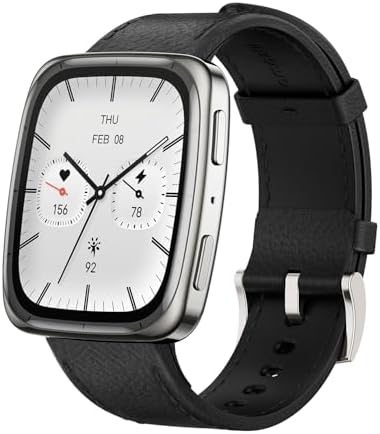
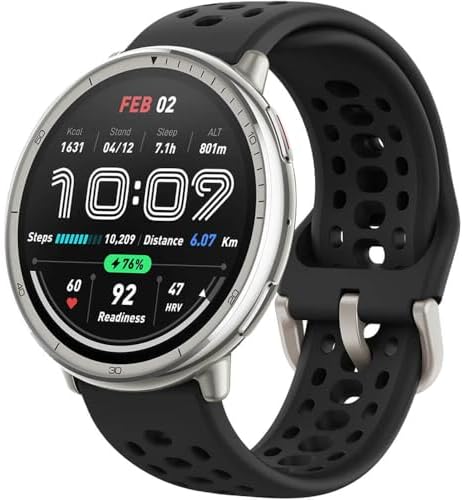
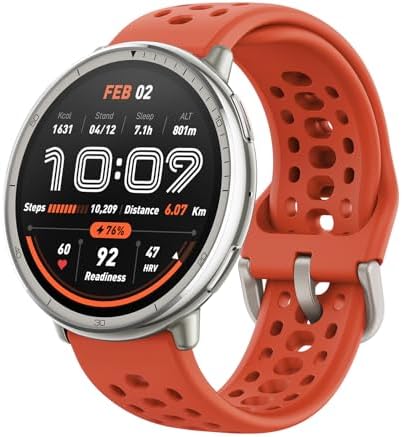
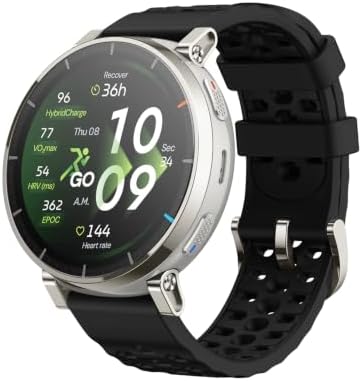
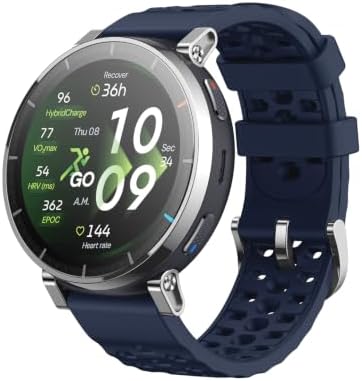
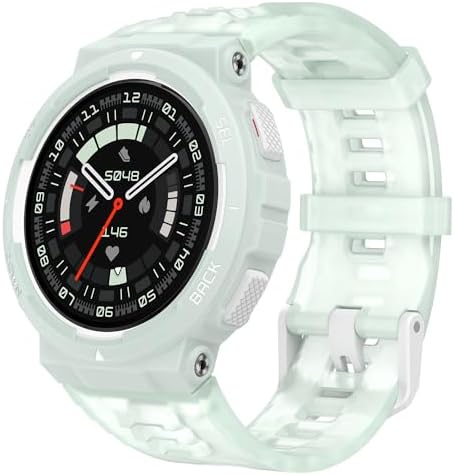
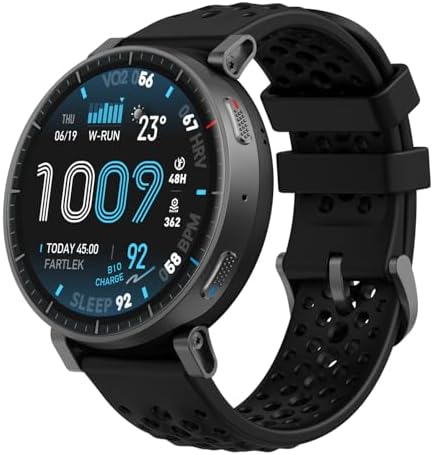
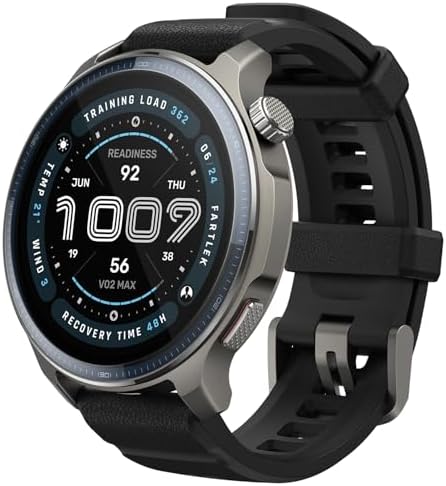
The Amazfit T-Rex 3 series and the Amazfit Balance 3 collection share a 1.5-inch AMOLED foundation and dual-band GPS, yet they are aimed at two different wrists. One leans into military-grade toughness and multi-week field endurance; the other wraps a stainless steel case around a more urban, health-focused brief. Because both run on Amazfit’s own platform, the choice is rarely about brand loyalty and almost always about how you actually wear a watch. What follows is a decision framework built around the specifications that genuinely change ownership, not the ones that merely look good on a spec sheet.
| Feature & Selling Point | Amazfit T-Rex 3 | Amazfit Balance 3 |
|---|---|---|
| Case Size | 48mm | 48mm |
| Display | 1.5″ AMOLED, 2000 nits | 1.5″ AMOLED |
| Glass Protection | Reinforced rugged cover | Sapphire glass |
| Case Material | Polymer rugged build | Stainless steel |
| Typical Battery Life | Up to 27 days | Up to 21 days |
| GPS | Dual-band with detailed maps | Dual-band |
| Offline Maps | Yes | Yes |
| Sport Modes | 170 modes | 180 modes |
| Onboard Storage | Standard music storage | 64GB |
| Flashlight | Not specified | Yes |
| Rugged Certification | Military-grade toughness | Standard water resistance |
| Identity | Outdoor and tactical | Urban wellness and style |
| Best Suited To | Multi-day treks and field work | Desk-to-dinner and training |
| Key Selling Point | 27-day endurance with hardened build | Sapphire and steel with 64GB |
The table shows where the two diverge most sharply: the T-Rex 3 answers with endurance and a hardened shell, while the Balance 3 answers with sapphire glass, stainless steel, a flashlight, and a large 64GB pool for offline media. Battery life, glass, and case material are the three rows that should decide most purchases, because they are the attributes you live with every day rather than notice once.
The Design Brief: Field Tool Versus Refined Companion
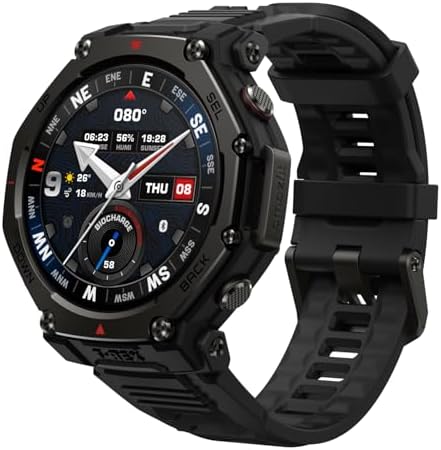
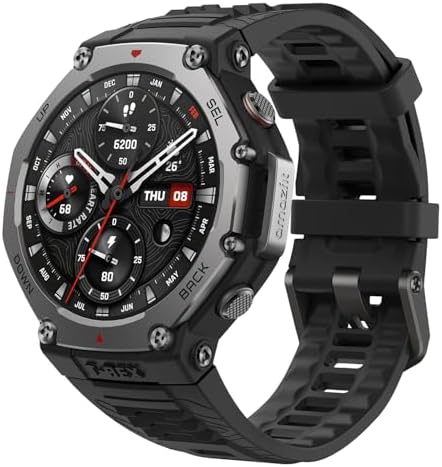
The Amazfit T-Rex 3 is built around the idea that a watch should survive the environment it is worn in. Its 1.5-inch AMOLED panel reaches 2000 nits, a figure that matters when you are reading splits on a sun-bleached ridge rather than reviewing a workout in an air-conditioned room. The 48mm case houses that screen alongside the dual-band GPS engine and the mapping data that the outdoor mode depends on. Amazfit positions the T-Rex line around adventure, and the hardware reflects that framing consistently: the bezel, the button geometry, and the case construction are all oriented toward gloves, impacts, and long days away from a charger.
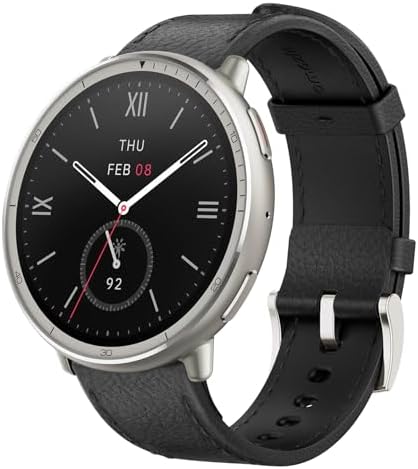
The Balance 3 takes the same 48mm footprint and the same 1.5-inch AMOLED panel but reinterprets the brief. A stainless steel case and sapphire glass place it closer to a conventional premium watch than to a piece of expedition equipment. Amazfit’s Balance family is presented as a lifestyle line, and the material choice is where that becomes concrete. Sapphire resists scratching far better than standard glass covers, which matters for anyone who wears one watch continuously through work, travel, and training rather than swapping cases at the trailhead. That combination makes it an easier fit for a wrist that sits at a desk Monday through Thursday and on a bike on Saturday.
Battery Life and Real-World Endurance
Battery figures rarely translate directly into lived experience, because they depend on screen brightness, GPS duty cycles, and how much time the watch spends connected. That caveat aside, the gap between these two is worth understanding in practical terms. Amazfit lists the Amazfit T-Rex 3 at up to 27 days of typical use, while the Balance 3 is rated at up to 21 days. Six days of headroom does not sound dramatic until you notice what it removes from the routine.
For a hiker or a field engineer, an extra six days in typical mode can be the difference between charging before a trip and charging during one. For a runner training five times a week with dual-band GPS enabled, both watches will drop well below their headline figures, and the proportional gap tends to hold. The practical reading is straightforward: if you are the kind of person who forgets the charger bag, the T-Rex 3 buys tolerance. If you charge alongside your phone each night out of habit, both devices will comfortably cover a fortnight of ordinary life.
Navigation, GPS, and Software Capability
Both watches carry dual-band GPS, which uses a second frequency band to reduce multipath errors in dense terrain and between tall buildings. That is the meaningful upgrade for anyone who has watched a route snap to the wrong side of a river in a canyon. Offline maps appear on both, which turns the watch into a standalone navigation device rather than a display tethered to a phone on the trail. Amazfit supplies detailed mapping on the T-Rex 3 in particular, and the larger onboard storage on the Balance 3 gives it more room for map packs and media.
Sport mode coverage differs narrowly. The T-Rex 3 offers 170 fitness and sport modes, including AI and voice control features for hands-free operation. The Balance 3 carries 180 modes, a marginally wider catalogue that mostly reflects its health and recovery focus rather than a fundamentally different training engine. Neither figure should be the deciding factor, since most users exercise within a handful of modes; the presence of offline maps and dual-band positioning on both is far more consequential than the count.
Materials, Storage, and the Practical Details
The hardware split continues into the small features. The Amazfit Balance 3 includes a built-in flashlight, a function that sounds minor in a review and quickly becomes habitual in a power cut, a tent, or a stairwell. Its 64GB of storage is the larger differentiator: enough room for offline music and podcast libraries, which lets the watch operate without a phone in a way the T-Rex 3 was not primarily designed for. Sapphire glass and stainless steel likewise position it as a wrist object that ages well in office settings.
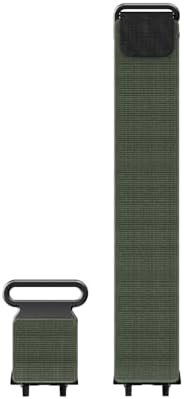
The T-Rex 3 answers with certified military-grade toughness and a harder-edged construction philosophy. That certification is not decoration; it reflects shock and environmental testing that urban-focused watch designs typically do not pursue. For climbing, trail running on technical ground, or physical work environments, the case architecture matters as much as the software. Straps are the first component to wear on any watch, and the Amazfit Hyrox 22mm Silicone Replacement Strap fits the T-Rex 3, the Balance, and several other Amazfit models, which keeps long-term ownership practical for either watch.
Which Watch Fits Which Wrist
Does your week include multiday trips away from power, rough terrain, gloves, or physical work? If yes, the T-Rex 3’s 27-day rating and military-grade construction are the answer, and its 170 sport modes cover almost every outdoor discipline. Do you want one watch for the office, the gym, and travel, with scratch-resistant sapphire and enough storage to leave the phone at home? The balance tilts toward the steel-cased model and its flashlight.
- Choose the T-Rex 3 if: endurance and impact resistance outrank style, and your training happens off pavement.
- Choose the Balance 3 if: you want sapphire glass, stainless steel, a flashlight, and 64GB of media storage in one daily watch.
- Either watch if: dual-band GPS, offline maps, and the 1.5-inch AMOLED display are what you actually came for.
Amazfit has grown wide enough that a single recommendation cannot serve everyone, and the T-Rex 3 and Balance 3 exist precisely because the company now designs for distinct use cases rather than a single buyer. Anyone comparing more of the range will find the same pattern: hardware decisions first, software polish second. Choose the watch whose construction matches the life it will actually live, and the specifications will stop being a spreadsheet and start making sense on the wrist.