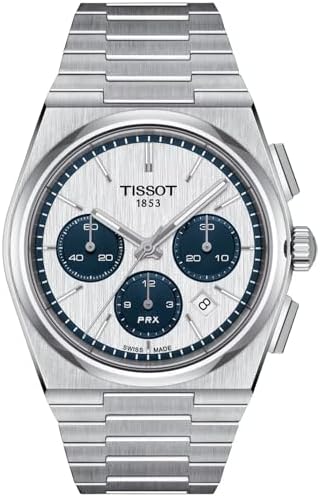
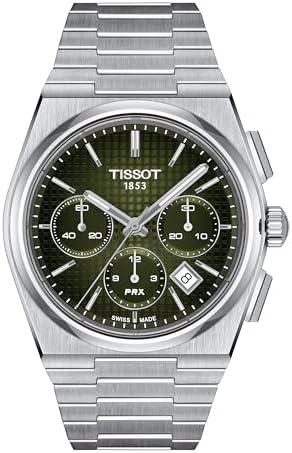
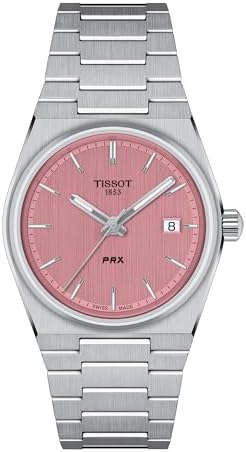
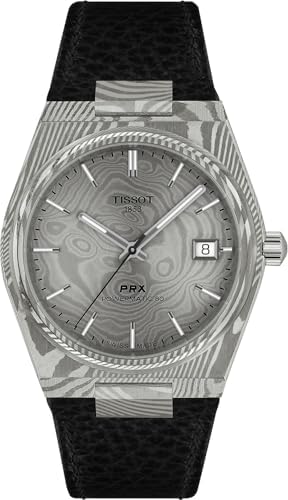
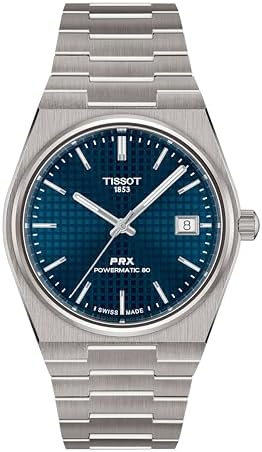
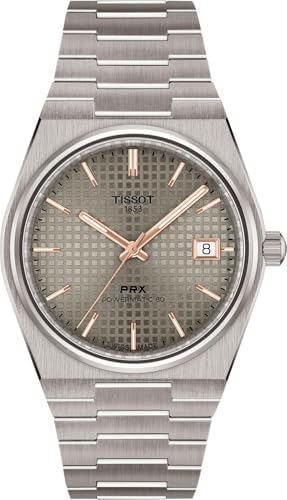
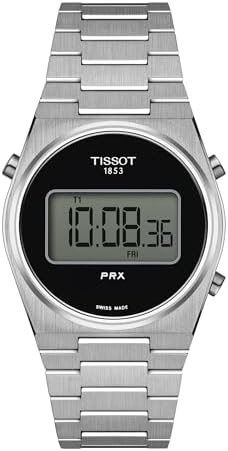
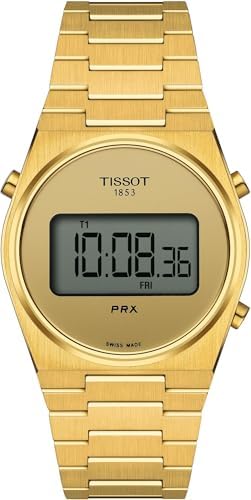
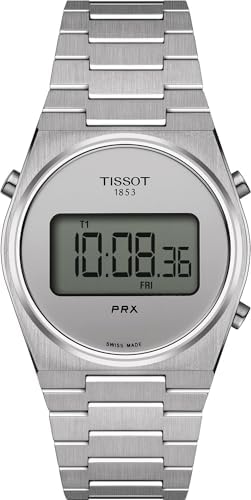
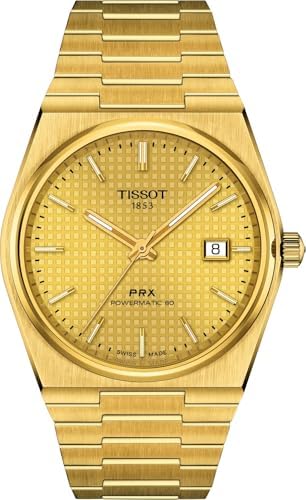
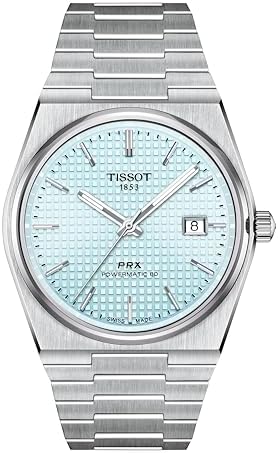
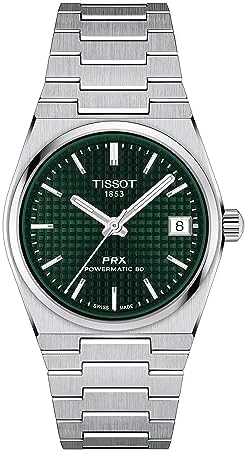
The Tissot PRX Chronograph emerges from a lineage that traces back to the late 1970s, when integrated-bracelet sports watches first captured the industry’s imagination. Tissot has revisited that aesthetic with a thoroughly contemporary execution, pairing a sharply defined 42mm case with a self-winding movement and a dial layout that balances chronograph functionality against everyday legibility. According to Tissot, the collection is positioned as a bridge between the brand’s heritage archives and its modern engineering capabilities, and the resulting watch reflects that dual ambition without feeling like a nostalgic exercise.
A Case Architecture Rooted in 1970s Geometry
The PRX Chronograph’s most immediate visual signature is its 42mm 316L stainless steel case, which measures just 14.54mm thick and carries a lug width of 13.00mm. The proportions are deliberately assertive without tipping into excess, and the case flows into a flat, tonneau-inspired profile that recalls the angular language of vintage sports watches. Unlike many modern chronographs that rely on tachymeter bezels to convey purpose, the PRX keeps its bezel clean and unbroken, letting the integrated bracelet and case geometry carry the design narrative.
The satin-brushed surfaces along the case flanks contrast with polished bevels that trace the edges of the lugs and the crown guards, creating a subtle interplay of light that shifts as the wrist moves. At 13mm thick at the caseback, the watch remains wearable under a shirt cuff, which is not always a given for automatic chronographs in this category. Tissot has also fitted this reference with a see-through caseback, exposing the movement’s finishing and offering a point of engagement for enthusiasts who appreciate mechanical transparency.
Dial Design and Chronograph Layout
The dial of the PRX Chronograph follows a tri-compax arrangement, with two sub-dials at 3 and 9 o’clock and a central chronograph seconds hand. This panda-style layout is cued directly from racing chronographs of the 1960s and 1970s, though Tissot has applied a restrained hand: the sub-dials are recessed slightly, and the applied indices have a faceted profile that catches ambient light without becoming distracting. A date window at 6 o’clock is integrated into the bottom sub-dial register, preserving the symmetry of the layout rather than interrupting it with a square aperture at 3.
The sapphire crystal carries an antireflective coating on both faces, which matters more than spec sheets suggest: chronograph dials with multiple registers can become visually cluttered under direct light, and the coating keeps legibility high in bright conditions. Luminous material on the hands and indices ensures the watch remains readable after dark, though the chronograph sub-dials themselves are not luminous, which is standard practice for this type of movement. For daily wearers, the combination of a clean slate dial on the stainless steel reference and a deep blue sunray finish on the TISSOT Men’s T1374271104100 PRX Automatic Chronograph Blue variant gives the line two distinct characters without altering the underlying architecture.
The Valjoux-Based Automatic Movement
Under the dial sits a Swiss automatic chronograph movement with a power reserve of up to 68 hours, according to Tissot’s own specifications. That figure places it comfortably in line with modern expectations for this price tier, and it means the watch can be set aside on a Friday evening and still be running accurately on Monday morning. The movement uses a cam-and-lever chronograph actuation system, a robust and well-proven design that produces a crisp start-stop action at the pushers. In practical terms, this is a modular architecture that Tissot has refined over multiple generations, and it continues to deliver reliable timekeeping without the servicing complexity of some higher-end column-wheel calibres.
The rotor is visible through the sapphire caseback, and while the decoration is industrial rather than ornate, it suits the PRX’s pragmatic positioning. The pushers engage with moderate resistance, avoiding the mushy feel that afflicts some value-oriented chronographs, and the crown is sized appropriately for the 42mm case. This is not a haute horlogerie movement, but the watch is honest about what it is: a well-sorted Swiss automatic chronograph built to be worn, not stored.
| Specification | Tissot PRX Chronograph |
|---|---|
| Case Diameter | 42mm |
| Case Thickness | 14.54mm |
| Lug Width | 13.00mm |
| Case Material | 316L Stainless Steel |
| Crystal | Scratch-resistant sapphire with antireflective coating |
| Movement | Swiss Automatic Chronograph |
| Power Reserve | Up to 68 hours |
| Caseback | See-through sapphire |
| Bracelet | Integrated stainless steel with quick-release system |
Bracelet Integration and Wearing Experience
The integrated bracelet is the element that defines the PRX as a family, and on the chronograph it is executed with the same single-link geometry as the three-hand models. The bracelet tapers from the case outward, and the link profiles alternate between brushed and polished finishes to create a visual continuity that many competitors struggle to achieve. Tissot has equipped the range with a quick-release system, which means the bracelet can be swapped for a strap without tools. That detail matters for owners who want to dress the watch down with a leather or rubber strap for casual wear.
On the wrist, the 42mm case sits with a broad, flat presence. The integrated lugs drop steeply from the case, so the watch hugs the wrist in a way that belies its nominal diameter. Owners with wrists under 6.5 inches may find the chronograph’s thickness noticeable, but the balance is deliberate: a chronograph movement needs space, and Tissot has chosen to preserve the movement’s integrity rather than compress the case into an uncomfortable profile. The butterfly clasp is finished to match the bracelet and sits flush against the underside of the wrist, which keeps the watch from rotating during daily activity.
Water Resistance and Everyday Durability
The PRX Chronograph carries a water resistance rating of 100 metres, which aligns with what Tissot specifies for the automatic PRX line. That rating covers swimming and showering, though the chronograph pushers should not be operated underwater. The screw-down crown and caseback gaskets provide the primary seals, and the sapphire crystal is rated as scratch-resistant, which keeps the dial clear through years of wear. For a chronograph that was designed with daily versatility in mind, this is a practical set of protections rather than an over-engineered specification.
The watch also benefits from Tissot’s broader service network, which is one of the less-discussed advantages of buying into a brand with global distribution. The movement can be regulated and serviced by any authorised Tissot centre, and replacement gaskets and crystals are widely available. This is a watch that can be worn hard without the anxiety that often accompanies more esoteric mechanical pieces.
Styling Versatility Across Contexts
The PRX Chronograph’s design language is deliberately context-neutral. The integrated bracelet gives it a sporty, almost architectural quality that works with a t-shirt and jeans, while the polished bevels and clean dial allow it to pass as a business-casual watch under a blazer. The 42mm case is large enough to read at a glance during a meeting but not so large that it overwhelms a dress shirt cuff. The blue dial variant adds a layer of visual interest with its sunray finish, which shifts between deep navy and brighter tones depending on the light. That variant pairs particularly well with grey and navy tailoring.
Because the PRX platform shares its bracelet release system across the range, owners can experiment with strap changes without committing to a single look. A black rubber strap transforms the chronograph into a summer-ready sports watch, while a brown leather strap pulls it toward a more traditional dress-watch register. That flexibility extends the watch’s relevance across seasons and social contexts in a way that fixed-lug chronographs cannot match.
Positioning Within the Tissot Collection
The PRX Chronograph occupies a specific niche within the wider Tissot brand. It sits above the quartz PRX models in both price and mechanical sophistication, but below the brand’s more complicated or higher-end automatic pieces. For buyers who want an automatic chronograph with a Swiss movement, a sapphire crystal, and a distinctive design that does not mimic a Rolex or an Omega, the PRX Chronograph is one of the more honest propositions in its segment. It does not pretend to be a luxury watch in the traditional sense, but it also avoids the aesthetic compromises that often come with value-oriented chronographs.
What makes the Tissot PRX Automatic Chronograph compelling is the coherence of its design. The case, bracelet, dial, and movement all point in the same direction: a wearable, durable automatic chronograph with a strong visual identity and a respect for its own heritage. Tissot has not overreached here, and that restraint is precisely what makes the watch work. For anyone seeking a first automatic chronograph, or a second watch that can handle both office days and weekend wear, the Tissot Mens PRX Automatic Chronograph 316L delivers a level of finish and design clarity that is difficult to find at its price point.