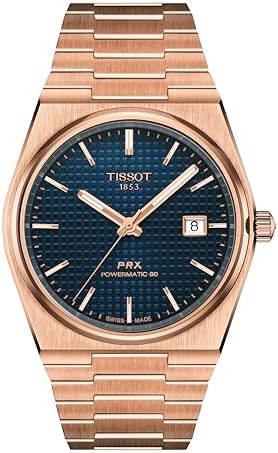
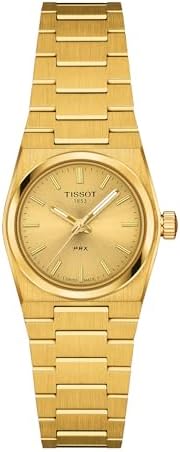
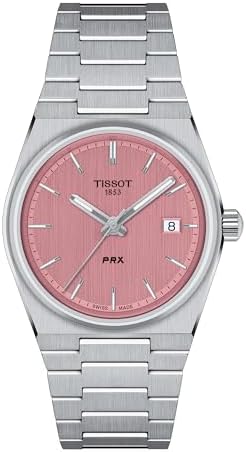
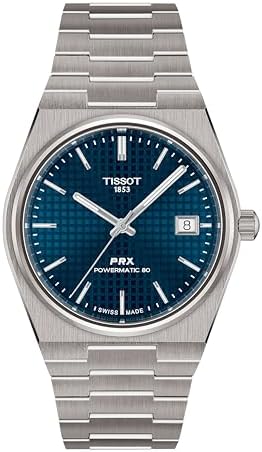
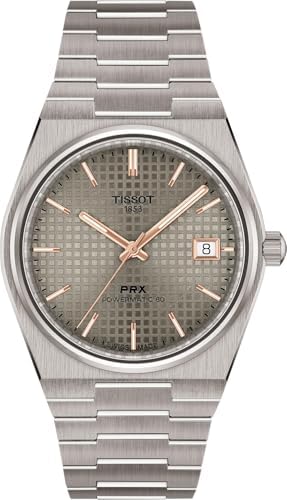
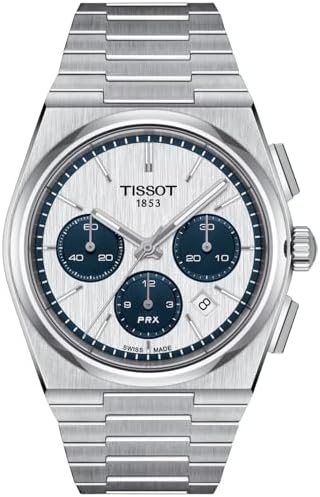
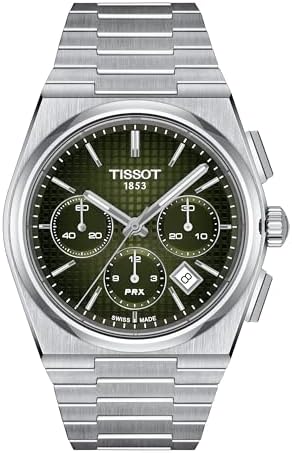
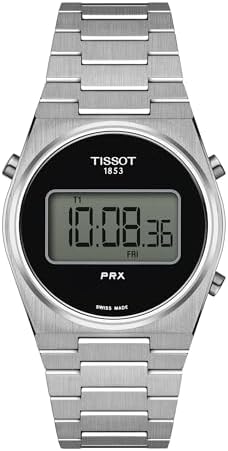
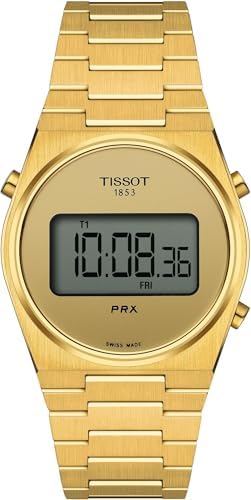
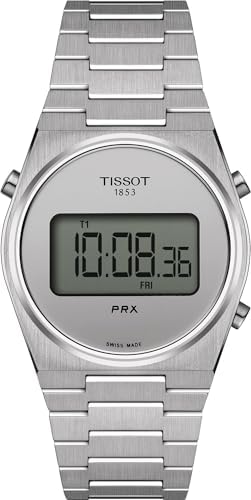
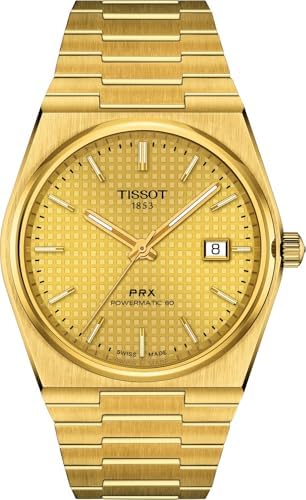
The Tissot PRX Gold family is anchored by a 40 mm stainless steel case with a distinct gold-tone treatment, a tonneau-inspired silhouette, and an integrated bracelet that flows from the lugs without a visible gap. Case dimensions sit at 40.00 mm across and 39.50 mm in length for the core PRX 40 mm references, with a thickness of 10.40 mm on the automatic variants. That combination produces a profile that reads slim on the wrist while retaining the geometric boldness that defined the original 1978 PRX concept.
The visual signature of the Tissot PRX Gold lies in its flat, brushed-and-polished case surfaces and the sharply faceted bracelet links. Gold PVD coating is applied to the 316L stainless steel, producing a warm tone that catches light along the beveled edges. Water resistance is rated to 100 meters, or 330 feet, which covers swimming and everyday exposure rather than diving. Anyone weighing this reference against siblings in the broader Tissot PRX family will find that understanding the case construction is the first step toward a confident decision.
A Design Lineage Rooted in the 1970s Sports Watch Boom
The PRX name refers to “Precise, Robust, and X,” a naming convention from a period when Swiss manufacturers answered the quartz revolution with tough, precise steel sports watches. Tissot first introduced the PRX shape in 1978, when integrated bracelet designs were a statement of technical modernity rather than nostalgia. The contemporary revival preserves that geometric case profile and the unbroken line between case and bracelet, while re-engineering the internals around current movements.
This is a case study in how a heritage silhouette can be adapted without being frozen in place. The gold-tone execution shifts the character of the watch away from pure tool watch territory and toward something that sits comfortably between casual wear and evening attire. The polished bevels along the case sides and the satin-brushed top surfaces create a two-tone effect within a single finish, a technique that requires more careful surface preparation than a uniformly brushed case.
Case Geometry, Materials, and Wearing Experience
The 40 mm case width is paired with a 12 mm lug width in the PRX architecture, a proportion that keeps the bracelet proportionate to the case rather than tapering aggressively. Case thickness varies by reference: the automatic versions sit around 10.40 mm, while the chronograph variant, reference T9314074104100, measures approximately 10.93 mm and weighs 138 grams.
Materials matter here. The case and bracelet use 316L stainless steel, a grade chosen for corrosion resistance and its ability to accept PVD coatings evenly. Gold PVD is a thin film deposited under vacuum, and its durability depends heavily on the substrate finish beneath it; a poorly polished surface underneath will telegraph flaws through the coating. Tissot applies the gold tone over both polished and satin surfaces, and the contrast between the two is central to how the watch reads in daylight.
- Case diameter: 40.00 mm
- Case length: 39.50 mm (PRX 40 mm automatic references)
- Case thickness: 10.40 mm automatic, 10.93 mm chronograph
- Case material: 316L stainless steel with gold PVD
- Water resistance: 100 m / 330 ft
The integrated bracelet is the decisive element. Because the first link is machined as part of the case rather than attached via spring bars, the watch sits lower and more flush against the wrist. The trade-off is that strap swapping is not part of the ownership experience; the bracelet is the design. Buyers who want versatility across leather and textile straps should look elsewhere, while those who want a single, resolved object will find the integrated approach coherent.
Movements: Powermatic 80 Automatic and Quartz Options
The automatic PRX references carry the Powermatic 80 calibre, a movement family developed within the Swatch Group with an extended power reserve. The architecture uses a reduced-frequency escapement to stretch running time between windings, and the result is a watch that can sit on a desk from Friday evening to Monday morning without losing its momentum.
Quartz references sit elsewhere in the range, and the distinction is more than mechanical versus battery. Automatic PRX models typically expose the movement through a transparent case back, while quartz versions use a closed back that keeps the case slightly slimmer and lower in profile. Those who value the visual theater of a decorated rotor should gravitate toward the automatic; those who prioritize grab-and-go convenience and thinner cases have a clear alternative.
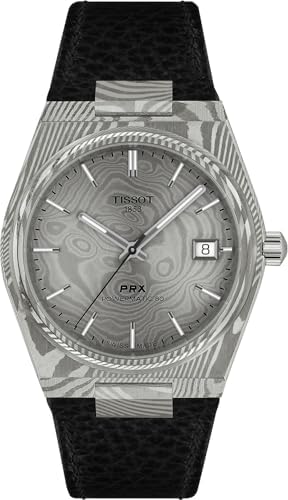
An example from the range is the Tissot Men’s PRX 316L Stainless Steel, which pairs the 40 mm 316L case with the automatic platform and a grey dial treatment. Meanwhile the Tissot PRX Digital carries the same case language into a digital display format, an option worth considering for buyers who want the silhouette without the analog dial. A further analog variant, the Tissot mens PRX 316L stainless steel, offers a different dial finish within the same steel-and-gold design vocabulary.
Dial Layout and Legibility
The PRX dial is a study in restraint. Applied indices sit on a flat surface, with a horizontal brushed texture on certain references that shifts tone as the wrist rotates. Faceted hands with luminous inserts keep night reading practical without interrupting the clean line of the design.
Colored dial variants including the gold-tone models incorporate a darker or tonal dial that provides contrast against the gold case, avoiding the monochrome flatness that plagues some gold-plated watches. Date windows are positioned at 3 o’clock on the automatic references, framed without a magnifier, which preserves the symmetry of the dial. Legibility is good at arm’s length, aided by the sharp contrast between the applied markers and the dial base.
Those comparing finishes should note that the gold-tone treatment is not solid gold, and it is not intended to be. It is a surface treatment that delivers the warmth of gold with the structural integrity and corrosion resistance of steel. Owners should treat it like any coated finish: avoid abrasive polishes, and wipe the case with a soft cloth after exposure to salt water or chlorine.
Where the Gold PRX Fits in a Collection
The gold-tone integrated sports watch occupies a specific niche. It is dressier than a dive watch without being a formal dress watch; the bracelet and case geometry keep it casual, while the gold finish pushes it toward evening wear. That duality is the point. A single watch that can be worn to a meeting in the morning and a dinner in the evening, without the ceremony of changing straps, is a practical proposition for many owners.
Within the family, the Tissot collection also offers steel-only finishes for those who find gold too assertive, and the PRX platform spans chronograph and digital formats for different tastes. Purchasing decisions often come down to three variables: automatic or quartz, gold-tone or steel, and analog or digital. Once those are settled, the case dimensions and 100 m water resistance are consistent across the family, which simplifies the choice.
Care, Longevity, and Ownership Considerations
A gold PVD coating will not match the wear characteristics of solid gold, and honest expectations matter. Friction points, such as the clasp and the inner edges of the bracelet links, may show thinning over years of daily wear. The coating is applied over a properly prepared surface, and general care extends its life considerably: rinse the bracelet with fresh water after heavy perspiration or swimming, dry it thoroughly, and store the watch away from direct sunlight.
Servicing follows standard Swiss practice. Automatic references benefit from a service interval of roughly four to six years depending on use, and water resistance should be tested whenever the case is opened. The transparent case back means the movement is visible but also accessible to dust if the seal degrades, so gasket replacement during servicing is not optional.
Final Perspective on the Gold PRX Proposition
The appeal of the gold-finish PRX is ultimately architectural. It takes a shape born in 1978 and renders it in a finish that reads contemporary rather than retrospective, with proportions that suit a wide range of wrists despite the 40 mm nominal width. The integrated bracelet, the flat-brushed dial surfaces, and the consistent 100 m water resistance form a coherent package.
For those drawn to the aesthetic but uncertain about the mechanical aspect, approaching the range with a clear sense of priorities is the most useful exercise: the automatic Powermatic 80 rewards those who value the movement, while the quartz and digital references appeal to a different use case entirely. Either way, the gold-tone PRX remains one of the more distinctive propositions in the accessible Swiss segment, a watch that carries a 1970s idea into a modern wardrobe without apology.