The Apple Watch Series 10 arrives with a thinner profile and a larger display than the Apple Watch Series 9, marking one of the most visible physical shifts in the lineup since the Series 7. Both models run watchOS and share the same health sensor suite, yet they differ in case geometry, screen technology, charging speed, and internal speaker architecture. This guide compares the two generations side by side so buyers can weigh the trade-offs before choosing between them.
| Feature & Selling Point | Apple Watch Series 10 | Apple Watch Series 9 |
|---|---|---|
| Case Sizes | 42mm and 46mm | 41mm and 45mm |
| Thickness | 9.7mm | 10.7mm |
| Display Area (46mm vs 45mm) | 1220 sq mm | 1143 sq mm |
| Resolution (large model) | 416 x 496 pixels | 396 x 484 pixels |
| Display Type | Wide-angle OLED | Always-On Retina OLED |
| Chip | S10 SiP | S9 SiP |
| Weight (aluminum, GPS, large) | 36.4 grams | 38.7 grams |
| Water Resistance | 50m, IP6X | 50m, IP6X |
| Health Sensors | ECG, blood oxygen, temperature | ECG, blood oxygen, temperature |
| Battery Life | 18 hours (36 in low power) | 18 hours (36 in low power) |
| Fast Charging | 80\% in 30 minutes | 80\% in 45 minutes |
| Speaker | Built-in speaker with media playback | Built-in speaker |
| Materials | Aluminum, titanium, jet black | Aluminum, stainless steel |
| Sleep Apnea Detection | Supported | Supported via update |
| Best For | Larger screen, lighter titanium | Proven value, familiar sizing |
The table shows that the core health sensors and battery ratings remain identical between the two generations, while the meaningful differences sit in the case, display, charging speed, and speaker hardware. The Series 10’s 9.7mm depth and larger 1220 sq mm display make it the more comfortable and legible option for users who read notifications at a glance, whereas the Series 9 holds its appeal through a mature, well-tested design and frequently lower pricing on the secondary market.
Design and Case Geometry
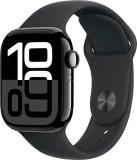
The most tangible upgrade in the Series 10 lies in its reworked chassis. At 9.7mm thick, it is roughly one millimetre slimmer than the Series 9, a change that is more noticeable on the wrist than the numbers suggest because Apple also widened the case and reduced the overall weight. The aluminum 46mm GPS model weighs 36.4 grams, compared with 38.7 grams for the equivalent 45mm Series 9. The Series 10 also introduced a polished jet black aluminum finish alongside natural, gold, and slate titanium options, while the Series 9 uses stainless steel for its premium tier. Buyers who prefer a darker, monochrome look may find the Apple Watch Series 10 Jet Black Aluminum a more distinctive choice than the Midnight finish common to the previous generation.
Display, Readability, and Speaker
The Series 10 uses a wide-angle OLED panel that Apple states is up to 40 percent brighter when viewed from an angle, which reduces the need to rotate the wrist to read a notification. The larger 46mm model offers 1220 sq mm of display area and a 416 x 496 pixel resolution, both higher than the 45mm Series 9. This matters most during workouts or when glancing at maps. The Series 10 also adds a built-in speaker capable of playing audio directly from the watch, a feature that the Series 9 cannot match in the same way.
Chip, Performance, and watchOS
Both watches use a 64-bit dual-core CPU with a four-core Neural Engine, and their real-world responsiveness is close enough that most users will not notice a gap in daily tasks. The Series 10 benefits from newer silicon efficiency that contributes to the faster charging figure, while the Series 9 lineup continues to receive current watchOS updates, including sleep apnea notifications and the double tap gesture. Longevity, in practice, depends more on battery health than on chip generation.
Health, Fitness, and Battery
Sensor parity is one of the defining facts of this comparison. Both generations include electrical heart rate sensors for ECG, blood oxygen measurement, a temperature sensor for cycle tracking, and crash and fall detection. The GPS + Cellular variants allow calls and messages without a paired phone. Battery ratings are quoted as up to 18 hours of normal use and up to 36 hours in low power mode for both, although the Series 10 charges to 80 percent in about 30 minutes versus roughly 45 minutes for the Series 9.
For runners who train with music and cellular connectivity, that charging gap can make a difference on travel days or back-to-back sessions. the Apple Watch Series 9 Midnight Aluminum remains a fully capable training partner, and its lower typical price makes it attractive for buyers who prioritize cost per feature over the slimmer case and wider screen.
Which Model Fits Which Buyer
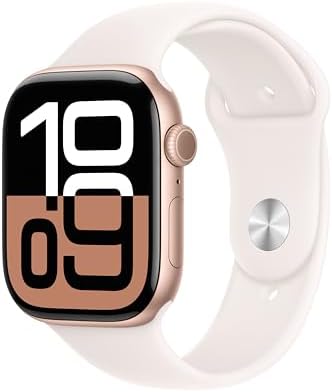
Someone upgrading from a Series 6, 7, or 8 will notice the thinner body, larger display, and speaker most immediately, and the titanium finishes on the Series 10 offer a lighter alternative to stainless steel. Buyers upgrading from a Series 9 have far less reason to switch unless they specifically want the jet black aluminum look or the faster charging.
Accessories, bands, and chargers remain largely cross-compatible between the two, which softens the cost of switching. The broader ecosystem from the Apple brand’s watchOS continuity with iPhone and AirPods treats both generations as first-class citizens, so the decision comes down to hardware refinement versus value. For shoppers who want the newest case geometry and the wide-angle display, the Series 10 collection is the natural starting point.
The Series 10 represents Apple’s ongoing effort to make the wearable thinner, brighter, and more comfortable for all-day wear, while the Series 9 stands as proof that the previous generation still delivers the same core health and connectivity experience. Choosing between them is less about capability and more about how much the refined case, wider display, and quicker charging are worth on a daily basis.

![Apple Watch Series 10 [42mm] - Solo Loop (Renewed)](http://www.donysterling.com/images/202508/thumb_img/70671_thumb_G_1754035651336.jpg)
![Apple Watch Series 10 [42mm] - Solo Loop (Renewed)](http://www.donysterling.com/images/202508/thumb_img/70733_thumb_G_1754035935157.jpg)
![Apple Watch Series 10 [GPS + Cellular 42mm case] Silver Aluminum Case with Denim Sport Band - S/M (Renewed)](http://www.donysterling.com/images/202508/thumb_img/70854_thumb_G_1754036525250.jpg)
![Apple Watch Series 10 [GPS + Cellular 42mm case] Silver Aluminum Case with Denim Sport Band - S/M (Renewed)](http://www.donysterling.com/images/202607/1785404135397_cmaghf_0.jpg)
![Apple Watch Series 10 [GPS + Cellular 42mm case] Smartwatch with Jet Black Aluminium Case with Ink Sport Loop. Fitness Tracker, ECG App, Always-On Retina Display, Carbon Neutral (Renewed)](http://www.donysterling.com/images/202609/1789643131377_0vugni_0.jpg)
![Apple Watch Series 10 [GPS + Cellular 42mm case] Smartwatch with Natural Titanium Case with Stone Grey Sport Band - S/M. Fitness Tracker, ECG App, Always-On Retina Display, Water Resistant](http://www.donysterling.com/images/202607/1785404542566_9baixv_0.jpg)
![Apple Watch Series 10 [GPS + Cellular 42mm case] Smartwatch with Rose Gold Aluminum Case with Light Blush Sport Band - S/M. Fitness Tracker, ECG App, Always-On Retina Display, Water Resistant](http://www.donysterling.com/images/202609/1789643531705_1nlv6i_0.jpg)
![Apple Watch Series 10 [GPS + Cellular 42mm case] Smartwatch with Silver Aluminium Case with Blue Cloud Sport Loop. Fitness Tracker, ECG App, Always-On Retina Display, Carbon Neutral](http://www.donysterling.com/images/202508/thumb_img/70764_thumb_G_1754036089646.jpg)