The Google Fitbit Air and the Amazfit Helio Strap arrive from two different philosophies of wearable design, yet both target the same buyer: someone who wants continuous health data without a bulky smartwatch on the wrist. The Fitbit Air leans on Google’s software ecosystem and Fitbit’s long history in consumer health tracking, while the Amazfit Helio Strap takes a stripped-down, strap-first approach that prioritizes endurance and a minimal footprint. Choosing between them comes down to how you train, how often you charge, and how deep you want your recovery metrics to go.
| Feature and Selling Point | Google Fitbit Air | Amazfit Helio Strap |
|---|---|---|
| Form Factor | Screenless band with soft-touch band | Screenless band with elastic woven strap |
| Display | No display, app-only readout | No display, app-only readout |
| Battery Life | Up to 10 days typical use | Up to 10 days typical use |
| Charging Method | Proprietary magnetic charger | Proprietary charging base |
| Water Resistance | Sweat and splash resistant | Sweat and splash resistant |
| Heart Rate Sensor | Continuous optical heart rate | Continuous optical heart rate |
| Sleep Tracking | Sleep stages, score, and smart wake | Sleep stages and recovery score |
| Stress and Recovery | Daily Readiness Score and EDA-based stress | Readiness and recovery insights |
| Sport Modes | Core workout profiles with auto-detect | 27 sport modes including HYROX |
| Strength Training | Automatic rep and set detection | Strength training with form guidance |
| GPS | Connected GPS via phone | Connected GPS via phone |
| Ecosystem | Google Fitbit app with Google Account | Zepp app with broad device support |
| Subscription Model | Premium features behind subscription tier | Most metrics available without subscription |
| Band Material | Polyester, nylon, and elastane yarn blend | Elastic woven fabric with adjustable fit |
| Compatibility | Android and iOS | Android and iPhone |
| Best For | Fitbit loyalists wanting Google integration | Users training for HYROX and hybrid events |
The comparison reveals that these two trackers are closer than their marketing suggests, with battery life and sensor accuracy sitting at near-identical levels. The clearest separation appears in sport mode depth and subscription policy: the Amazfit Helio Strap includes 27 dedicated sport modes covering HYROX and hybrid racing, while the Google Fitbit Air reserves its most advanced recovery metrics behind a Fitbit Premium subscription. For multi-sport athletes and hybrid racers, that combination of sport coverage and unrestricted data access gives the Amazfit a practical edge, while Fitbit loyalists may stay for Google’s ecosystem integration.
Design Philosophy: Screenless Trackers and the Case for Going Without a Display
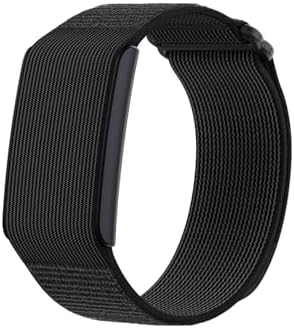
Both the Google Fitbit Air and the Amazfit Helio Strap belong to a growing category of screenless trackers that strip away displays to focus entirely on continuous sensing. The Google Fitbit Air keeps a softly textured band in obsidian tones, with the module hidden against the wrist and data pushed entirely to the Google Fitbit app. The Amazfit Helio Strap uses an elastic woven strap that adjusts with a single pull, built for people who put on and take off their tracker multiple times a day around training sessions.
The logic behind removing the screen is consistent across both devices: fewer components means longer battery life, and fewer glanceable distractions means more natural wear over long sessions. The Google Fitbit Air Performance Loop Band makes this philosophy tangible, using a micro-adjustable weave of polyester, nylon, and elastane that stays anchored during burpees, sprints, and grip-heavy lifting. Neither tracker competes with a smartwatch on notifications or navigation; both compete on being forgettable enough that you keep them on all day.
Tracking Accuracy and Sensor Behaviour
Optical heart rate sensing on both trackers runs continuously, sampling throughout the day and night. The practical difference rarely shows up while sitting still, but it becomes noticeable during intervals. Fitbit’s algorithms lean on years of consumer-scale data and tend to smooth out readings during steady-state running and cycling, then assign a Daily Readiness Score that factors in overnight heart rate variability and recent activity. Amazfit’s approach is more direct: the Amazfit Helio Strap Fitness Wristband 24/7 Activity & Sleep Tracker delivers a comparable readout through the Zepp app, where recovery metrics sit alongside a training load graph that’s particularly useful for hybrid athletes balancing lifting and conditioning on the same day.
Battery Life, Charging, and Daily Routine
Ten days is the headline number for both trackers, and in practice the gap depends almost entirely on how often you use connected GPS or extended workout sessions. The Google Fitbit Air and the Amazfit Helio Strap both rely on proprietary charging hardware, which means losing the cable is a real inconvenience. The Amazfit Official Charging Base for Various Models Like Active Max, T-Rex 3 Balance 2, T-Rex 3 Pro and Helio Strap works across a wide range of Amazfit devices including the Helio Strap, so households that already own an Amazfit watch already have a compatible charger. Fitbit users, by contrast, typically need the dedicated Fitbit cable, with no cross-model compatibility.
The bigger routine decision is what happens at the end of a 10-day cycle. Charging a screenless tracker takes about an hour, and because these bands rarely need to come off during the day except for charging, the choice between them often comes down to whether a rechargeable band will realistically find time on the wrist overnight. For continuous sleep staging and recovery scoring, both devices expect to be worn to bed, which nudges users toward short top-up charges during showers or desk work rather than full discharge cycles.
Software, Ecosystem, and Subscription Trade-offs
The Google Fitbit Air sits inside Google’s account system, and the Fitbit app surfaces sleep stages, readiness scores, and stress tracking in a layout that will feel familiar to anyone who has used a Fitbit product in the past decade. The catch is that several of the more nuanced insights, including deeper readiness breakdowns and long-term trend analysis, sit behind Fitbit Premium. The device remains useful without a subscription, but core aspects of its value proposition assume that the user will eventually subscribe.
Amazfit takes the opposite approach with the Helio Strap. Most metrics in the Zepp app, including recovery insights and the hybrid training breakdown that has drawn attention from the HYROX community, are available without a recurring fee. Standout features like the ability to log transitions in a HYROX race, pair strength work with running load, and track race-specific readiness place the Helio Strap in a niche that most general-purpose fitness trackers ignore. Users comparing subscriptions should note that the difference over three years can easily exceed the initial hardware cost.
- Fitbit Premium: Required for advanced readiness scoring and long-term trend data
- Zepp app: Most metrics available without a subscription
- Google integration: Fitbit Air data flows into Google Account services
- Cross-platform support: Both trackers work with Android and iPhone
Comfort, Wearability, and Everyday Use
Both trackers emphasize comfort, using textile bands rather than silicone to reduce sweat build-up. The Google Fitbit Air band uses a blend of polyester, nylon, and elastane yarn that keeps the strap light while remaining workout friendly, and the obsidian colourway hides wear far better than lighter options. Amazfit’s elastic woven strap is the more adjustable of the two, tightening and loosening with a single motion, which matters for strength athletes who prefer a tighter fit while lifting and a looser feel at rest.
Which Tracker Fits Which Athlete
Someone already embedded in Google’s hardware family will find the Fitbit Air easier to live with, thanks to one shared app and consistent sign-in. Fitbit Premium is worth evaluating on its own merits rather than dismissing it out of hand, because the readiness and stress data it surfaces are among the more useful interpretations on the market. Fitbit’s long history in consumer wellness gives the Air a mature feel, and buyers who value that depth will accept the subscription model.
Those focused on hybrid training will find more of what they need in the Helio Strap. The 27 sport modes and race-specific features in the Amazfit brand are built around people juggling running, strength work, and competitions like HYROX in the same week. Because most of the tracking is unlocked without a subscription, Amazfit also appeals to buyers who want a single up-front cost and no recurring charge. Both bands are lightweight, display-free, and 10-day rated, so the deciding factor is rarely the hardware itself. It comes down to which software ecosystem matches your routine, and whether you prefer paying monthly for deeper interpretation or paying once and keeping the data on your wrist.