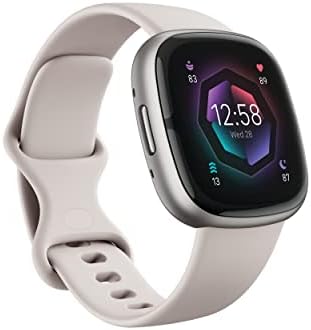
The decision between a health-first wearable and a full smartwatch platform usually comes down to how much daily interaction is expected. The Fitbit Sense 2 series was built around continuous body sensing, while the Samsung Galaxy Watch8 Classic family pushes toward an app-rich, screen-forward experience. This guide is written for readers who want a permanent reference before spending money, so it focuses on the trade-offs that actually change a purchase decision rather than a recap of marketing slides.
| Feature & Selling Point | Fitbit Sense 2 | Samsung Galaxy Watch 8 |
|---|---|---|
| Operating System | Fitbit OS (closed platform) | Wear OS with Galaxy AI layer |
| Stress Sensing | Continuous EDA sensor plus skin temperature | Stress index derived from heart rate variability |
| ECG Function | ECG app for rhythm checks | ECG and irregular rhythm notifications |
| Display Brightness | Standard AMOLED, no published peak figure | Up to 3,000 nits, readable in direct sun |
| Case Thickness and Profile | Slim, low-profile square case | Cushion design, thinner generation-on-generation |
| Battery Life | Six or more days on typical use | Roughly two days, less with heavy GPS |
| GPS Navigation | Built-in GPS for distance and pace | Built-in GPS with route guidance on the wrist |
| Third-Party Apps | Very limited app catalogue | Google Play ecosystem access |
| Running Guidance | Active Zone Minutes and basic coaching | Running coach with real-time form prompts |
| Recovery Metric | Daily Readiness Score | Energy Score computed by Galaxy AI |
| Body Composition | Not offered | BioActive sensor for body composition |
| Phone Compatibility | Android and iOS, wider reach | Android and iOS, fuller features on Samsung phones |
| Physical Controls | Haptic side button only | Sapphire crystal touch display plus side key |
| Sleep Coaching Depth | Nightly Sleep Score plus sleep animal profiling | Sleep coaching with staged sleep guidance |
| Charging Routine | Roughly twice weekly top-up | Almost nightly or alternate-night routine |
The table exposes the central tension: the Fitbit Sense 2 is a monitoring instrument that happens to sit on the wrist, whereas the Galaxy Watch 8 is a small computer that also monitors. Battery life is the most visible consequence of that split, and stress sensing methodology is the most revealing technical difference, because it shows how each brand approaches the same health question from opposite directions.
How Each Device Approaches the Health Data Problem
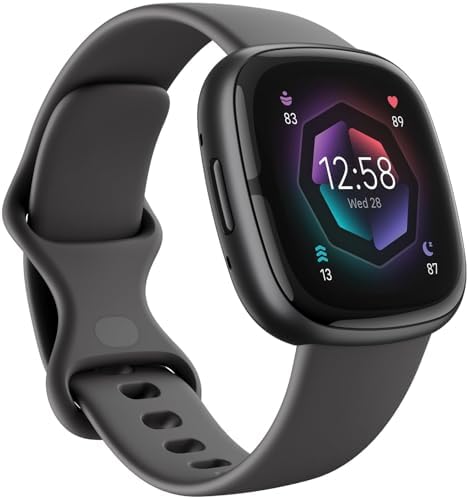
Stress tracking illustrates the philosophical distance between the two platforms. The Fitbit Sense 2 carries a continuous electrodermal activity sensor that reads changes in skin conductance, the same variable measured in laboratory stress research, alongside a skin temperature sensor and heart rate variability data. That combination produces an ongoing stress management score rather than a periodic measurement. The body response feature exists to catch the physiological shift while it is happening, which is why the sensor hardware sits permanently against the skin rather than activating on command.
Samsung takes a software-first route. The Galaxy Watch 8 derives its stress index from heart rate variability alone, then routes that number through the Galaxy AI layer for interpretation. The result is a metric that is easier to generate with existing optics but depends more heavily on the algorithm than on a dedicated biosensor. Whether that matters comes down to the individual: a user who wants a physiological record of stress events has a different need from one who wants a single number between workouts.
ECG, SpO2, and the Limits of Both Sensors
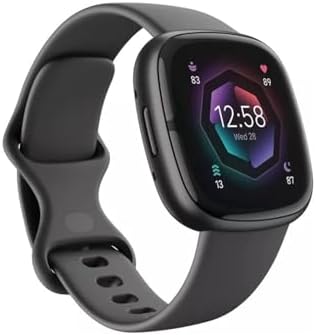
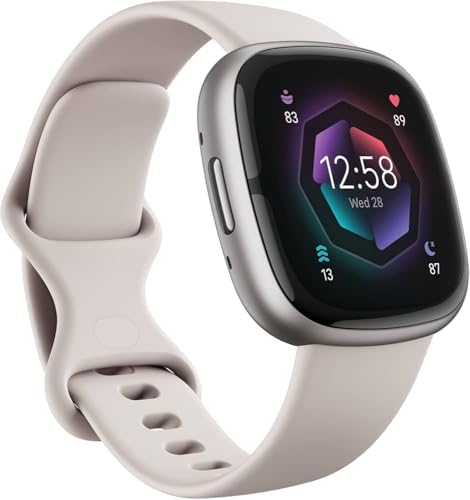
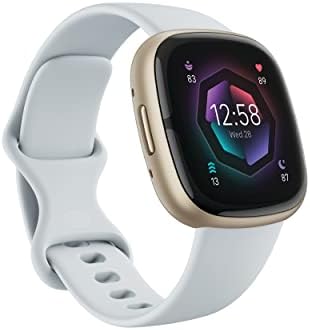
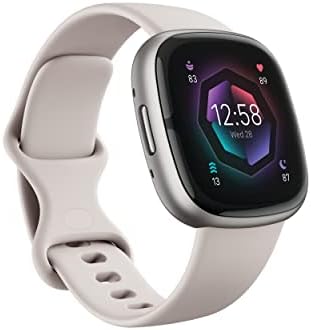
Both watches carry ECG functionality for detecting signs of atrial fibrillation, and both read blood oxygen saturation during sleep. Neither is a diagnostic device, and both carry the same regulatory disclaimer. Where they diverge is the surrounding context. The Fitbit Sense 2 Health and Fitness White GPS pairs its sensor array with the Fitbit app to consolidate rhythm results, breathing data, and sleep stages into a single daily dashboard with minimal interaction required from the wearer.
The Galaxy Watch 8 spreads similar data across Samsung Health, adding a BioActive sensor that estimates body composition through bioelectrical impedance. That feature appeals to users tracking training load and body composition over months rather than to casual step counters. It is worth being clear that the measurement exists, not that its accuracy matches dedicated equipment, because body composition estimation through a wrist contact point remains an indirect method regardless of brand.
Display, Build, and Wrist Presence
The Galaxy Watch 8 display is rated at up to 3,000 nits of peak brightness, a figure confirmed on Samsung’s own specification pages. That number matters more than it sounds, because a watch that stays legible in bright sunlight gets glanced at more and, in practice, delivers more of its data. The cushion design also reduces the case profile generation on generation, so the watch sits flatter than earlier Galaxy models with the same screen size. The pairing of a sapphire crystal face with a touch-driven interface gives it a more precious feel than a fitness-first device usually carries.
The Fitbit Sense 2 chooses quietness over presence. Its case is intentionally unobtrusive and its interface avoids visual noise, which suits users who want data delivered after the fact rather than displayed constantly. For sleeping and continuous wear, the lighter profile is a practical advantage. The trade-off is that the display is designed to be checked briefly, not admired, and Samsung’s panel is more engaging during a workout when split-second glances matter.
Battery Life, Software, and Long-Term Ownership
Battery behavior separates these watches more sharply than anything else in the specification list. The Fitbit Sense 2 is designed around multi-day use, with most owners charging roughly twice a week. The Samsung Galaxy Watch 8 (2025) 40mm Graphite Bluetooth runs a full smartwatch operating system and settles into a night or two per charge, with GPS sessions cutting that shorter. Neither is wrong, but the charging routine is a daily-life factor that rarely appears in short reviews and heavily influences long-term satisfaction.
Software depth runs in the opposite direction. Wear OS gives the Galaxy Watch 8 access to Google Play, offline playlists, navigation, and a mature running coach with real-time prompts. The Fitbit Sense 2 keeps its feature set deliberately closed and polished, with a smaller set of tools executed consistently. For readers weighing the Fitbit brand’s sensor-led design philosophy against broader platform flexibility, the honest answer is that they are not competing for the same buyer.
Who Should Choose Which
| Buyer Profile | Better Match | Reason |
|---|---|---|
| Stress and sleep focus | Fitbit Sense 2 | Dedicated EDA sensor and readiness scoring |
| App and navigation needs | Galaxy Watch 8 | Wear OS with Play Store access |
| Charging reluctance | Fitbit Sense 2 | Multi-day battery in active use |
| Outdoor readability | Galaxy Watch 8 | Peak brightness rated at 3,000 nits |
| Body composition tracking | Galaxy Watch 8 | BioActive impedance sensor |
The clearest deciding criterion is how the watch is used between 9 a.m. and 6 p.m. A reader who wants a body-monitoring companion that asks nothing and runs for days belongs with the Fitbit. A reader who wants notifications, maps, music, and a training coach on the wrist, and who accepts a nightly charge, belongs with Samsung’s model.
The Health Ecosystem and What It Means Over Time
Long-term value in wearables depends on the ecosystem, not the launch spec sheet. Fitbit’s data is now consolidated inside Google’s health services, which gives the Sense 2 a stable, well-supported reporting back end and makes historical trends easy to read. The subscription model behind premium insights remains part of the cost of ownership, and that is worth factoring into the full outlay rather than the sticker figure alone.
Galaxy Watch 8 sits inside a much larger Samsung device network, where a Galaxy phone unlocks the deepest integration for features and Galaxy AI services. Using it with a non-Samsung Android handset or an iPhone works, but the feature set narrows, and Samsung’s own support documentation advises verifying operating system compatibility before purchase. That is the practical caution for anyone not already inside the Samsung phone ecosystem. Readers who want to survey the Samsung Galaxy Watch lineup before deciding will find that the Watch 8 establishes a clear baseline for what the platform now delivers.
Final Judgment for the Undecided Buyer
Neither device is the safer pick in absolute terms, and the specification table makes the reason obvious: they optimize for different outcomes. The Galaxy Watch 8 converts wrist space into screen real estate and computational capacity, then adds a credible health layer on top. The Fitbit Sense 2 converts wrist space into sensor contact time, accepting a smaller display and a closed platform in exchange for continuous physiological coverage across days and nights.
The reading for body-focused users is straightforward, because continuous monitoring rewards uninterrupted wear, and the lighter device with longer endurance wins that argument. The reading for phone-adjacent users points to the watch that can host the apps they already live in. Making that single decision first, rather than comparing feature counts, eliminates most of the uncertainty that keeps buyers circling between these two.