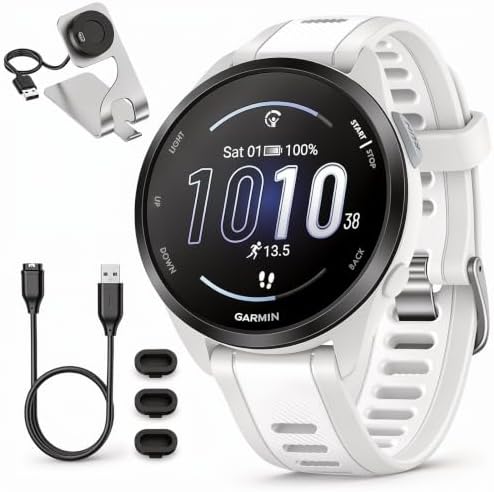
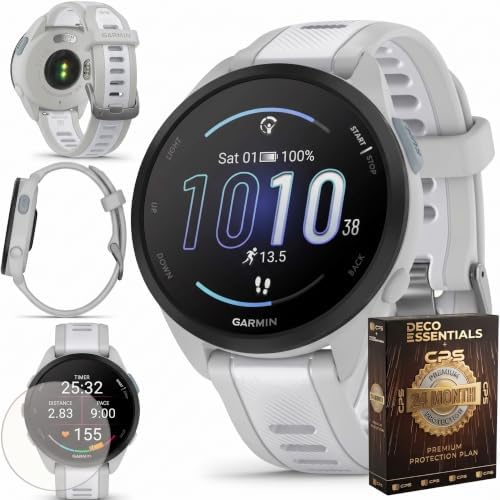
Two Garmin running watches sit at very different points on the value curve, and the gap between them is wider than the price tags suggest. The Forerunner 55 has spent years as the default first serious running watch, while the Forerunner 165 arrives with an AMOLED panel and a deeper training toolkit. This is a buying guide built for the decision itself: who each watch suits, where the real trade-offs sit, and which specifications actually change the purchase rather than simply decorating a spec sheet.
The comparison below is the decision standard. Every row reflects something a runner notices within the first month of ownership, from the screen in daylight to what happens when a training block gets interrupted.
| Feature & Selling Point | Garmin Forerunner 165 | Garmin Forerunner 55 |
|---|---|---|
| Display Technology | AMOLED, full color | MIP, transflective |
| Smartwatch Battery Life | Up to 11 days | Up to 2 weeks |
| GPS Battery Life | Up to 19 hours (GPS-only) | Up to 20 hours |
| Battery Saver Mode | Up to 20 days | Not a headline figure |
| Satellite Positioning | Multi-band GNSS options | Standard GPS and GNSS |
| Training Readiness | Not included | Not included |
| Recovery Insights | Training status and recovery metrics | Basic recovery guidance |
| Daily Suggested Workouts | Included | Included |
| Training Metrics Depth | Broader performance and recovery set | Core pace and heart rate data |
| Touchscreen | Yes, with button control | Buttons only |
| Health Monitoring | Heart rate, sleep, stress, women’s health | Heart rate, sleep, stress |
| Smart Notifications | iPhone and Android compatible | iPhone and Android compatible |
| Built-in Sports Apps | Wider multisport coverage | Running-focused set |
| Best Suited To | Runners wanting a modern screen and richer data | First-time runners and budget-first buyers |
| Value Positioning | Mid-tier upgrade path | Entry-level benchmark |
The table makes the central tension obvious: the Forerunner 55 wins on raw battery endurance, while the Forerunner 165 wins on display quality, positioning accuracy and the breadth of training feedback. Neither gap is cosmetic, and which one matters depends entirely on how the watch will be used.
The Display Question Changes Daily Use More Than Expected
An AMOLED panel alters the relationship a runner has with a watch between sessions. The Forerunner 165 renders workout summaries, sleep graphs and notification previews with the contrast and color depth of a modern phone screen, and the touch layer added on top shortens the path to most menus. Out on the road, that same panel has to compete with direct sunlight, and Garmin addresses this through adjustable brightness and a raise-to-wake behavior rather than the always-legible reflectivity of older display types.
The Forerunner 55 takes the opposite approach. Its memory-in-pixel screen reflects ambient light, so legibility improves as conditions brighten, and the backlight is only needed after dark. That design choice explains much of the battery advantage, and it also means the display never becomes the reason a run gets interrupted by a charging cable. For runners who glance at pace and heart rate mid-session and little else, the MIP screen remains entirely sufficient.
The honest trade-off is this: the Forerunner 165 offers the better screen for everything that happens off the wrist, while the Forerunner 55 offers the better screen for everything that happens in bright daylight with no charging opportunity nearby.
Battery Life and What Two Weeks Really Means
Garmin specifies up to 11 days in smartwatch mode for the Forerunner 165, with a battery saver mode stretching that to roughly 20 days, and up to 19 hours in GPS-only mode. That range covers a marathon training block without daily charging, provided the AMOLED panel is not left at maximum brightness during long outdoor sessions.
The Forerunner 55 posts up to 2 weeks in smartwatch mode and up to 20 hours in GPS mode. Those figures are close enough on paper that the practical difference appears only at the edges: a runner logging six sessions a week with notifications enabled will notice the Forerunner 55’s cushion, while a runner who charges on a fixed weekly routine will find both watches comfortable.
Battery life should be weighed against screen expectations rather than treated as an isolated number. Choosing the AMOLED model means accepting a shorter cycle in exchange for a display that makes post-run analysis genuinely pleasant.
Training Metrics: Where the Two Watches Diverge
Both devices share the fundamentals that make Garmin running watches coherent: built-in GPS, wrist-based heart rate monitoring, sleep tracking, stress tracking, smart notifications, and compatibility with iPhone and Android. Daily suggested workouts appear on both, which matters more than it sounds, because that feature turns either watch into a coach-like presence on easy days.
The divergence sits in depth. The Forerunner 165 carries a broader performance and recovery set, giving runners more context around training load and how sessions stack across a week. Notably, Garmin forum discussion around the Forerunner 165 confirms that training readiness is not part of the package, so buyers expecting every advanced metric from the higher tiers should recalibrate. The 165 is positioned for runners who want meaningful training feedback and a modern interface rather than the complete analytics suite found further up the range.
For runners weighing the Forerunner 165 against the Forerunner 55, the practical question is how much data actually gets acted upon. The Forerunner 55 stays deliberately lean: pace, distance, heart rate, cadence and basic recovery guidance cover the needs of someone building a first consistent habit. Adding more data to a watch worn by a new runner often produces noise rather than insight, and the Forerunner 55 respects that boundary.
- Choose the Forerunner 165 if: the screen is used for review as much as for running, multi-band positioning matters on trails or in cities, and richer recovery context supports the way training is planned.
- Choose the Forerunner 55 if: the priority is a dependable running companion with the longest practical interval between charges and the lowest entry cost.
GPS Accuracy, Size and Everyday Wear
Satellite performance separates these watches in environments where signals bounce. The Forerunner 165 supports multi-band GNSS configurations, which improves track stability under tree cover, between tall buildings and on routes with frequent direction changes. The Forerunner 55 relies on standard GPS and GNSS modes that perform well on open roads and predictable loops, which describes the majority of beginner running routes.
Case size and weight follow the same logic. The Forerunner 165 is built around a larger AMOLED display, and that physical presence suits wrists that carry a watch all day and expect it to look contemporary with casual clothing. The Forerunner 55 is lighter and more discreet, which tends to matter for smaller wrists and for runners who wear a watch overnight for sleep tracking.
Both watches use button-based navigation as their foundation, though the Forerunner 165 adds touch input as a secondary method. During a hard interval session, physical buttons remain the more reliable control surface on either model, particularly with sweaty fingers.
Who Should Buy Which Watch
The purchase decision comes down to a small number of questions. Does the watch need to look and feel current on the wrist every day, or does it need to disappear until the next run? Is post-run data review part of the routine, or does the value sit entirely in the run itself? Will the watch be charged on a fixed schedule, or does it need to survive an unpredictable week?
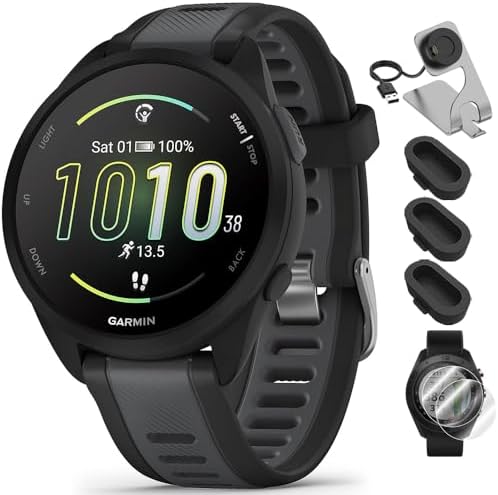
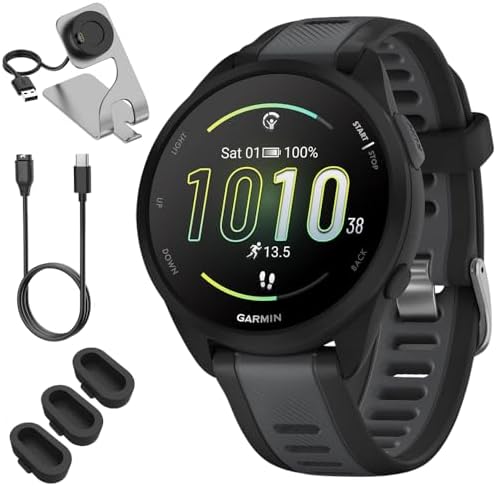
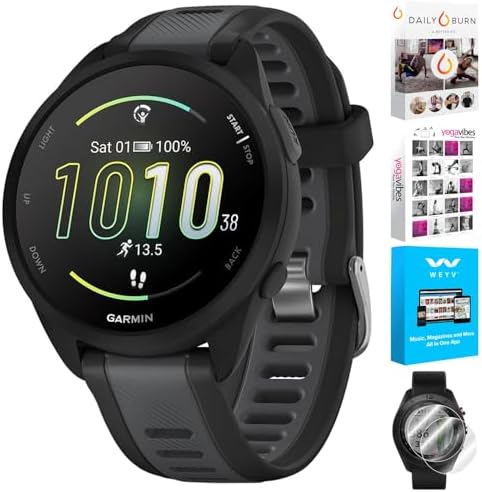
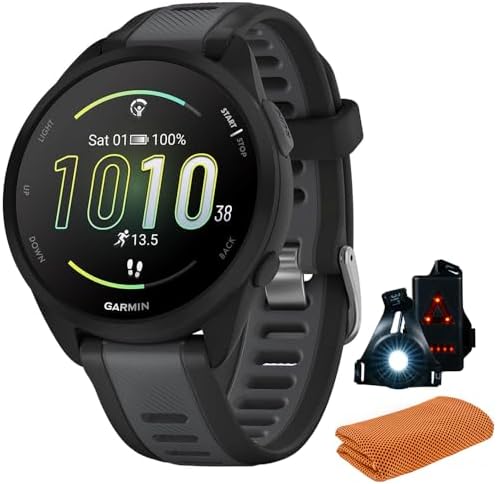
Those leaning toward display quality, multi-band positioning and a fuller training picture should look at Garmin Forerunner 165 Running Colorful AMOLED Black, which packages the modern interface with the metrics that support structured training. Those who want the established entry point with the longest battery interval should consider Garmin Forerunner 55 GPS Running Watch Black, a model that has earned its reputation by doing the essentials without distraction.
A useful frame is upgrade path versus endpoint. The Forerunner 55 works well as a first watch that a runner may eventually outgrow, while the Forerunner 165 works well as a watch that will not need replacing when training ambitions expand. Neither is the wrong answer; they simply answer different questions.
What the Forerunner Line Represents
Garmin has built the Forerunner family around a clear principle: running data should be accessible at every price point, with capability scaling rather than disappearing. Garmin brand’s approach across the range keeps core training features consistent and reserves display technology, positioning precision and analytics depth for the tiers above.
That structure is why the Forerunner 165 and Forerunner 55 can coexist without either undermining the other. One represents the modern expression of the entry-to-mid running watch, with a screen that invites engagement and data that rewards attention. The other represents restraint done properly, where two weeks of battery life and dependable pacing information remain the most useful things a running watch can offer.
A runner who picks either watch is buying into the same philosophy of measurable, honest training feedback. The difference is simply how much of that philosophy they want visible on their wrist every day, and how often they are willing to reach for a charger to see it.