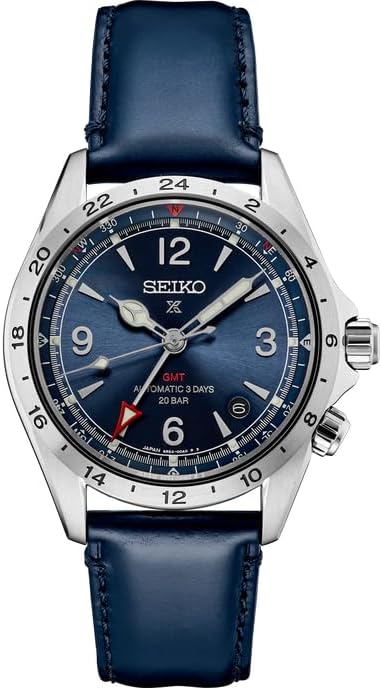
The Seiko Prospex Alpinist line carries a design language rooted in necessity rather than decoration, tracing its lineage to the 1959 Laurel Alpinist, which Seiko identifies as its first sports watch. That origin story matters because the modern references do not simply imitate vintage cues; they translate a climber’s tool into a daily companion. A rotating inner compass ring, a legible dial architecture, and a compact case define the family, and the current generation sharpens each of those elements for people who spend more time on city streets than alpine ridges but still want a watch that could handle either.
The reference most often associated with the modern revival is the Seiko Prospex"Alpinist" Compass Green Dial Sapphire, a watch that collects the series’ signature green sunburst dial, a sapphire crystal, and a bundled leather strap into one coherent package. Understanding why this family endures requires looking at how Seiko has evolved the formula across references such as the SPB155, the SPB377, and the newer SPB507, each of which adjusts proportions, movement, or finishing while preserving the Alpinist identity.
A Design Language Built for Orientation
The defining visual element of any Alpinist is the internal rotating bezel with its compass scale, operated by a secondary crown at four o’clock. Unlike an external dive bezel, this ring sits under the crystal, which keeps the case profile slim and protects the markings from knocks. The layout asks the wearer to align the north indicator with the hour hand and the sun’s position, a low-tech navigation method that has kept the concept relevant for decades. Seiko has not repositioned this feature as a gimmick; it remains a functional compass bearing scale, and the twin-crown arrangement is a recognizable silhouette within the Prospex range.
Dial design follows the same logic of clarity over ornament. Applied indices carry generous luminescent fill, the hands are broad enough to read at a glance, and the minute track is precise without crowding the surface. The green dial on the SPB121 variant is the most requested finish, but the family also appears in lighter and darker tones across references, giving collectors a reason to compare generations. The overall effect is dressier than a dive watch and more purposeful than a field watch, which explains why the Alpinist circulates comfortably between office and trail.
Case Proportions and Engineering Choices
Current Alpinist references sit in a wearable middle ground. According to Seiko’s published specifications, the SPB507 measures 39.5mm in diameter, 12.7mm thick, and 46.4mm lug-to-lug, dimensions that suit a wide range of wrists without surrendering presence. Stainless steel with a super hard coating resists daily scuffs, and a sapphire crystal provides scratch resistance that older mineral crystals could not match. The case finishing alternates brushed and polished surfaces, a detail that separates the line from more utilitarian Prospex models.
Water resistance is rated to 20 bar across the mechanical Alpinist range, a figure Seiko lists consistently in its specifications. That rating covers swimming and heavy rain but should not be read as a dive certification. The dual-crown construction requires proper sealing, and Seiko maintains that engineering standard across the family. For context on how the Alpinist’s robustness compares with other tool-oriented Prospex designs, the SEIKO SRPE93 Prospex Black 45mm takes a different route with a larger case and a dive-style bezel, showing how the brand segments its sports watches by intended use.
Mechanical Movements Across Generations
Movement specification is where the Alpinist family shows its clearest evolution. The SPB155 uses an automatic caliber with manual winding capability, rated at approximately 70 hours of power reserve and an accuracy tolerance of +25 to -15 seconds per day with 24 jewels. Later references such as the SPB377 move to roughly 72 hours of reserve while retaining the same accuracy window and jewel count. The newest generation, represented by the SPB507 and associated 2025 releases, is powered by the Caliber 6R55, which Seiko specifies as a mechanical automatic with manual winding and a three-day power reserve.
That progression matters for buyers comparing references on the secondary market or at retail. A jump from 70 to 72 hours is marginal in daily use, but the consistency of the +25 to -15 seconds per day tolerance across calibers tells you what to expect from regulation. The exhibition case back found on many references lets owners see the movement, and the winding action gives the watch a tactile appeal that quartz alternatives cannot replicate. For a mechanical watch at this price tier, the combination of a three-day reserve and a compass complication is unusual, and it explains much of the Alpinist’s following.
How the Alpinist Fits Within Prospex
Prospex is Seiko’s professional-sports umbrella, and its sub-families target distinct activities. Dive watches dominate the lineup, but chronograph-focused models also sit under the same banner. Much like the SEIKO SSC947 Prospex Speedtimer represents the racing-oriented branch with a solar chronograph architecture rather than a mechanical three-hand movement, the Alpinist occupies its own compass-driven territory. Placing the two side by side clarifies the design brief: one is built for timing and motorsport, the other for orientation and overland travel.
Buyers frequently cross-shop these sub-families because they share a price band and the Prospex name. The distinction comes down to complication philosophy. The Alpinist offers a compass ring and a clean three-hand dial; the Speedtimer offers sub-dials and a tachymeter scale. Neither approach is inherently superior, but the Alpinist’s quieter layout makes it the more versatile choice for formal wear, while the Speedtimer’s busier face suits casual and sporting contexts. Understanding that trade-off prevents a purchase that looks right in photos but feels wrong on the wrist.
Strap Options and Ownership Experience
The Alpinist has historically shipped on leather, and the SPB121 is a clear example with its bundled strap. Leather suits the watch’s vintage-inflected character, but owners often experiment with steel bracelets or nylon straps to change the feel. The 20mm lug width common to the family makes aftermarket pairing straightforward, and the drilled or standard lugs depending on reference affect how easily straps can be swapped. This flexibility is part of the ownership appeal: the same watch can read as a dress piece on leather and a field tool on fabric.
Serviceability follows Seiko’s standard mechanical support structure. The calibers used in the line are well-documented, parts availability is broad, and independent watchmakers are familiar with the architecture. That matters for long-term ownership in a way that proprietary movements do not, and it keeps the cost of running an Alpinist predictable. Collectors also track reference numbers carefully because dial colors, compass ring typography, and crown design shift between generations, creating a genuine research hobby around a watch that retails at an accessible level.
Choosing the Right Reference
The decision usually narrows to dial preference and movement generation. Those who want the classic green sunburst and a proven caliber gravitate toward earlier references, while buyers who value the upgraded power reserve and latest finishing look to the newest releases. Case size differences between 38mm and 39.5mm references are subtle on paper but noticeable on smaller wrists, so trying a watch on or checking lug-to-lug figures before ordering is worthwhile. Accuracy expectations should be set from Seiko’s stated tolerance rather than anecdotal reports.
Compass operation is also worth understanding before purchase. The bezel is not a set-and-forget feature; it requires the wearer to learn the sun-alignment method, and that learning curve is part of the charm. Buyers who want a purely decorative rotating ring may find the Alpinist more complicated than necessary, while those who hike, travel, or simply enjoy mechanical problem-solving will find the complication earns its place. The family rewards curiosity, and that is a rare quality in a market full of straightforward three-handers.
The Enduring Appeal of a Purposeful Tool
Seiko has kept the Alpinist alive by resisting the urge to reinvent it. The compass ring, the twin crowns, the restrained dial, and the mechanical heartbeat underneath have all survived multiple generations because they work together as a system rather than a checklist of features. Newer references refine the formula with sapphire crystal, improved coatings, and longer power reserves, but the core idea remains unchanged since the 1959 original. That continuity gives the line a coherence that fashion-driven releases rarely achieve, and it explains why the Alpinist continues to attract both first-time mechanical buyers and seasoned collectors.
For anyone building a collection around usable watches rather than safe-queen pieces, the Alpinist occupies a specific and durable niche. It is capable enough for travel and outdoor use, refined enough for daily office wear, and mechanically interesting enough to justify a closer look at the movement through the case back. The broader Seiko collection offers dozens of directions for a buyer to explore, but few models balance heritage, function, and wearability as cleanly as this mountain-born family. The watch rewards the wearer who values a tool with a story, and that story is still being written with each new reference.