The Garmin Forerunner 165 series and the Forerunner 255 series sit close enough in price and purpose that buyers routinely cross-shop them, yet they were designed around different priorities. One leans on a bright AMOLED panel and a lighter training load; the other leans on multi-band positioning, dual-size options and race-day readiness tools. This guide exists to make that decision concrete: it compares the specs that actually change daily use, explains the trade-offs behind them, and closes with clear criteria for who should buy which model.
| Feature & Selling Point | Garmin Forerunner 165 | Garmin Forerunner 255 |
|---|---|---|
| Display technology | AMOLED, full color | MIP trans-reflective |
| Case sizes offered | Single 43 mm case | 46 mm and 41 mm S variant |
| Smartwatch battery life | Up to 11 days (20 days in battery saver) | Up to 14 days |
| GPS battery life | Up to 19 hours GPS-only; 17 hours all-systems | Up to 30 hours GPS-only; 25 hours all-systems |
| Satellite positioning | Multi-GNSS, single-band | Multi-GNSS with multi-band option (255 Music) |
| Training readiness score | Not included | Not included (reserved for Forerunner 265) |
| Daily suggested workouts | Included | Included |
| Running dynamics | Basic metrics; advanced data via accessory | Native running dynamics and running power |
| Race predictor and VO2 max | Included | Included |
| On-device music storage | Not available (controls phone playback) | Available on the 255 Music edition |
| Multi-sport and triathlon modes | Running-centric profiles | Includes triathlon and multi-sport transitions |
| Touchscreen input | Touchscreen plus buttons | Button-only operation |
| Typical price positioning | Lower entry point | Mid-tier, higher than the 165 |
| Best suited to | Newer runners, daily readability, casual tracking | Structured training, racing, multi-sport athletes |
The table reveals the shape of the decision in one glance. The Forerunner 165 competes on display quality, touch input and price, while the Forerunner 255 competes on battery endurance, dual case sizing, multi-band GPS and triathlon versatility. Neither watch includes Garmin’s training readiness score, a detail worth noting because forum discussion often assumes otherwise; that metric belongs to the Forerunner 265.
Display and Daily Wearability
The most immediate difference between these two watches is the screen. A bright AMOLED display makes notifications, watch faces and workout summaries legible in a way that feels closer to a smartphone than to a traditional sports watch. In dim conditions the contrast is striking, and the touchscreen adds a second input method for swiping through widgets and glanceable data.
Extended outdoor sessions tell a different story. Trans-reflective memory-in-pixel panels rely on ambient light, so they become sharper as the sun gets brighter and draw very little power. The Forerunner 255 uses that older, more efficient display philosophy, which partly explains why it stretches further on a charge. A runner who trains at midday will find both readable; a runner who streams wrist notifications all day on a wrist that rarely charges will notice the gap between up to 11 days on the 165 and up to 14 days on the 255.
Physical sizing is another practical divider. The 165 ships in a single 43 mm case, which sits comfortably on most wrists and keeps the lineup simple. The 255 arrives in a 46 mm version and a smaller 41 mm S variant, so buyers with slimmer wrists or a preference for compact cases get a genuine choice rather than an afterthought.
GPS Accuracy and Battery Strategy
Accuracy under tough conditions is where price tiers quietly separate. Multi-band positioning uses multiple satellite frequencies at once to reduce errors from signal reflections in cities and dense terrain. The Forerunner 255 provides multi-band capability on the 255 Music edition, and it pairs that with the longer GPS budget: up to 30 hours in GPS-only mode and up to 25 hours in all-systems mode, against up to 19 hours and 17 hours respectively on the 165.
Those numbers map onto real plans. A marathon takes most runners under five hours, so both watches cover race day comfortably. The divide appears over ultras, overnight relays and weekend adventure races, where every saved percentage point of battery matters. The following list frames how the two watches approach a training week:
- Short daily runs: Both watches handle commute-friendly sessions with satellite lock and heart rate tracking.
- Long efforts: The 255 holds GPS lock for noticeably longer stretches before charging.
- Signal-hostile routes: Multi-band on the 255 Music edition reduces drift in urban canyons.
- Charging rhythm: The 165 suits weekly charging habits; the 255 forgives forgetful owners.
Battery strategy is not simply about capacity. Garmin’s compare pages show the 255 trading a lower-resolution panel for endurance, which is a deliberate engineering trade rather than a limitation. Buyers who value a brilliant wrist display every day should weigh that preference against the peace of mind of a watch that can go nearly two weeks without a charger.
Training Metrics and Coaching Tools
Both watches provide far more coaching data than most runners use. Each supports VO2 max estimation, race prediction, daily suggested workouts and recovery insights, so the core training loop is present on either model. The gap sits in the depth and immediacy of advanced data. The Forerunner 255 reports native running dynamics and running power without extra accessories, whereas the 165 leans on basic metrics and needs a compatible sensor for the deepest form analysis.
It is worth addressing two misconceptions directly. Neither watch offers training readiness, a score that estimates how prepared the body is for hard work; that tool lives in the 265 and higher tiers. The 165 conversely carries a substantial set of training metrics for its class, so the entry model is far from stripped down. For a runner working through a structured 5K to half-marathon block, the difference is subtle; for a runner chasing lap-level form data and multi-sport efficiency, the 255 is the better-trained instrument.
Sport profile breadth closes the gap for triathletes. The 255 includes triathlon and multi-sport transition modes that log swim, bike and run legs as one continuous effort. The 165 stays running-centric and handles related disciplines less elegantly. That distinction matters most to athletes who treat multisport racing as a habit rather than an experiment.
Connectivity, Music and Everyday Use
Music storage is a clear fork in the road. The 255 Music edition stores playlists on the watch and connects directly to Bluetooth headphones, which is useful for runners who leave the phone at home. The 165 instead controls playback on a paired phone, meaning the handset has to travel along. Neither approach is wrong, but the requirement to carry a phone changes what a minimalist run looks like.
Everyday usability tilts toward the 165. The touchscreen makes scrolling through notifications and widgets more intuitive, particularly for buyers stepping up from a general-purpose smartwatch. The 255 sticks with button-only operation, a choice many serious runners actually prefer because physical buttons respond predictably with wet fingers or gloves.
Smartwatch essentials are shared across both models: heart rate monitoring, smartphone notifications, sleep tracking and iPhone and Android compatibility. Buyers entering the ecosystem for the first time will find these fundamentals fully present, which is why the choice so often comes down to hardware priorities rather than missing features.
Which Buyer Should Choose Which Watch
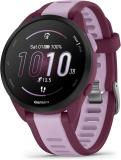
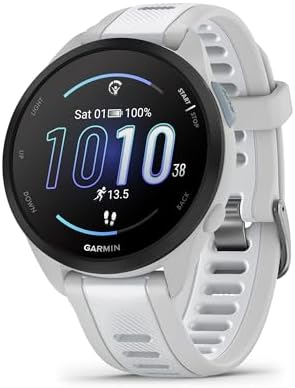
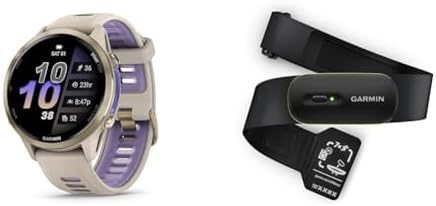
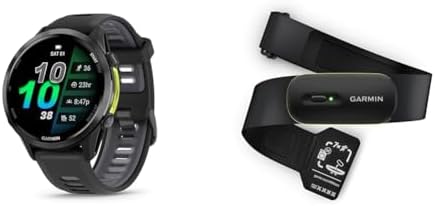
A runner stepping up from a general smartwatch, prioritizing a vivid display and everyday glanceability, will find the Garmin Forerunner 165 Running Colorful AMOLED Black a sensible first serious training watch. It keeps the essential metrics, adds touch convenience and stays approachable on price. Buyers testing whether structured training fits their routine lose little by starting here.
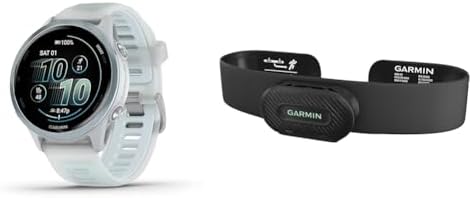
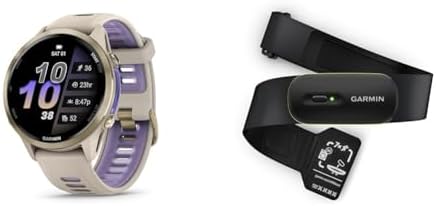
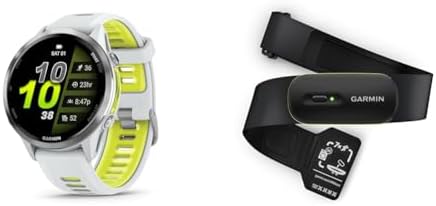
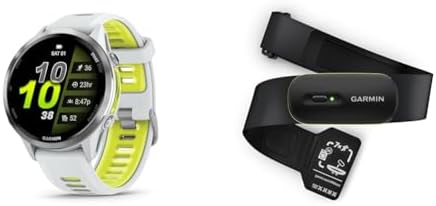
A runner with a race calendar, multi-sport ambitions or a preference for compact case sizing should weigh the alternative. The Garmin Forerunner 255 GPS Running Advanced Slate brings native running dynamics and triathlon modes in a package that is less flashy but more capable over long efforts. The trade is a less striking screen and button-only control.
Buyers who want to see how the entry tier is positioned before committing can browse the Forerunner 165, where the AMOLED-first approach defines the whole line. Runners who already know their training will extend into longer blocks and multi-sport racing tend to gravitate toward the Forerunner 255 instead, since its battery and positioning headroom only matter once weekly mileage climbs. The Garmin brand’s broader running catalog makes that progression easy to trace, and the shared app platform means data carries over if a runner later trades up or down.
The decision standard can be reduced to three questions. First, does a bright AMOLED display and touchscreen change how often the watch is worn and checked? Second, does the training plan involve distances or terrain where multi-band accuracy and 30-hour GPS budgets alter the outcome? Third, does the sport list stay inside running, or does it extend into swim and bike legs? Honest answers to those three questions resolve nearly every case, and they explain why two watches this similar can serve such distinct buyers.
The Forerunner line has always traded equipment at the margins of training rather than at the margins of marketing, and this pairing continues that tradition. Choosing deliberately, based on display preference, battery expectations and race ambitions, produces a watch that stays useful through seasons of training rather than one that merely looks right on the wrist.