The Amazfit T-Rex 3 and the Garmin Instinct 3 Solar approach the same brief from opposite directions: one leans on a large AMOLED panel and a vast activity catalogue, the other on sunlight-harvesting power management and a monochrome memory-in-pixel screen. This comparison is built as a working buying guide, structured so that the decision criteria stay useful long after the launch cycle fades.
Both the Amazfit T-Rex 3 series and the Garmin Instinct 3 Solar collection target hikers, trail runners, and tactical-minded users, but their engineering priorities diverge sharply. The table below sets out the specifications that actually change a purchase decision.
| Decision Factor | Amazfit T-Rex 3 | Garmin Instinct 3 Solar |
|---|---|---|
| Display Type | 1.5-inch AMOLED, full colour | Monochrome memory-in-pixel, solar lens |
| Case Size | 48mm | 45mm |
| Power Strategy | Rechargeable battery only | Solar charging assists battery |
| Typical Battery Claim | Up to 27 days in watch mode | Multi-week smartwatch mode, extended by sun exposure |
| Offline Maps | Included | Navigation-focused, dependent on model tier |
| Sport Modes | 170+ profiles | Core outdoor and multisport profiles |
| Flashlight | Not a headline feature | Built-in LED flashlight |
| Bezel Construction | Polymer rugged housing | Metal-reinforced bezel |
| Water Resistance | Rated for swimming and water sports | Rated to 10 ATM |
| Voice and AI Features | Voice control and AI assistance | Companion-app driven |
| Ecosystem Depth | Zepp app, broad but younger platform | Garmin Connect, mature training analytics |
| On-Wrist Weight Feel | Larger footprint, lighter materials | Compact, dense build |
| Best Suited To | Map-led hiking, gadget-heavy users | Multi-day expeditions, solar-focused users |
| Value Proposition | Feature density at a lower tier | Longevity and field reliability |
The most consequential split sits in the first two rows: a bright colour AMOLED against a sunlight-readable monochrome panel, and a 48mm case against a 45mm one. That single pairing already sorts most buyers, because it determines whether the watch is read like a smartphone on the wrist or like an instrument that simply refuses to power down.
Display Philosophy: Colour Saturation Versus Sunlight Survival
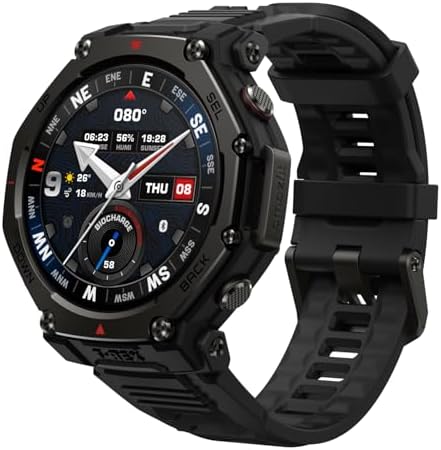
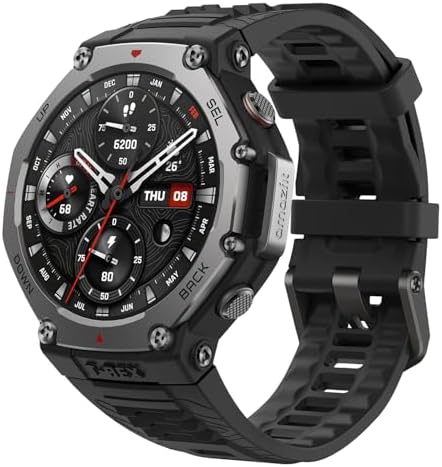
The 1.5-inch AMOLED panel on the Amazfit T-Rex 3 produces the kind of contrast that makes map tiles and workout graphs immediately legible. Colour grading, watch face variety, and animated transitions all benefit from the panel technology, and the larger 48mm case gives that display room to breathe. For users who treat a smartwatch as a secondary screen, this is the more rewarding arrangement.
Garmin’s memory-in-pixel approach on the Instinct 3 Solar reverses the priority. The panel draws very little current because it only refreshes the pixels that change, and each segment stays visible without backlighting. Combined with the solar lens layered over the display, the watch can gain usable charge from ambient light during long days outdoors. Garmin states that the Instinct 3 line pairs solar charging with a rugged build, and that positioning is visible in how the display behaves: it is designed to be read at a glance in direct sun rather than admired indoors.
Battery Math and the Solar Advantage
Amazfit’s headline claim of up to 27 days in watch mode is a genuine figure for careful users, and it puts the T-Rex 3 well beyond most colour-screen rivals. The caveat is standard: GPS sessions, always-on display settings, and music playback erode that number quickly, and a colour AMOLED is inherently a heavier consumer of power than a monochrome panel.
The Instinct 3 Solar answers the same question through a different mechanism, layering photovoltaic collection on top of an already frugal display. Field reports on Garmin’s own community forums describe smartwatch-mode testing with heart rate, Bluetooth, notifications, and sleep tracking all active, and the meaningful takeaway is that light exposure genuinely changes the effective runtime. For a multi-day trek where a charging cable is dead weight, that behaviour is not a gimmick but a planning variable.
Navigation, Mapping, and the Offline Question
Offline map support is one of the clearest differentiators in the T-Rex 3’s favour. Preloaded map data on a colour screen turns the watch into a genuine navigation aid for unfamiliar trails, with route overlays that remain readable without a phone signal. The Amazfit T-Rex 3 also carries a claimed 170-plus sport profiles, which matters to users who rotate through climbing, paddling, and gym work and dislike being told a mode does not exist.
Garmin’s advantage lies in the maturity of its route and track handling rather than raw profile counts. Navigation on the Instinct 3 is built around waypoints, tracks, and return-to-start routing, and the depth of the Connect platform supports pre-trip planning and post-trip analysis in a way that a younger ecosystem is still catching up to. Neither approach is wrong; they answer different questions about how much preparation happens before the trailhead.
Build, Durability, and Field Ergonomics
The Instinct 3 Solar’s metal-reinforced bezel and built-in LED flashlight are the two details that most often decide the purchase for field users. A bezel that resists rock abrasion protects the investment, and a wrist-mounted light removes the need to fumble for a headlamp during a late descent or a tent-side repair. Garmin positions the Instinct 3 as a rugged GPS smartwatch with tactical features, and the hardware backs that framing.
At 48mm, the T-Rex 3 will read as a large watch on slimmer wrists, and its polymer-forward construction trades some perceived density for reduced weight. Buyers with wrist circumferences below roughly 17cm should try to see one in person before committing, because the difference between 45mm and 48mm is more noticeable in daily wear than the specification sheet suggests.
Training Ecosystem and Everyday Intelligence
Garmin’s ecosystem is the more complete training instrument. Garmin’s ecosystem consolidates load trends, recovery insight, and structured workouts through the Connect platform, and that breadth is why endurance athletes tend to stay inside it once they arrive. The Garmin Instinct 3 45mm Solar Charged Black inherits that infrastructure, which is often the deciding factor for anyone already tracking training data seriously.
Amazfit counters with breadth of a different kind: voice control, AI-assisted features, and a very large activity library wrapped around the Zepp app. For users who want a smartwatch that also functions as a daily fitness companion with smart-home-adjacent conveniences, the T-Rex 3 delivers more surface-level capability per unit of spend. The trade-off appears over months rather than days, as the depth of long-term analytics separates the two platforms.
Who Should Buy Which
- Choose the Amazfit T-Rex 3 if: offline maps and a bright AMOLED display are priorities, wrist presence is not a concern, and the larger sport-mode catalogue plus voice features are genuinely useful.
- Choose the Garmin Instinct 3 Solar if: multi-day trips without reliable power are routine, the monochrome display suits your reading habits, and a flashlight plus hardened bezel solve real field problems.
- Choose neither yet if: wrist size sits below 17cm and the 45mm Instinct feels like the upper limit, or if structured training analysis is the main use case rather than navigation.
Both watches are honestly specified for their price tier, and the decision hinges on which constraint binds first: power availability, wrist real estate, or ecosystem depth. Amazfit’s approach rewards users who want maximum visible capability, while the solar-harvesting Instinct rewards users who plan around sunlight and silence rather than screens and notifications. Matching the watch to the terrain, rather than to the specification sheet, is the criterion that holds up long after the comparison tables are forgotten.