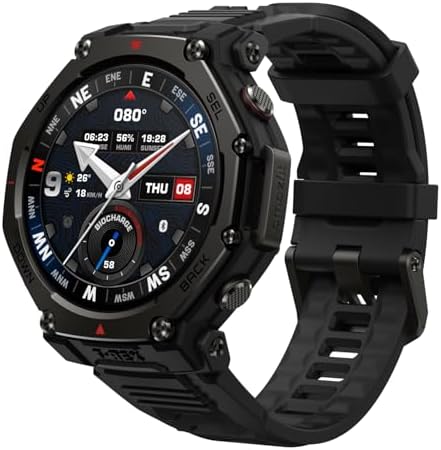
The rugged GPS smartwatch segment has split into two distinct engineering philosophies, and the choice between the Amazfit T-Rex 3 Pro series and the Garmin Instinct 3 collection illustrates that divide more clearly than any spec sheet alone. One path prioritises maximum screen area, sapphire-class scratch resistance and multi-day endurance at an aggressive price; the other leans on a mature outdoor ecosystem, solar-assisted power management and a 45mm AMOLED variant that balances legibility with battery economy. This guide is written as a permanent reference for buyers who intend to wear one watch across trail runs, altitude hikes, gym sessions and everyday office hours, so the comparisons below focus strictly on the decisions that actually change which model leaves the shelf with you.
| Decision Criterion | Amazfit T-Rex 3 Pro | Garmin Instinct 3 |
|---|---|---|
| Display Type | 1.5 in AMOLED | AMOLED (45mm) or solar-assisted MIP (50mm) |
| Glass and Bezel | Sapphire glass, titanium bezel | Metal-reinforced bezel, chemically strengthened glass |
| Typical Case Size | 48mm | 45mm (AMOLED), 50mm (Solar) |
| Stated Battery Life | Up to 25 days | Up to 18 days (45mm AMOLED) |
| Solar Charging | Not listed | Available on Instinct 3 Solar |
| GNSS Positioning | Dual-band GPS | Multi-band GNSS (model dependent) |
| Offline Maps | Included | Course and track navigation, no full topo maps on base model |
| Integrated Flashlight | Yes | Yes |
| Water Resistance | Rated for swimming and water sports | Rated to 10 ATM (100 metres) |
| Training Load Analytics | Broad multi-sport profiles | Deeper recovery, TSS and daily suggested workouts |
| App Ecosystem | Zepp app, lighter third-party library | Garmin Connect plus Connect IQ store |
| Tactical Tools | Standard outdoor toolkit | Stealth mode and kill switch on tactical variants |
| Best Suited To | Large-wrist wearers wanting screen size and map coverage | Multi-sport users who train to recovery data |
| Primary Trade-Off | Bigger, heavier case with a shallower software ecosystem | Smaller screen and no full topographic maps on standard models |
Two rows in that table decide most purchases. The first is endurance: the Amazfit lists a 25-day figure against 18 days for the 45mm AMOLED Instinct 3, yet only the Instinct 3 collection extends that headline number through solar harvesting on its 50mm Solar edition, which Garmin states delivers more than five times the GPS-mode battery life of the outgoing Instinct 2 Solar. The second is screen ambition: a 1.5-inch AMOLED behind sapphire glass on a titanium bezel is a specification normally reserved for flagship multisport watches, and it is the clearest reason to pick the Amazfit over the Garmin.
Display Philosophy: Sapphire AMOLED Against a Dual-Line Strategy
The T-Rex 3 Pro treats its display as the centrepiece. A 1.5-inch AMOLED panel inside a 48mm titanium-bezel case gives a genuinely large viewing area for offline maps, and the sapphire crystal covering it resists the abrasion that scuffs ordinary mineral glass on granite scrambles and caving trips. For buyers who read contour lines while moving, that combination of surface area and hardness is difficult to argue against.
Garmin splits the question instead. The Garmin Instinct 3 45mm AMOLED Display Black GPS brings a bright, colour-rich screen down to a 45mm case with a metal-reinforced bezel, while the 50mm Solar variant keeps a lower-power memory-in-pixel display tuned for sunlight readability and battery conservation. Neither approach is superior in the abstract; the distinction matters because a transflective MIP panel stays legible in direct glare in a way even a strong AMOLED must work harder to match, and it draws far less current in always-on scenarios.
Battery Architecture and the Meaning of a 25-Day Claim
Long-duration figures are only useful when the conditions behind them are understood. The T-Rex 3 Pro quote of 25 days reflects watch-mode operation on a large battery, and that runtime shortens materially once dual-band GPS tracking, music playback or continuous heart-rate broadcasting are layered on. The structure still favours the Amazfit for users who take one charge into a two-week trek and want the buffer.
Garmin’s counter is topological rather than numerical. The 45mm AMOLED model is rated to roughly 18 days, and the Solar edition trades display technology for energy harvesting, topping up in daylight and extending operation in exactly the environments where chargers do not exist. Garmin positions solar charging not as a novelty but as an endurance feature, and the company’s own comparison to the Instinct 2 Solar frames the generational gain in GPS runtime as the headline improvement for expedition users.
Navigation Depth: Offline Maps Versus Course-Based Routing
Spatial confidence is where the Amazfit makes its most persuasive case. Offline maps stored on the watch mean a full trail network can be consulted on-wrist without a phone signal, which is a meaningful advantage on alpine routes where networks drop out for hours. Add dual-band GPS reception, which mitigates the multipath errors common in canyon and dense-forest terrain, and the navigation package reads as a genuine backcountry tool rather than a route breadcrumb display.
The Instinct 3 answers with a different set of navigation strengths: track-based routing, back-to-start guidance and waypoint handling that integrates tightly with saved activities and course files. Full topographic charting is not part of the standard model’s offer, so a buyer whose trips depend on reading full map layers should weigh that limitation honestly. Where the Garmin compensates is continuity, since routes planned in Garmin Connect transfer to the wrist without friction and the watch’s multi-band GNSS behaviour can be tuned per activity.
Training Intelligence: Analytics Ecosystems Under Scrutiny
Recovery guidance increasingly separates these two classes of device. Garmin’s platform produces a training status reading built from heart-rate variability, sleep quality and accumulated load, and it will suggest daily sessions calibrated to that state. For athletes following a structured block of base building or threshold work, the value lies in the way the Instinct 3 converts raw sensor data into a directive rather than a chart to interpret manually.
The Amazfit T-Rex 3 Pro Smart Watch Titanium 48mm GPS does not sit out this contest. It covers a wide catalogue of sport profiles, tracks training load and keeps the health-monitoring suite that owners of the Amazfit range expect, from continuous heart rate to sleep staging. What it does not replicate is the depth of Garmin’s recovery modelling or the maturity of the Garmin brand’s Connect IQ library, where third-party data fields and watch faces remain a practical advantage for users who tune their dashboards relentlessly.
Case Size, Materials and Daily Wearability
Physical presence changes who should buy what. A 48mm titanium-bezel case with a 1.5-inch screen suits larger wrists and rewards wearers who want the watch to read as a piece of outdoor equipment. On a narrower wrist the same dimensions can feel unwieldy during sleep tracking or under a shirt cuff, which is a practical consideration rather than an aesthetic one.
The 45mm AMOLED Instinct 3 sits closer to conventional sports-watch proportions, and its metal-reinforced bezel adds protection without adding bulk. Both watches meet serious water-resistance expectations, and both include an integrated flashlight, a small feature that proves disproportionately useful on night descents and in tents. Buyers choosing between them should treat case diameter as a primary filter rather than an afterthought: an oversized watch that gets left in a drawer loses every specification argument.
Who Should Buy Which
- Choose the Amazfit T-Rex 3 Pro if: wrist presence is welcome, offline topographic maps are a requirement, sapphire-and-titanium durability appeals, and the longest possible unplugged runtime matters.
- Choose the Garmin Instinct 3 if: structured training and recovery metrics drive your week, solar top-up on multi-day expeditions is valuable, or you prefer a smaller 45mm case with a metal-reinforced bezel.
- Choose the Instinct 3 Solar specifically if: you spend consecutive days above the treeline and want the 50mm display technology that trades colour for daylight harvesting.
- Purchase criteria to settle first: case diameter on your wrist, whether you need full map layers or course routing, and how much recovery coaching you will genuinely use.
Both watches represent defensible answers to the same question about what a rugged GPS device should be. The Amazfit T-Rex 3 Pro pushes screen technology and map capability into a case built for hard use, while the Garmin Instinct 3 refines an outdoor ecosystem that turns sensor data into guidance and lets sunlight extend an expedition. Deciding between them is less about which specification sheet is longer and more about which philosophy matches the terrain ahead.