Two running watches from the same family can still pull a training week in opposite directions, and the Forerunner 170 versus Forerunner 265 question is really a question about how much interpretation a runner wants from a wrist device. The Forerunner 170 series sits at the value end of the lineup, while the Forerunner 265 collection occupies the data-rich middle tier, and the gap between them is not one feature but a whole philosophy of training. This comparison is written as a buying guide worth keeping, because the right choice depends less on the spec sheet than on how a runner actually uses the data.
The essentials sit side by side below. Both watches track pace, distance, and heart rate, but they diverge on display technology, recovery analytics, safety features, and case size. Those four axes decide most purchases.
| Feature and Selling Point | Garmin Forerunner 170 | Garmin Forerunner 265 |
|---|---|---|
| Display Type | Color LCD, always-on option | AMOLED, color-rich and bright |
| Smartwatch Battery Life | Up to 13 days | Up to 13 days |
| GPS Battery Life | Long single-frequency GPS runtime | Up to 20 hours GPS-only, 16 hours SatIQ |
| Display Size | Compact running-watch panel | 1.3-inch diagonal |
| Resolution | Standard color resolution | 416 x 416 pixels |
| Case Size | 43 mm | 46 mm |
| Weight | Lighter, compact fit | Approximately 47 g |
| Training Readiness | Basic training status | Full Training Readiness score |
| Recovery Analytics | Recovery time only | Recovery, HRV status, sleep score |
| Music Storage | Yes on Music edition | Yes, built in |
| Sport Modes | Full running, cycling, swim set | Expanded multisport profile |
| Running Dynamics | Core metrics via app | Running economy and tolerance |
| Water Resistance | 5 ATM | 5 ATM |
| Payment and Safety | Smart notifications | Garmin Pay and incident detection |
| Best Use Case | First serious race watch | Multi-distance racers and data hounds |
| Value Position | Lower entry cost | Premium tier, higher cost |
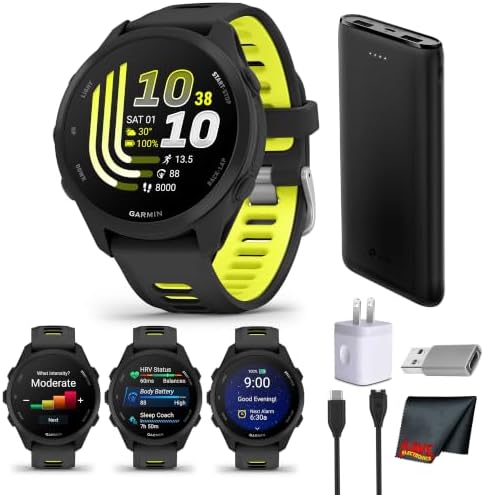
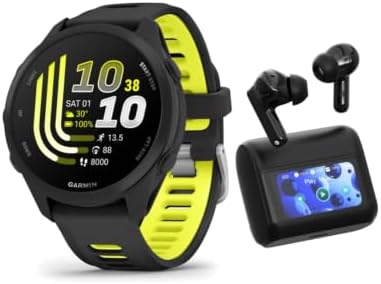
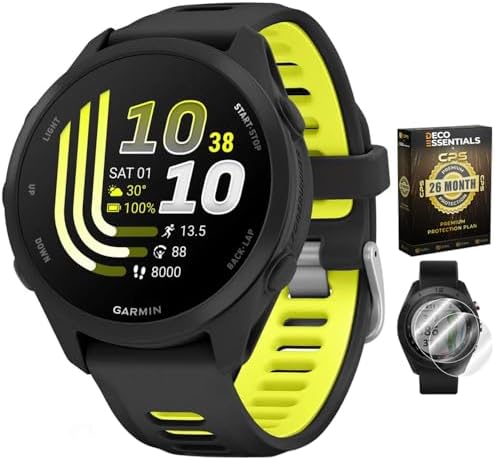
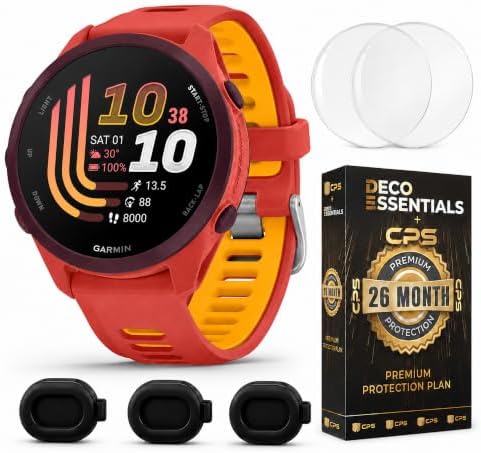
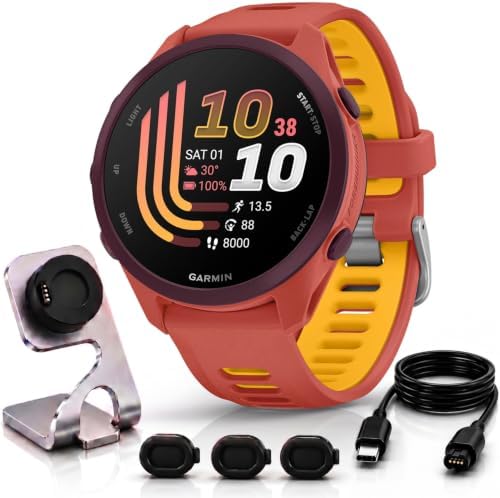
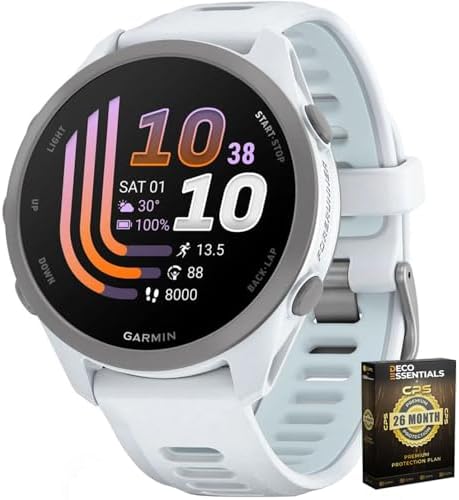
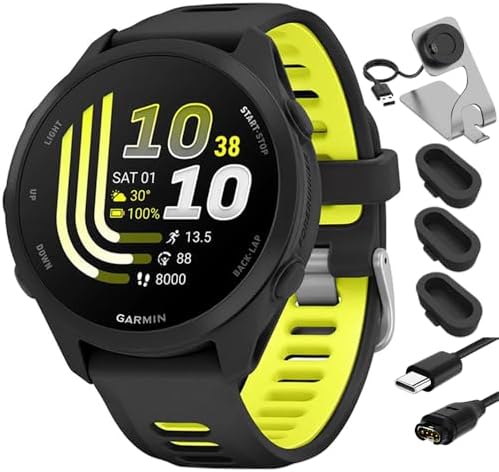
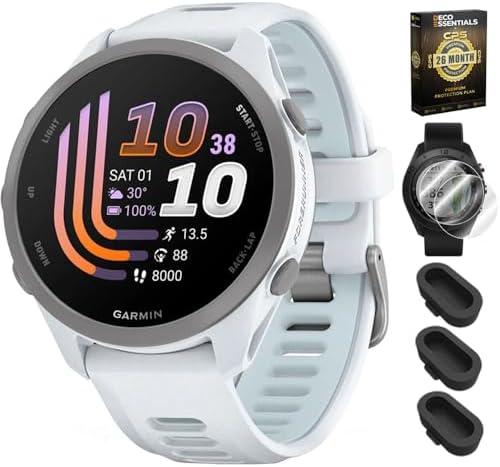
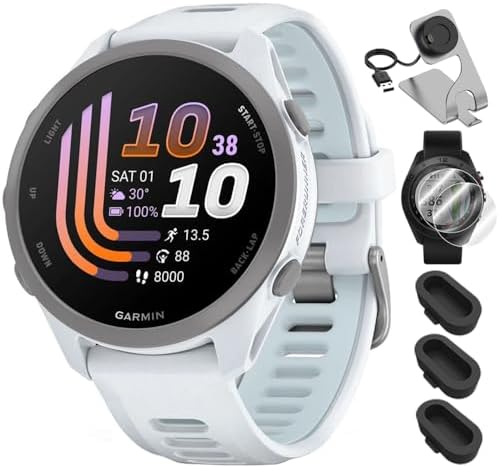
The table makes two differences decisive. The Garmin Forerunner 170 Music 43mm Black keeps a smaller case and a lower cost without surrendering the training basics. The Garmin Forerunner 265 Running Colorful AMOLED Black trades that price advantage for display quality and physiological depth. Everything else in this comparison follows from those two trade-offs.
Display Technology and Daily Wear
The most immediate difference a buyer notices is the screen. The Forerunner 265 runs an AMOLED panel at 416 x 416 pixels across a 1.3-inch diagonal, and the effect is not cosmetic: dark-mode watch faces preserve battery, text is legible at a glance on the run, and the display remains visible in direct sunlight. Garmin also uses that screen to color-code training zones, heart-rate ranges, and readiness scores, which matters more than it sounds when a glance at the wrist happens mid-interval.
The Forerunner 170 takes a different route. Its color display is bright enough for outdoor use and supports an always-on option, but it does not carry the AMOLED panel’s contrast or the same efficiency profile. In return, the 43mm case and lighter build produce a lower swing weight, which some runners prefer for fast sessions and sleep tracking. Anyone moving from a decades-old monochrome Forerunner will find the 170 a clear upgrade; anyone moving from a modern smartwatch may find the 170’s display the compromise and the 265’s the reason to spend more.
Battery Strategy in Practice
Garmin publishes matching smartwatch figures for both watches, up to 13 days in normal use, but the GPS numbers diverge. The Forerunner 265 is rated for up to 20 hours in GPS-only mode and up to 16 hours when SatIQ automatically selects satellite systems. That is enough for a marathon or a long trail day without a charging break, and it explains why the 265 has become common on ultra start lines. The Forerunner 170 leans on a lower-power panel to stretch its GPS runtime, and its smaller display demands less from the battery; exact figures should be checked against the current Garmin spec sheet rather than assumed from marketing copy.
Weight and Fit on the Wrist
Garmin lists the Forerunner 265 at approximately 47 g with a 46mm case, which is light for its screen size but still a significant presence on smaller wrists. The Forerunner 170 at 43mm sits closer to the profile of a traditional training watch, and the Music edition’s Black/Amp Yellow colorway keeps the silicone band visually subdued for everyday wear. Runners who wear a watch to sleep will notice the difference; the 170’s smaller footprint makes overnight HRV and sleep tracking less intrusive.
Training Analytics and Recovery Depth
Garmin positions the Forerunner 265 as a training partner, not a lap counter. The watch combines Training Readiness, a composite score built from sleep, recovery time, HRV status, and acute load, with detailed recovery insights and running economy and running tolerance metrics. For runners chasing a personal best, those numbers answer a practical question: is today the day to push, or is the body still absorbing Tuesday’s session?
The Forerunner 170 covers the fundamentals well. It records pace, distance, heart rate, cadence, and training effect, and it flags recovery time after hard efforts. What it does not do is combine those signals into the same composite readiness score or surface HRV status with the 265’s granularity. A novice runner will not miss that layer. A runner who has plateaued and is trying to understand why will notice its absence within a month.
- Training Readiness: available on the Forerunner 265, absent on the 170
- HRV Status: tracked overnight on the 265 as a standalone recovery signal
- Running Economy and Tolerance: 265 only, aimed at race-time improvement
- Recovery Time: both models, simpler implementation on the 170
Music, Connectivity and Everyday Utility
Both watches can carry a playlist, though the route differs. The Forerunner 170 Music edition includes onboard storage so a phone can stay at home, and the pairing workflow with major streaming services follows the same Garmin Connect pattern used across the family. The Forerunner 265 builds music storage into every version, so there is no model-selection trap: buy the 265, and music is present.
Connectivity separates them further in safety features. The 265 supports Garmin Pay for contactless purchases and includes incident detection that can alert an emergency contact after a fall during a run. The 170 handles smart notifications and standard phone pairing. For city runners who train alone before dawn, incident detection is not a gimmick; it is the kind of feature that justifies a tier jump on its own.
Choosing Between the Two
The decision is not about which watch is better overall; it is about which set of trade-offs matches a training life. The Forerunner 170 suits the runner who has just signed up for a first half marathon, wants a bright screen and music on board, and would rather put the saved money toward race entries. Its 43mm case also fits smaller wrists better than the 265’s 46mm body, which is a practical consideration that no spec sheet can override.
The Forerunner 265 suits runners who already train to a plan and want the watch to interpret that training. The AMOLED display, Training Readiness score, HRV status, and deeper endurance analytics form a coherent package for anyone preparing for a marathon or a trail race where pacing and recovery management decide the result. Garmin’s own comparison materials place the 265 alongside training-focused models with built-in map analysis, and the watch is designed for that mid-to-advanced bracket.
The Verdict on Training Value
Garmin has spent years narrowing the gap between entry running watches and premium training computers, and the Forerunner 170 shows how small that gap has become. It offers a color display, music storage, and reliable core metrics at a level that once demanded a much larger outlay. The Forerunner 265 remains the choice when the training itself is the priority: its AMOLED screen, readiness scoring, and recovery depth are not luxuries but tools that change how a runner reads a training week. Matching the watch to the runner, rather than the runner to the spec sheet, is the only decision that holds up over a full season, and the Garmin brand’s broader range rewards that kind of honest self-assessment.