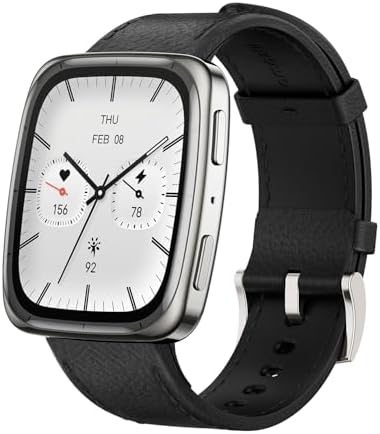
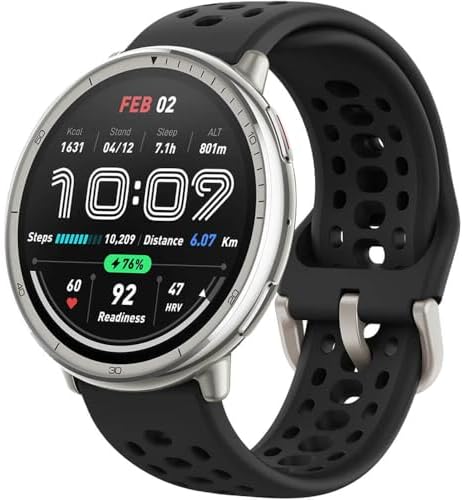
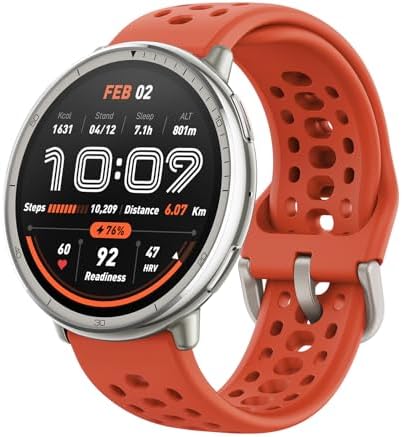
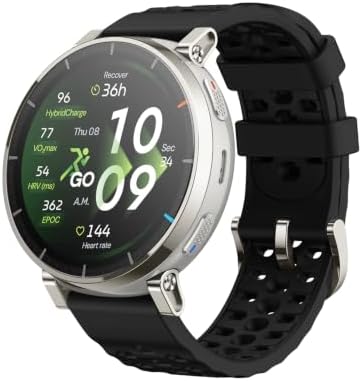
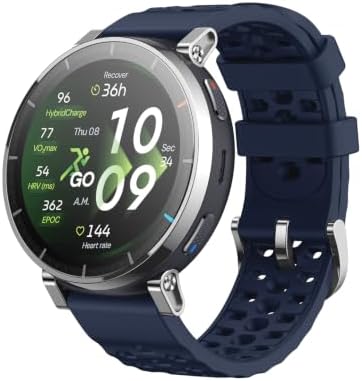
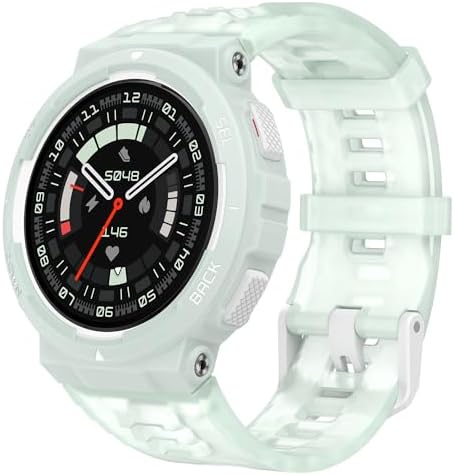
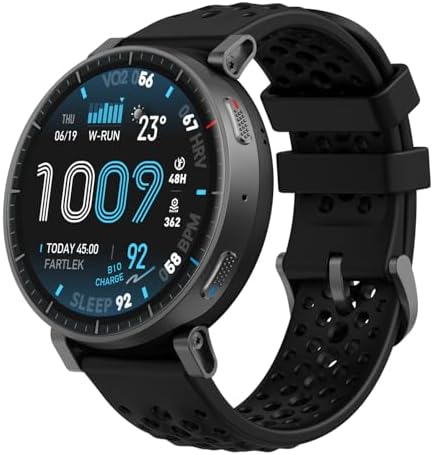
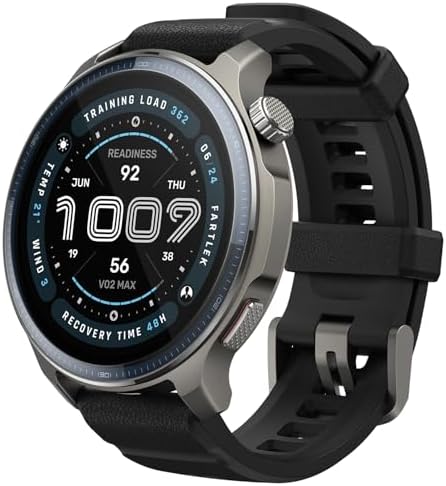
The Amazfit T-Rex 3 series and the Amazfit Balance 2 series sit at opposite ends of the brand’s smartwatch philosophy, and the decision between them hinges on where your training actually happens. One is engineered to absorb rock strikes, cold snaps, and multi-day exposure; the other is shaped to move from a gym floor to a meeting room without drawing attention. This comparison works as a buying guide worth saving, mapping the real trade-offs across battery allocation, case architecture, navigation, and training modes so the right watch lands on the right wrist.
| Feature & Decision Point | Amazfit T-Rex 3 | Amazfit Balance 2 |
|---|---|---|
| Case Material & Build | Reinforced polymer, 48mm rugged chassis | Polished, scratch-resistant case for daily wear |
| Display Panel | 1.5-inch AMOLED, 2000 nits | 1.5-inch AMOLED with sapphire glass |
| Typical Battery Life | Up to 27 days | Up to 21 days |
| GPS Hardware | Dual-band GPS with detailed offline maps | Multi-system GPS for training routes |
| Positioning Focus | Marketed as a military-grade, heavy-duty sports watch | Aimed at polished daily wear and standard training |
| Sport Mode Architecture | 170 fitness and sports modes, with AI voice control | 180+ sports modes, including smart strength training |
| Official HYROX Support | Not specified in the manufacturer’s outline | Official HYROX modes |
| Crystal Type | Toughened display module | Scratch-resistant sapphire glass |
| Operational Scope | Wilderness and extreme environment tracking | Urban fitness, studio training, casual wear |
| Mapping Inclusion | Built-in detailed maps | Standard route mapping |
| App Ecosystem Focus | Enriched for outdoor navigation logs | Enriched for physiological metrics and readiness |
| Case Profile | 48mm single profile for the T-Rex 3 | Lower-profile case for an everyday fit |
| Intended Demographic | Outdoor survivalists, trail athletes, hikers | Gym-goers, runners, working professionals |
| Interface Emphasis | High-contrast clarity for outdoor light conditions | Refined interface for notifications and data sweeps |
| Strap Integration | 22mm ruggedized loops and adventure bands | 22mm mounts, adaptable with hybrid fitness bands |
| Best Suited Scenario | Multi-day wilderness expeditions | Cohorts blending running, lifting, and desk work |
The table’s most telling gap is not a specification at all but the tuning of each device’s purpose: the T-Rex 3’s dual-band GPS and offline map library push it toward remote terrain, while the Balance 2’s sapphire crystal and HYROX certification signal a watch built for mixed training under gym lights. Both share a 1.5-inch AMOLED foundation, so the real decision rests on case architecture, battery target, and the vocabulary of sports modes you actually use. The two flagships from the Amazfit brand’s lineup are tuned to distinct buyer profiles rather than competing for the same wrist.
Why the T-Rex 3 and Balance 2 Feel Like Different Species
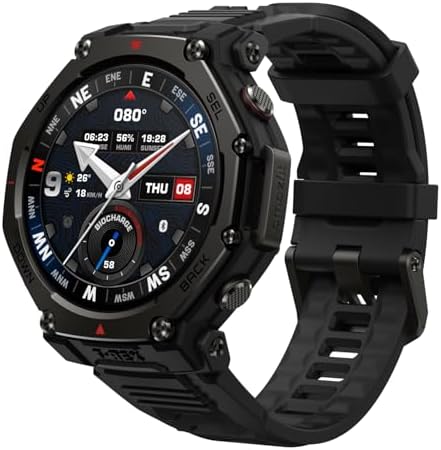
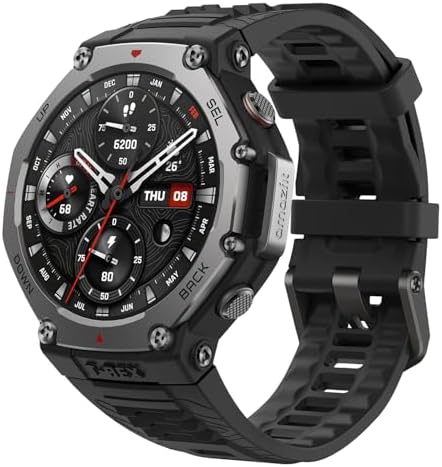
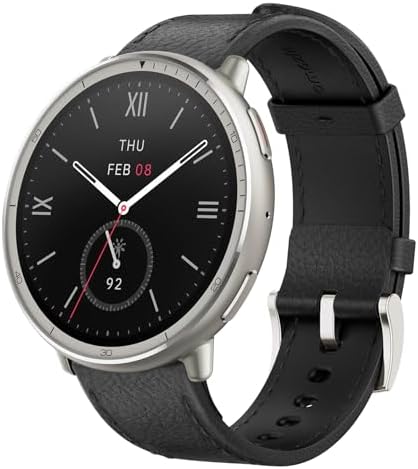
Sharing a display size does not make two watches siblings. The T-Rex 3 is engineered around surviving impacts, cold, and dust; its chassis is wider, its bezel more pronounced, and its overall mass signals hardware meant to be knocked around. The Balance 2 is designed to slip under a shirt cuff without looking out of place in a meeting, because its target user might track a half-marathon at dawn and then handle presentations by midday. This deliberate shaping means buyers should approach the decision not as a spec-sheet duel but as one question: does most of your training happen away from pavement or on it? The watch you pick should disappear on your wrist during the activity you repeat most often.
Material choices reveal the same split. The Balance 2 uses scratch-resistant sapphire glass, a feature that protects a display during the odd brush with a barbell or a door frame. The T-Rex 3 counters with a reinforced hull and a 2000-nit panel so that midday sunlight on an exposed ridge does not wash out a navigation prompt. Each decision is rational for the audience it serves, which makes this comparison less a contest and more a fork in the road. A ruggedized chassis would add unwelcome bulk to a desk-bound worker’s wrist, while sapphire alone cannot fix the absence of detailed offline maps on a trail without a signal.
Battery Life and GPS Accuracy Over the Long Haul
Battery figures rarely translate directly between categories. The T-Rex 3 is listed with up to 27 days of typical use, while the Balance 2 rounds out at 21 days. Both numbers are long enough to remove range anxiety from the average week, but the T-Rex 3’s extra endurance matters most in an expedition scenario where charging becomes an afterthought. That margin is paired with dual-band GPS on the T-Rex 3, which improves position fixes in challenging terrain where signals reflect off cliffs or dense tree cover. A trail runner checking a route on an unmarked path will notice a smoother trace; a commuter tracking a flat park loop may not.
Mapping capability becomes the decisive factor here. The T-Rex 3 includes detailed maps held on-device, so route planning can happen without a phone, which is precisely the layout the Amazfit T-Rex 3 Smart Watch 1.5″ 48mm GPS is built to exploit. The Balance 2 handles route tracking proficiently for gym floors and suburban loops, but its energy budget is booked for a broader scope of wellness readings and daily activity prompts. Buyers should read those batteries not as better and worse but as differently allocated, one banked toward orientation far from a charger, the other spread across a week of varied sessions.
Training Features That Actually Change a Purchase
Both watches can log multiple workout types, but the modes tell you who the manufacturer had in mind. The T-Rex 3, with its 170 fitness and sport profiles, includes voice control and AI-assisted training tools built to function when fingers are cold or gloved. The Balance 2 steps ahead in raw breadth with 180+ modes and adds smart strength training, a useful asset for anyone rotating between cardio machines and free weights. Neither spec is universally better; the value depends on whether your calendar is dominated by outdoor movement or by structured exercises you intend to log in sequence.
The Balance 2’s official HYROX modes are worth pausing on, since they reflect a real, verifiable race format rather than generic marketing language. HYROX combines running with functional stations, and having a dedicated mode streamlines splits and transitions for that specific competition. By contrast, the T-Rex 3 looks designed to survive anything the weather throws at you. For a cyclist, climber, or through-hiker, that rugged orientation is the more meaningful capability; for a HYROX competitor, the Balance 2’s specialised mode saves manual logging. This is where the correct choice narrows quickly. If you can name a HYROX event on your calendar, the Balance 2 answers that need directly. If you cannot, the T-Rex 3’s wider survival envelope becomes the more valuable long-term purchase.
Wrist Presence and the Materials You Touch Daily
Thoughtful watch design is as much about what you don’t touch as what you do. Sapphire glass on the Balance 2 keeps the face readable for years without plastic film or display cleaners, an underrated reason to lean toward the model for anyone who dislikes maintenance. The T-Rex 3’s polymer platform and raised bezel gather less visual scuffing on chips and boulders, and its 48mm footprint is clearly sized for a substantial wrist. Trying a watch in the metal, not just on a web page, settles the question of whether a wide case rolls against your wrist bone mid-run, something no pixel comparison will answer.
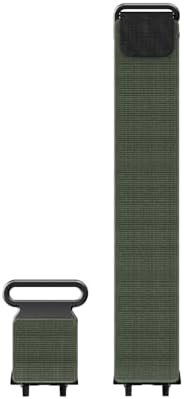
Strap compatibility is the quiet constant across both models. Both use 22mm mounts, so owners are not locked into a single look. A fitness-first buyer who needs a replacement band after a season of heavy sweat can consider the Amazfit Hyrox 22mm Silicone Replacement Strap, which is listed as compatible with the Balance 2, the T-Rex 3, and the broader Bip and GTR ranges. That shared mount makes both watches valuable long-term because a second band is an inexpensive way to shift a rugged tracker closer to a clean-looking daily watch or to refresh grip after the first one wears smooth.
Who Should Buy the T-Rex 3 and Who Should Buy the Balance 2
The T-Rex 3 is the right pick for backpackers, trail runners, climbers, and military or law-enforcement personnel whose primary requirement is durability wrapped around days of usable battery and offline orientation. Its harder edges are not flaws but evidence of where it was supposed to survive. Choose it if losing a route because of a dead battery or a fractured display would break the trip, and if charging once or twice a month sounds acceptable in return for survival-grade construction. The aesthetics serve that purpose too: an owner gets a watch that visually signals its purpose, which is valuable if field work requires clear equipment standards.
The Balance 2 handles the multitasker who needs one wrist device for gym sessions, commutes, and evening plans without looking tactical. It is the stronger choice if you track a mix of running, strength work, and studio classes, or expect to compete in HYROX-style events. Its sapphire display and lower-profile build suit a professional who wants wellness metrics visible but not loud. Neither entry in this pair is the universal answer; each was built around one user and will reward them with capabilities the other owns only on paper. The clearest way to decide is to log the activities you genuinely repeat over a month, check which functions would actually see use, and buy for the days that fill the most space on that list rather than the highlights of a commercial pitch. Sizing and strap feel remain the deciding factors once you have matched the watch to your routine.
Once the training schedule is on paper, the decision usually resolves itself: Balance 2 owners end up with a graceful daily companion, and T-Rex 3 owners are those whose weekends are measured in altitude and distance. The durable appeal of this split line is its simplicity. The brand has committed to serving two different athletes well rather than asking one watch to impersonate both, and the resulting usability serves each without compromise.