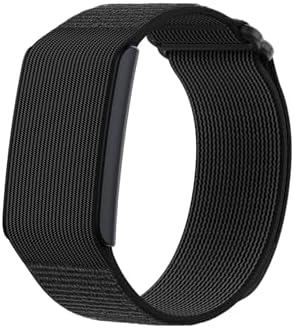
The Amazfit Helio Strap and the Whoop 5.0 occupy a narrow corner of the wearable market: bands that deliberately omit a display and route every readout to a phone. Both are engineered for continuous sensing, and both assume the wearer wants training and recovery data without another glowing screen competing for attention. The Amazfit Helio Strap is rated 5 ATM and positioned for daily wear through sweat, showers, and shallow-water swimming, while the Whoop 5.0 is sold with a twelve-month membership that unlocks its coaching layer. This guide is written for buyers who have already rejected the smartwatch format and now need to choose between two very different business models.
Because the two products diverge on nearly every decision-relevant axis, the table below isolates the specifications that actually change a purchase: what sits on the wrist, what it costs to keep running, how long it lasts between charges, and what kind of feedback each ecosystem returns.
| Feature and Buying Criterion | Amazfit Helio Strap | Whoop 5.0 |
|---|---|---|
| Display | None, screen-free band | None, screen-free band |
| Ownership Model | One-time hardware purchase | Hardware bundled with membership |
| Recurring Cost | No subscription required for core tracking | 12-month membership included, renews thereafter |
| Battery Life Claim | Up to 10 days | 14+ days |
| Water Resistance | 5 ATM, suitable for showering and shallow swimming | Built for continuous 24/7 wear including training |
| Sport Mode Count | 27 modes plus 29 added in the December 2025 update | Activity-agnostic strain and recovery scoring |
| Strength Training Support | Dedicated strength training tracking | Muscular load and strain-based strength logging |
| Recovery Metrics | Recovery tracking built for round-the-clock training | Recovery, strain, and sleep coaching |
| Stress Tracking | Heart rate, energy levels, stress, and sleep | Stress and readiness signals within the coaching app |
| Coaching Depth | App-side summaries without a coaching subscription | Personalized coaching tied to the membership |
| Cycle and Women’s Health | General wellness metrics | Menstrual cycle insights |
| Compatibility | Android and iPhone | Android and iPhone |
| Strap and Finish Options | Light Gray polyamide and alternate band styles | Interchangeable band system |
| Race-Specific Edition | HYROX Edition tuned for functional fitness racing | No equivalent race-edition hardware |
| Best Fit For | Buyers who want to own the hardware outright | Buyers who value guided recovery over device ownership |
| Long-Term Cost Exposure | Fixed at the point of sale | Recurring at each membership renewal |
Two rows in that table decide more purchases than the rest combined. The first is the cost structure: the Amazfit Helio Strap is bought once and keeps working, whereas the Whoop 5.0 is inseparable from its twelve-month membership, which makes the second-year calculation the most important number a buyer will never see written next to the spec sheet. The second is feedback style. Amazfit tracks a broad set of activities and lets the wearer interpret them, while Whoop converts the same raw signals into strain and recovery directives the member is expected to follow.
Two Approaches to Removing the Screen
Removing the display sounds like a single engineering decision, but the two products arrive at it from opposite directions. Amazfit treats the Helio Strap as a conventional fitness tracker with the screen amputated, keeping the full sensor suite and a library of named workouts. Whoop treats hardware as an access key to a service, which is why the wristband is sold alongside a membership rather than as a standalone object. Understanding that split explains almost every other difference in this comparison.
The Amazfit Helio Strap Fitness Tracker Wristband is rated 5 ATM, which the manufacturer states covers everyday wear, sweating, showering, and swimming in shallow water while excluding diving and high-pressure water sports. That rating is a useful marker of intent: this is a band designed to stay on through a normal training week, not a dive instrument. Long sessions or back-to-back training days are the stated target, and the strap is positioned around tracking performance and recovery around the clock rather than around any single discipline.
Sensor Load and What Each Band Actually Measures
Both devices track heart rate, sleep, and stress continuously, which means the raw signal quality story is broadly similar at the level a consumer can verify. The divergence appears in how many distinct activities the system is willing to name. Amazfit ships 27 sports modes on the Helio Strap and, per the official December 2025 software update, added 29 new workout modes along with the ability to build a personalized list of favorite workouts. That is a meaningful expansion for anyone who rotates through lifting, rowing, and intervals within the same week.
- Heart rate: continuous optical monitoring on both devices
- Sleep: nightly staging and duration on both platforms
- Stress: all-day stress signals, surfaced differently in each app
- Energy: Amazfit frames this as an energy-level readout; Whoop frames it as strain against recovery
The interpretation layer is where buyers should be honest about their own habits. The WHOOP 5.0/MG Activity Tracker with 12 Month Membership is built around personalized coaching drawn from that data, and the membership also adds menstrual cycle insights, which remains one of the few genuinely differentiated features in the screen-free category. A user who wants to be told what to do will extract more from the Whoop layer than from a raw activity log.
Functional Fitness and the HYROX Question
Amazfit has done something specific with this platform by releasing a HYROX Edition of the Helio Strap, a version the company describes as built to go further and to track heart rate, energy levels, stress, and sleep even when a smartwatch is off the wrist. HYROX is a hybrid racing format that mixes running with loaded functional stations, and the edition exists because that format stresses exactly the metrics a screen-free band is good at capturing. For anyone training for that kind of event, the fit is unusually direct.
Strength training support is the quieter half of that story. The Helio Strap includes dedicated strength training tracking, and for lifters the practical value of a band without a display is that nothing needs to be tapped between sets. The trade-off is equally clear: without a screen, form guidance, rep counting reliability, and mid-set feedback all depend on the phone app rather than the wrist.
Battery, Charging, and the Cost of Forgetting
The Helio Strap is quoted at up to 10 days of battery life, while the Whoop 5.0 is quoted at 14+ days. In practice the gap matters less than the habits each device encourages. A ten-day cycle means roughly three charges per month; a fourteen-day cycle means about two. Both are far removed from the nightly charging ritual of a smartwatch, and both fall into the category of devices a wearer can genuinely forget about.
The charging hardware itself is worth noting for buyers who own several devices from the same brand. The Amazfit Charging Base for Various Models is listed as compatible with the Helio Strap alongside models such as the Active Max, T-Rex 3 Balance 2, and T-Rex 3 Pro, which reduces cable clutter for anyone already inside that ecosystem. Whoop takes a different route entirely, shipping a dedicated charger tied to its membership service model.
Who Should Buy Which
The decision honestly resolves into a question about how the buyer relates to guidance and to ownership.
Buy the Amazfit Helio Strap if the priority is owning a capable screen-free tracker without an ongoing financial commitment, if a large named library of sports modes matters for a varied training week, if functional fitness racing such as HYROX is on the calendar, or if the 5 ATM rating and light polyamide strap match a preference for wearing the band continuously through showers and pool sessions. The gym-first trainee who lifts three times a week and runs twice will find the strength training tracking and expanding workout list cover the ground well.
Buy the Whoop 5.0 if the value being paid for is interpretation rather than hardware. The twelve-month membership delivers personalized coaching, recovery and strain guidance, and menstrual cycle insights, and the 14+ day battery life supports truly continuous wear. The model suits someone who already understands that a recovery score is only useful when paired with behavioral advice, and who accepts that the membership renews.
What the Spec Sheet Cannot Tell You
Two things fall outside any comparison table. The first is app ergonomics. A screen-free device lives or dies by its phone interface, and the strength of the Amazfit app versus the Whoop membership app will determine daily satisfaction far more than a one-day battery difference. The second is longevity of support. Amazfit has already demonstrated a software update cadence with the December 2025 release, adding 29 workout modes and favorite-workout lists to an existing product. Whoop’s roadmap is rolled into the membership, which means improvements arrive as part of a subscription that continues to be paid for.
Neither approach is inherently superior; they simply suit different relationships between a person and their training data. For a buyer assembling a set of wearables from a single brand, The Amazfit brand’s continuity of charging hardware and app ecosystem across watches and bands is a practical advantage. For the buyer who wants recovery treated as a service rather than a feature, the Whoop brand frames the entire proposition around an ongoing coaching relationship rather than a one-off device.
Viewed over a multi-year horizon, the Amazfit Helio Strap is a fixed-cost instrument that keeps improving through free firmware updates, while the Whoop 5.0 is an ongoing coaching relationship with a band attached. The buyer who knows which of those two sentences sounds more appealing already has the answer, and the specifications above simply confirm it. A practical way to close the decision is to pick the device whose second year of ownership matches the budget and habits a buyer can realistically sustain, because the wristband itself will perform well in either case.