The Google Pixel Watch 4 and the Apple Watch Series 11 represent two mature answers to the same question: what should a wrist-worn computer actually do for its owner. Google’s hardware leans on Fitbit’s biometric heritage and Gemini’s on-device intelligence, while the Apple approach builds outward from a tightly governed sensor stack and a decade of algorithmic refinement. This is a purchasing comparison rather than a spec-sheet recital, and the table below is built to be saved, revisited, and used as the deciding document when the choice finally has to be made.
| Decision Factor | Google Pixel Watch 4 | Apple Watch Series 11 |
|---|---|---|
| Case Sizes Offered | 41mm and 45mm | 42mm and 46mm |
| Display Technology | Actua 360 dome OLED, always-on | LTPO3 wide-angle OLED, always-on |
| Stated Battery Life | Up to 30 hours, 40 with power saver | Up to 24 hours, 38 in low power mode |
| Charging Speed Claim | Roughly 15 minutes to 50 percent | Around 15 minutes to 8 hours of use |
| Water Resistance Rating | 5 ATM, swim-proof | 50 metres, ISO standard rated |
| Repairability Approach | User-replaceable screen and battery | Service-based repair only |
| Health Sensor Suite | Heart rate, SpO2, skin temperature, ECG | Heart rate, ECG, blood oxygen, wrist temperature |
| Sleep Insight Depth | Fitbit sleep stages plus readiness score | Sleep Score plus sleep apnea notifications |
| Built-In Assistant | Gemini, on-device and cloud | Siri with Apple Intelligence features |
| Phone Compatibility | Android only, Wear OS pairing | iPhone only, watchOS pairing |
| Satellite Emergency Feature | Not available | Satellite messages in supported regions |
| Navigation Support | Google Maps with offline caching | Apple Maps with offline routing |
| Best Suited User | Android owners wanting Fitbit depth | iPhone owners wanting the deepest ecosystem |
| Long-Term Cost Angle | Lower servicing friction, parts replaceable | Higher repair dependency on Apple service |
The two columns that should stop a buyer cold are repairability and phone compatibility. The Pixel Watch 4 is engineered around a user-replaceable screen and battery, a structural decision that changes the ownership math over three or four years. The Apple Watch Series 11 offers no such path, and it will only pair with an iPhone. Neither is a fault; both are architectural choices that should map onto the phone already in the buyer’s pocket.
Start with the health layer, because on both devices it is now the reason the watch exists rather than a bullet on a comparison page. Google’s wearable inherits Fitbit’s long-standing separation of sleep stages, readiness scoring, and daytime activity into distinct, readable scores. The sensor suite includes heart rate, blood oxygen, skin temperature, and an ECG function, all routed through Fitbit’s algorithms. The Pixel approach treats biometrics as a lifestyle narrative: sleep debt, recovery trends, and daily readiness are presented as advice rather than raw telemetry.
Apple’s counterpart takes the same physical sensor categories and applies a clinical-philosophy filter. Apple has publicly documented its approach through published accuracy studies, and the company’s own Heart Rate Accuracy Study 2026 states that Apple Watch demonstrated statistically better accuracy across all individual workout activities except cycling against Pixel Watch 4, where the result was described as indeterminate. Buyers who run, row, or lift should read that sentence twice, because it is one of the few verifiable accuracy claims available outside a lab.
The Apple implementation also adds sleep apnea notifications and a Sleep Score system, and it pairs those with an ECG function carried forward from Series 4 and later generations. Neither brand claims diagnostic authority; both position the data as screening support that should prompt a conversation with a clinician rather than replace one. The difference is packaging: Apple frames the data as a health record attached to the wrist, and Google frames it as a coaching system layered on top of the wrist.
The Intelligence Layer: Gemini Against Apple Intelligence
Google has placed Gemini at the centre of the Pixel Watch 4 experience, and that is the single largest philosophical divide between these two products. Gemini on the wrist supports contextual follow-up questions, multimodal input, and cross-app actions that lean on Google’s broader data graph. In practice, this means the watch behaves like a conversational endpoint rather than a notification relay. Asking about a calendar conflict, a route, or a recipe can produce a multi-step answer without picking up the phone.
Apple’s answer is Siri routed through Apple Intelligence, and it is designed to stay closer to on-device processing. That results in fewer expansive conversational responses and more tightly scoped commands, but it also means more predictable privacy behaviour and more reliable execution of simple tasks. Neither implementation is objectively superior; they solve different problems. A buyer who wants a wrist assistant that can improvise should lean Google. A buyer who wants a wrist assistant that stops at the edge of the phone should lean Apple.
Battery, Charging, and the Daily Ritual Problem
Google rates the Pixel Watch 4 at up to 30 hours of use, extending to roughly 40 hours with power-saving mode engaged. Apple rates the Series 11 at up to 24 hours in normal use, extending to around 38 hours in low power mode. The gap is real but narrower than the headline suggests, and both figures collapse under continuous GPS tracking with an always-on display overhead.
What matters more is the charging interruption. Google states that the Pixel Watch 4 can reach roughly 50 percent in about 15 minutes, and Apple makes a comparable fast-charge claim equivalent to several hours of use from a similar window. For shift workers, frequent fliers, and anyone who sleeps with a watch for tracking, the deciding criterion is not total runtime but how quickly a forgotten charge can be reversed. Both devices answer that question acceptably; neither eliminates the routine.
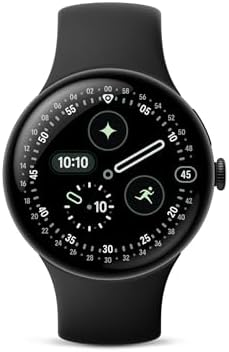
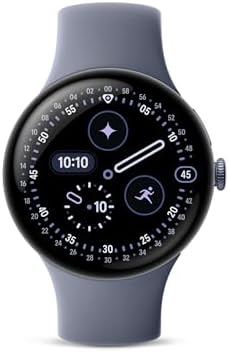
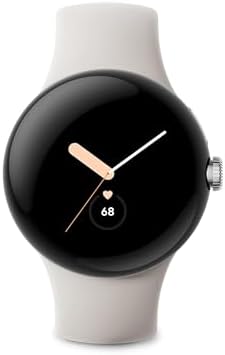
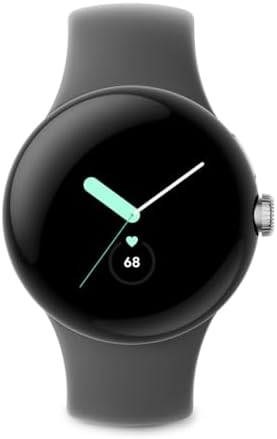
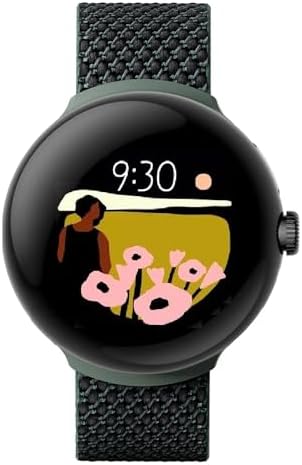
The Google Pixel Watch 4 model sold in the 45mm Moonstone configuration pairs a Wi-Fi connection with the Active Band, and the larger case size should be factored into comfort rather than dismissed as cosmetic. Wrist circumference and shirt cuff clearance remain underrated variables. The Google Pixel Watch 4 (45mm) – 45mm Wi-Fi sits at the larger end of the range, while the 41mm variant serves smaller wrists and buyers who prefer a lighter profile during sleep tracking.
Repairability as a Buying Criterion
Google’s decision to make the screen and battery user-replaceable on the Pixel Watch 4 is the most consequential structural change in this comparison, and it deserves its own heading rather than a footnote. A battery is a consumable component with a predictable degradation curve. On most smartwatches, replacing that component means a service visit, a shipping window, and a bill that can approach a meaningful fraction of the purchase price. Google’s approach shifts that calculation toward a parts purchase and a short repair session.
Part of the Series 11 design philosophy sits in the opposite direction. Apple has built a wearable that is tightly sealed for water resistance, sensor alignment, and structural rigidity, and that sealing directly constrains field serviceability. The trade-off is defensible: the Series 11 carries a 50-metre water resistance rating certified under ISO standard, and that rating is not easy to maintain through a user-serviceable back panel. Buyers weighing five-year ownership costs should understand precisely which compromise they are accepting.
Movement Context and What Each Watch Replaces
Neither device is a mechanical object, yet both compete directly with traditional pieces for wrist time, and their designers clearly studied that market. The domed Actua 360 display on the Pixel Watch 4 echoes the curvature of a sapphire crystal, and Apple’s wide-angle LTPO3 panel on the Series 11 preserves the edge-to-edge face that has become the line’s signature. For buyers already rotating through Apple hardware, the Series 11 is the natural extension of an established daily routine rather than an experiment.
The smartwatch question is therefore not whether it replaces a mechanical watch but when it displaces one. Runners, swimmers, and sleep trackers will reach for the digital watch first. Formal settings, desk work, and long stretches away from a charger still favour a hand-wound or automatic piece. Buyers should count charging occasions per week before committing to either of these models as a daily driver.
Water, Outdoors, and Emergency Preparedness
Both watches are swim-capable. Google rates the Pixel Watch 4 at 5 ATM, which supports pool laps and shower wear but should not be trusted beyond recreational depth. Apple rates the Series 11 at 50 metres and states that the rating is certified under ISO standard, a procedural distinction that carries weight for open-water swimmers and divers who want a verifiable test standard behind the printed number.
Then there is the satellite question. The Series 11 supports satellite messaging in supported regions, which extends the watch’s usefulness into terrain with no cellular coverage. The Pixel Watch 4 does not offer an equivalent capability. For hikers, trail runners, and backcountry skiers, that single difference can override several other advantages combined, and it is one of the few genuine category splits in this comparison rather than a matter of preference.
Which Buyer Should Choose Which Watch
The decision logic is cleaner than the feature lists suggest. Anyone carrying an iPhone should treat the Series 11 as the default and only move away if battery runtime or repair costs become a decisive constraint. The Apple Watch Series 11 [GPS 46mm] Jet Black Aluminum Black 46mm M/L GPS sits at the larger end of the Apple range, and the 46mm aluminium case with a Sport Band covers the majority of buyers without forcing a materials upgrade.
Anyone on Android has a smaller but still real decision. The Pixel Watch 4 offers the deeper Fitbit health framework, a longer stated runtime, a conversational Gemini assistant, and a repairability model that lowers long-term cost. Its limitations, satellite communication and iOS support, are structural rather than fixable through software. Buyers should also consider whether the 41mm or 45mm case suits their wrist before locking a configuration, and the broader Google smartwatch lineup routes Android owners through the same Fitbit integration and the same Gemini assistant.
What separates these two watches in the end is not a sensor count or a screen specification. It is a philosophy about ownership. Google has built a product around the assumption that a watch should be serviced, understood, and kept running. Apple has built a product around the assumption that a watch should disappear into the wrist and be looked after when something fails. Neither assumption is wrong, and both are honest about their costs. The buyer who knows which assumption matches their habits will find the decision has already been made.