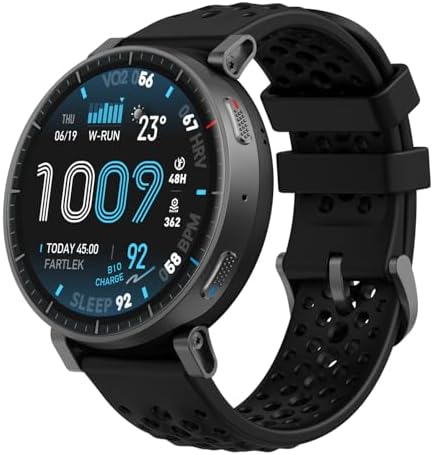
The Amazfit Active Max series and the Garmin Vivoactive 5 collection represent two distinct answers to the same question: how much smartwatch do you actually need? One leans into a large 1.5-inch AMOLED panel and a battery rated in weeks rather than days. The other stays deliberately light and compact, backed by Garmin’s long-established recovery and health science. This guide is built to be kept, a reference point for anyone whose shortlist has narrowed to these two names.
| Feature & Selling Point | Amazfit Active Max | Garmin Vivoactive 5 |
|---|---|---|
| Display Size and Type | 1.5-inch AMOLED | 1.2-inch AMOLED |
| Battery Life (Smartwatch Mode) | Up to 25 days | Up to 11 days |
| GPS Battery Life | Extended multi-day tracking | Up to 19 hours (GPS-only mode) |
| Case Size | 48mm | 42mm |
| Weight | Heavier, full-size build | Lightweight, easy all-day wear |
| Onboard Storage | 4GB | Limited internal storage |
| Offline Maps | Yes | No |
| Sport Modes | 170+ modes | 30+ built-in profiles |
| Water Resistance | Water-resistant, swim-ready | 5 ATM |
| Health Monitoring | Heart rate, sleep, SpO2 | Heart rate, sleep, SpO2, Body Battery, HRV status |
| Recovery and Training Insights | Basic activity and readiness scores | Advanced recovery, stress, and sleep coaching |
| Compatibility | iOS and Android | iOS and Android |
| Best Suited For | Long battery life, large display, offline navigation | Lightweight comfort, recovery science, daily wellness |
| Key Selling Point | 25-day battery and 4GB storage with offline maps | Garmin’s recovery ecosystem in a 42mm case |
The table above highlights the core decision: the Amazfit Active Max wins on raw endurance, storage, and navigation independence, while the Garmin Vivoactive 5 counters with a lighter footprint and a deeper recovery and wellness platform. Neither is a compromise pick, but they reward different priorities.
Display and Build: Size Against Subtlety
The Amazfit Active Max Smart Watch 1.5″ 48mm GPS makes its presence known immediately. A 1.5-inch AMOLED panel fills the 48mm case, giving notifications, maps, and workout data room to breathe. That extra real estate matters during navigation, where a larger canvas reduces the need to squint at a route mid-run. The trade-off is physical: a 48mm case sits prominently on the wrist and adds noticeable weight during sleep tracking.
The Garmin v铆voactive 5 Health and Fitness Ivory GPS takes the opposite approach. Its 1.2-inch AMOLED display is smaller but still bright and legible, and the 42mm case keeps the watch close to the wrist. For anyone who wears a watch around the clock, including overnight, that lower profile is a genuine advantage rather than a minor detail. Garmin’s design language here is understated, which suits both gym sessions and office days without drawing attention.
Battery Life and Charging: Weeks Against Days
Battery endurance is where the Amazfit Active Max separates itself most clearly. A rating of up to 25 days in smartwatch mode means charging becomes a monthly habit rather than a weekly chore. For travellers, shift workers, or anyone who simply forgets to plug in, that margin is liberating. GPS sessions naturally draw more power, but the underlying reserve is large enough that multi-day hikes remain realistic without a charger.
Garmin rates the Vivoactive 5 at up to 11 days in smartwatch mode and up to 19 hours in GPS-only mode. Those figures are strong for a watch with continuous health monitoring and an always-on AMOLED display, but they sit in a different category. The practical consequence is a weekly charging routine. Buyers who prioritise recovery tracking over charging convenience will accept that rhythm; those who want to forget about cables entirely will lean toward the Amazfit.
Health, Recovery, and Training Depth
Garmin’s strength has never been the spec sheet alone; it is the interpretation layer built on top of the sensors. The Vivoactive 5 inherits Body Battery energy monitoring, heart rate variability status, stress tracking, and structured sleep coaching. These tools are designed to answer a specific question: should today be a hard training day or a recovery day? For runners, cyclists, and gym-goers who plan their week around readiness, that guidance is the reason to choose Garmin over a simpler tracker.
The Amazfit Active Max covers the essentials well. Heart rate, sleep staging, blood oxygen, and activity scoring are all present, and 170+ sport modes mean almost any discipline is accounted for out of the box. What it lacks is the same depth of longitudinal recovery analysis. It tells you what happened; Garmin spends more effort telling you what to do about it. Neither approach is wrong, but they suit different types of athlete.
Navigation, Storage, and Everyday Utility
Offline maps and 4GB of onboard storage give the Amazfit Active Max a practical edge for outdoor use. Routes can be loaded and followed without a phone, and music or audio can be stored locally for phone-free sessions. For hikers, trail runners, and commuters who prefer to leave the handset behind, this combination is a meaningful convenience rather than a marketing line.
The Vivoactive 5 focuses its utility elsewhere. It handles notifications, contactless payments, and Garmin’s connected ecosystem cleanly, but it does not offer built-in offline mapping. Its appeal is a frictionless daily companion rather than a standalone navigation device. Buyers who rarely venture beyond mapped city routes will not miss the feature; those who do will notice its absence.
Who Should Buy Which
The decision comes down to two clear buyer profiles. Choose the Amazfit Active Max Smart Watch 1.5″ 48mm GPS if battery life is your primary constraint, if you want a large display for maps and metrics, and if offline navigation or onboard storage matters to your routine. It suits long-distance hikers, frequent travellers, and anyone upgrading from a watch that demanded constant charging.
Choose the Garmin v铆voactive 5 Health and Fitness Ivory GPS if you train with structure, value recovery guidance, and prefer a watch that disappears on the wrist. It rewards users who act on Body Battery and HRV data, and it fits smaller wrists more comfortably. The 5 ATM rating and Garmin’s established health platform make it a dependable everyday companion.
Both watches are capable, well-built, and genuinely useful. The right choice is not about which is better in the abstract, but about which constraint you are unwilling to accept: weekly charging or a larger, heavier case. Answer that question honestly, and the shortlist resolves itself.